 111
111 2
2 3
3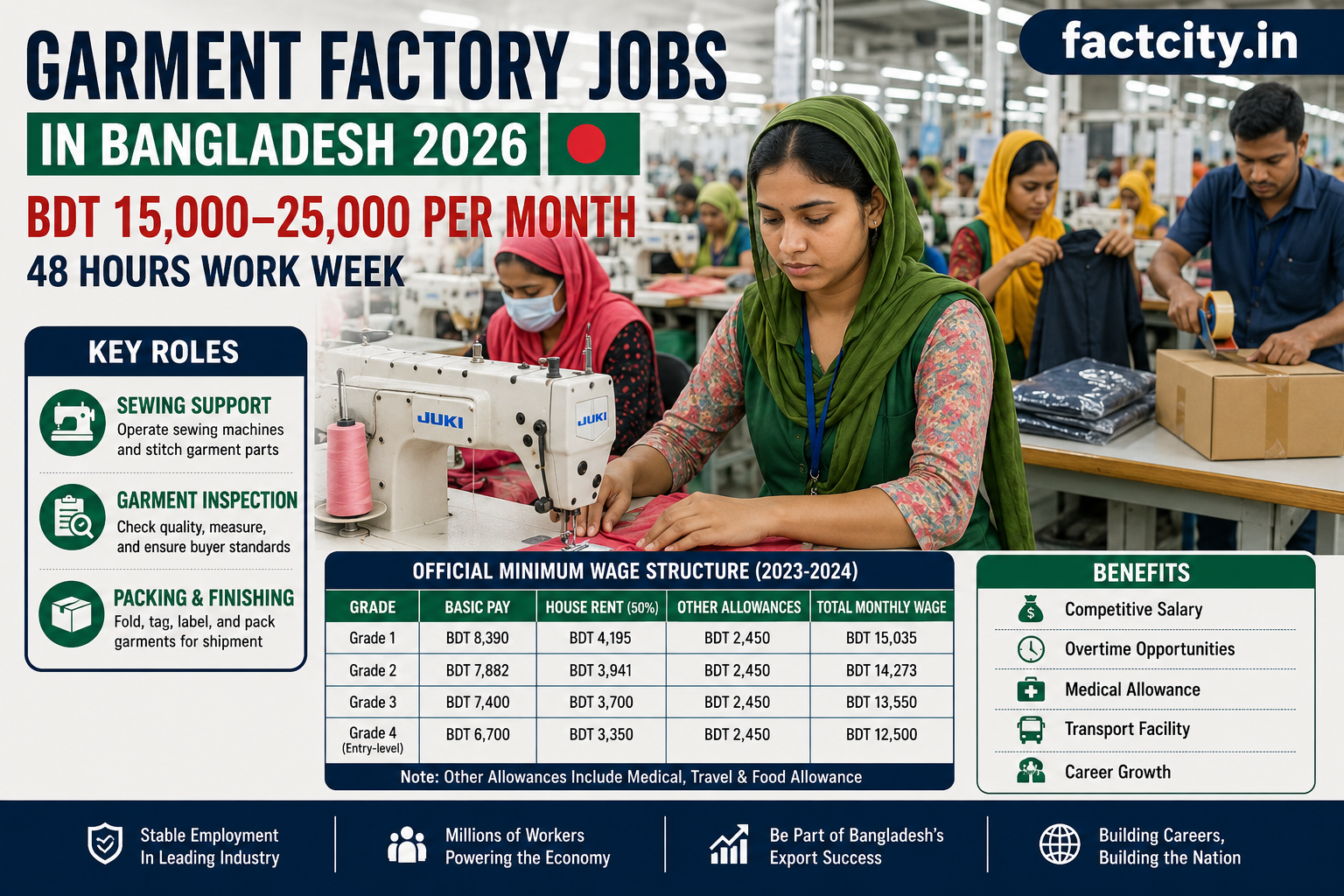
Garment Factory Worker Jobs in Bangladesh, The ready-made garment (RMG) sector is the backbone of Bangladesh’s economy, employing over 4 million workers and serving as the nation’s primary export engine . For millions of Bangladeshis, a position as a garment factory worker represents a critical entry point into formal employment and a pathway to economic stability. This comprehensive guide examines the key roles of sewing support, garment inspection, and packing, while providing a realistic and detailed look at salaries, working hours, working conditions, and the current challenges facing the industry.
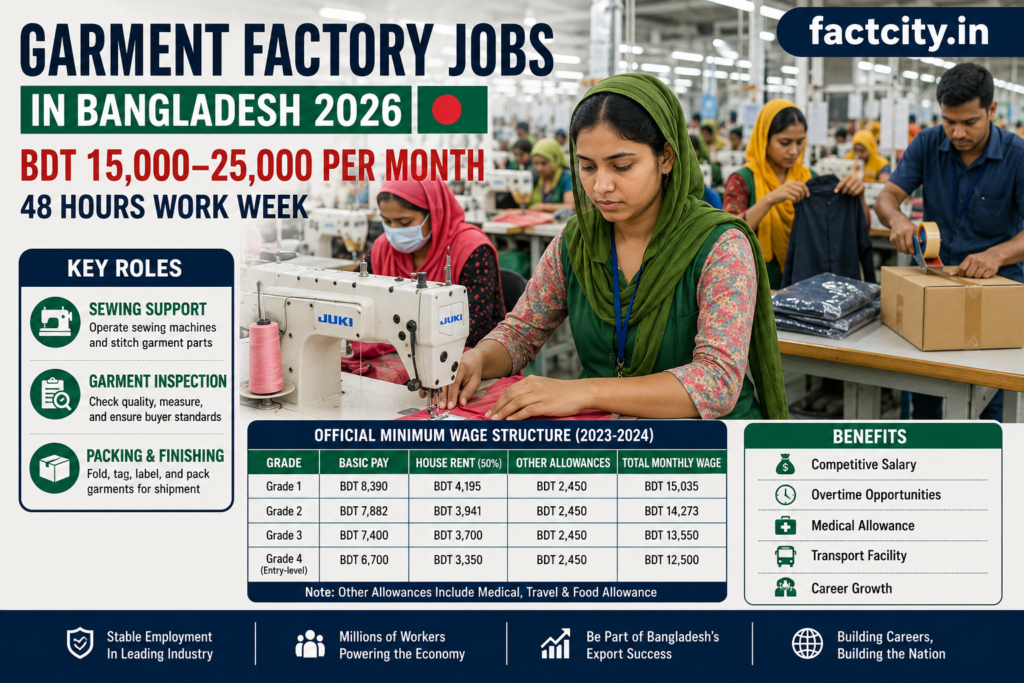
The wage landscape for garment workers in Bangladesh has undergone significant changes, with the government finalizing a new minimum wage structure. The advertised range of BDT 15,000–25,000 per month represents positions above the entry-level minimum, typically requiring some experience or specialized skills. Garment Factory Worker Jobs in Bangladesh
The government-mandated minimum wage for entry-level garment workers was set at BDT 12,500 per month in late 2023, following extensive negotiations and protests . This represented a 56.25% increase from the previous minimum wage of BDT 8,000 . However, trade unions and labor organizations had demanded BDT 23,000–25,000, arguing that the final amount was insufficient given rising inflation and living costs . Garment Factory Worker Jobs in Bangladesh
Below is a detailed breakdown of the official wage structure for different worker grades:
| Worker Grade | Basic Pay | House Rent (50% of Basic) | Medical Allowance | Travel Allowance | Food Allowance | Total Monthly Wage |
|---|---|---|---|---|---|---|
| Grade 1 | BDT 8,390 | BDT 4,195 | BDT 750 | BDT 450 | BDT 1,250 | BDT 15,035 |
| Grade 2 | BDT 7,882 | BDT 3,941 | BDT 750 | BDT 450 | BDT 1,250 | BDT 14,273 |
| Grade 3 | BDT 7,400 | BDT 3,700 | BDT 750 | BDT 450 | BDT 1,250 | BDT 13,550 |
| Grade 4 (Entry-level) | BDT 6,700 | BDT 3,350 | BDT 750 | BDT 450 | BDT 1,250 | BDT 12,500 |
Source: Minimum Wage Board, effective December 2023
The BDT 15,000–25,000 range advertised for these roles typically corresponds to Grade 1 positions or workers with significant experience. For instance, a Quality Controller with a diploma in textiles can earn between BDT 15,000–40,000, while experienced Sewing Machine Operators can earn BDT 15,000–18,000 or more . It’s important to note that these figures are before tax and do not include overtime payments, which form a crucial supplement to workers’ base salaries . Garment Factory Worker Jobs in Bangladesh
Sewing support is the most common and in-demand job in the RMG sector . Workers in this category typically operate industrial sewing machines for specific garment components. Entry-level positions such as Junior Operators are classified under Grade 4 with a base wage of BDT 7,400, while more experienced operators may be classified under higher grades .
The role requires attention to detail, the ability to meet production targets, and proficiency with different types of machines. Training is often provided on the job, though experience is strongly preferred by employers. Workers may specialize in different types of sewing operations, from simple stitching to more complex assembly work .
Quality control is paramount in the RMG sector, as Bangladesh’s garment exports must meet strict international buyer standards. Quality inspectors are responsible for ensuring products meet specifications using quality control systems like the Acceptable Quality Level (AQL) 2.5 standard. Garment Factory Worker Jobs in Bangladesh
Inspectors check for various defects including:
Junior Quality Inspectors are classified under the Grade 3 structure with a minimum wage of BDT 13,550, while more senior QC positions can command significantly higher salaries, particularly with technical qualifications . Garment Factory Worker Jobs in Bangladesh
The packing role represents the final stage before shipment. Workers in this position must ensure correct folding, labeling, tagging, and barcode scanning. Junior Packing men, Folding men, and Poly men are classified under the Grade 4 structure with the entry-level minimum wage of BDT 12,500 . The role requires precision and attention to detail to ensure final products match buyer specifications for packing and assortment. Garment Factory Worker Jobs in Bangladesh
The standard workweek in the Bangladeshi garment industry is 48 hours, typically structured as six 8-hour days. However, the reality of working conditions extends far beyond basic hours.
Garment workers face significant challenges related to workplace conditions. Rising temperatures have created what labor advocates call an invisible “heat tax” —an added cost burden borne by workers trying to cope with extreme heat . According to a 2022 study, temperatures inside Bangladeshi factories regularly exceed 30°C (86°F) during summer months .
Workers like Nasrin Begum, a 32-year-old garment worker in Gazipur, spend over Tk 1,000 per month from their Tk 14,000 salary just on hydration salts, lemons, and cooling drinks to maintain their health during shifts . Another worker, Md. Safiqul Islam, spends approximately Tk 2,500 monthly on cooling measures . Garment Factory Worker Jobs in Bangladesh
Peak summer temperatures in Bangladesh have increased by 1.1°C since 1980, slightly faster than the global average, with humidity pushing “feels-like” temperatures up by 4.5°C . While factory owners have implemented measures like improved ventilation, fans, and hydration breaks, these have increased operating costs by 2-5%, and much of the burden remains on workers themselves .
A recent report by Justice Makers Bangladesh in France (JMBF) documented serious concerns regarding working conditions, including:
These conditions disproportionately affect women, who represent the majority of Bangladesh’s garment workforce . Garment Factory Worker Jobs in Bangladesh
The garment sector faces significant headwinds that directly impact workers. Between January and June 2026, approximately 20,783 workers from 80 garment factories lost their jobs across Bangladesh . Furthermore, 457 garment and textile factories reportedly ceased operations between August 2024 and June 2026, leaving over 240,000 workers unemployed .
The reasons for factory closures include:
The report also highlighted widespread delays in wage payments, unpaid overtime, unpaid festival bonuses, and arbitrary dismissals, leaving thousands of workers and their families facing severe financial hardship . Peaceful protests over unpaid wages have reportedly been met with intimidation and excessive use of force by law enforcement . Garment Factory Worker Jobs in Bangladesh
For workers seeking these roles, specific qualifications are typically required:
Educational Requirements: SSC or HSC pass is often preferred, though not always mandatory for entry-level positions .
Experience Requirements: Many roles, particularly in sewing support, require minimum 6 months to 3 years of experience in similar positions . Garment Factory Worker Jobs in Bangladesh
Technical Skills: For inspectors, knowledge of AQL standards, garment production processes, and quality management principles is essential. Physical fitness is also required for factory work .
Specialized Training: Some positions may require specific technical training. Junior Operators, Junior Quality Inspectors, and Junior Packing men are all classified under specific grades with corresponding pay scales . Garment Factory Worker Jobs in Bangladesh
Garment factory worker jobs in Bangladesh offer employment with salaries ranging from BDT 15,000 to 25,000 per month for more experienced or skilled workers, with a standard 48-hour workweek. The recent wage adjustments have provided some relief, raising entry-level pay to BDT 12,500, though labor organizations continue to push for higher wages. Garment Factory Worker Jobs in Bangladesh
The roles of sewing support, garment inspection, and packing are fundamental to Bangladesh’s export economy. However, prospective workers must be aware of the challenging landscape—including rising workplace temperatures, occupational health concerns, job security issues, and ongoing disputes over wages and working conditions. Garment Factory Worker Jobs in Bangladesh