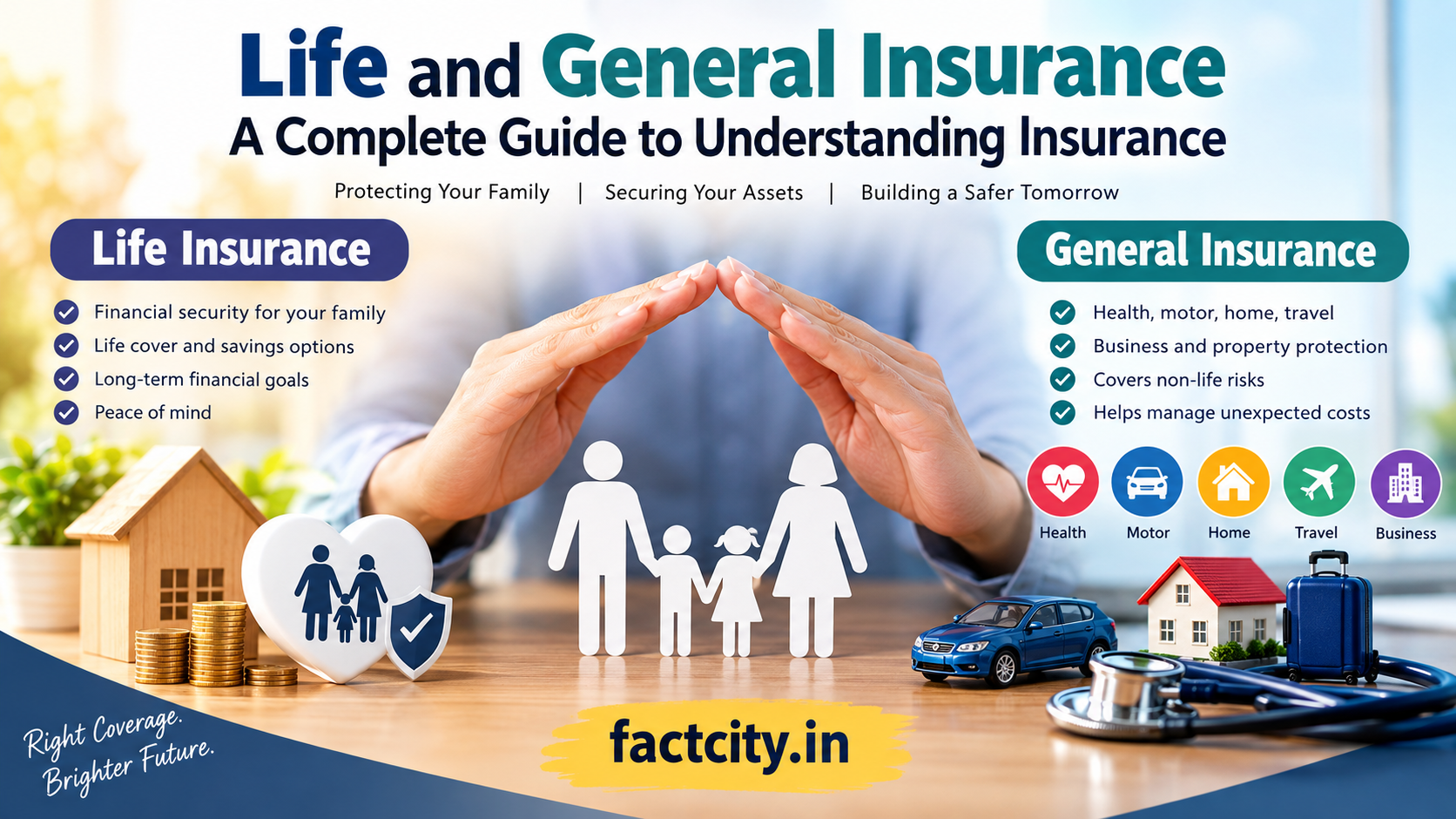
Life And General Insurance, Insurance is an important part of financial planning as unforeseen events can be expensive. Insurance can give you financial backup when covered events happen. Whether you’re thinking of protecting your family, health, car, home, business or other valuable assets.
Life insurance and general insurance are commonly used terms in the insurance industry. While both are intended to provide financial protection, they are designed for different purposes and protect against different kinds of risks.
In this comprehensive guide, we will discuss life and general insurance, differences between them, major types, benefits, how policies work, and important things to consider before buying an insurance policy.
What do you mean by life and general insurance?
Insurance products can be broadly divided into two categories- Life and General.
The primary concern of life insurance is the protection of the individual and the family from the financial loss caused by death. Depending on the policy, it may also provide benefits for savings, investments, retirement or other particular life events.
General insurance is an insurance other than life insurance. It covers the risks other than the risks from life insurance. This can include health, auto, home, travel, property, business and other types of coverage.
Both types are important in financial planning, but the coverage, how long the policy lasts, the premiums and the benefits you get when you make a claim can be very different.
What Is Life Insurance?
A life insurance policy is a contract between the policy holder and an insurance company. Generally the policyholder pays premiums as specified in the policy. In return, the insurer will provide a specific financial benefit if a covered event occurs.
The significant advantage of many life insurance policies is paid to the nominee or beneficiaries of the policy holder on death of the insured person subject to the terms and exclusions of the policy. “Life And General Insurance“
Depending on the product structure, some life insurance policies also offer benefits while the policyholder is still alive.
Why You Need Life Insurance?
Life insurance can be especially important for those who have financial responsibilities such as:
- Supporting spouse or children
- Paying your home loan or other payments.
- Funding for children’s education
- Handling of household expenses
- Safeguarding a Family Business
- Long-term financial goal planning
When the breadwinner in the family suddenly dies, the family suffers a sudden loss of income. A life insurance policy appropriately taken out may provide a financial benefit to the beneficiaries to cover eligible financial liabilities and future expenses.
Major Types of Life Insurance
There are various types of life insurance products. Features vary by insurer and policy.
1. Term Life Insurance
Term insurance is a life cover for a fixed tenure. If the insured dies during the term of the policy and the claim satisfies the requirements of the policy, the death benefit, if applicable, may be paid to the beneficiaries.
Term insurance is usually protection-oriented rather than savings-oriented.
2. Whole Life Insurance
Whole life insurance is designed to cover a much longer period of time, possibly the life of the insured person, depending on the policy.
However, such policies may have complex terms that are not as simple as a term insurance policy and may have different premium structures and benefits.
3. Endowment Plan
Endowment policies typically combine an insurance protection component and a savings component. Depending on the terms of the policy, the policyholder may receive a maturity benefit if the policy matures on its specified maturity date.
4. Money Back Policies
Money Back Insurance policies are designed to provide certain benefits at certain intervals during the policy term subject to the conditions of the policy.
5. Unit Linked Insurance Plans
Unit-linked insurance products are a combination of life insurance and investment-linked products. Investment value may fluctuate based on the underlying investment choices and market performance.
Investments in these products carry a risk of loss and charges. Customers should read the policy documents carefully before buying. “Life And General Insurance“
What is General Insurance?
General insurance covers all other forms of insurance other than life insurance.
Take, for example, the experience of a vehicle being damaged in an insured accident, where motor insurance can help cover the cost of eligible repairs. Certain risks to a property or its contents can also be covered by home insurance.
General insurance policies are typically issued for a specific policy period and are usually renewed as per the terms of the insurer.
General Insurance Types
General insurance covers a wide range of categories.
1. Medical Insurance
Health Insurance is meant to cover the eligible medical expenses as per the terms and conditions of the policy.
Coverage may cover hospitalisation, specific medical procedures, costs before and after hospitalisation, or other designated health care costs, depending on the policy.
Before you buy health insurance you should check:
- Limits to coverage
- Timeframes to wait
- Exclusions:
- Write-offs
- Hospitals in Network
- Procedures of claim
- If applicable, room-rent conditions
- 2. Motor Insurance
Motor insurance covers vehicles against certain risks as defined in the chosen policy.
Motor insurance may cover:
- Damage by accident
- Burglary – Theft
- Third Party Liability
- Nature phenomena
- Staged Events
- Some vehicle related losses
Coverage varies by policy type and terms.
3. Property Insurance
Home insurance can cover a house, flat or contents against certain risks.
Depending on the policy, coverage may include:
- Fire Theft |
- Some natural disasters
- Damage to property
- Contents of the house
Homeowners and tenants require different types of insurance, therefore the policy should be chosen according to the property and the needs of the individual.
4. Insurance for Travel
Travel insurance is designed to protect you financially from certain unexpected things that can happen when you travel.
Depending on the plan it might include scenarios like:
- Cancellation of trip
- Lost luggage
- Delays in travel
- Emergency medical care
- Lost Passport
- Some travel emergencies
Coverage differs widely between policies so travellers should read the conditions before buying.
5. Commercial Insurance
Businesses face a variety of risks including property damage, liability claims, loss of equipment and interruptions.
Commercial insurance products can be tailored to reflect specific business risks. The right policy will depend on the type, size, location and activities of the business.
Life Insurance vs General Insurance
Both types of insurance are meant to provide financial protection, but they are different in some important ways.
- Life Insurance FeatureGeneral Insurance
- Primary objective Protect life and financesCover for a variety of non-life risks
- Common examples Term, whole life, endowment Motor, health, travel, home
- Duration of policy Generally long termOften once a year depending on the product
- Key insured riskLife related riskProperty, health, vehicle, travel and other risk.
- Beneficiary benefit Usually paid to nominated beneficiariesTypically pays for covered losses or eligible expenses
- Renewal is dependent on policyOften needed at periodic intervals
- Policy structure May include protection, savings or investment componentsTargeted on particular risks and losses
The particular features will differ from individual insurance product to product and customers should not assume that all policies in a category operate in exactly the same way.
Benefits of General and Life Insurance
There are several financial planning benefits to having the right insurance.
Financial independence
Insurance can help mitigate the financial impacts of the unexpected. The policy may offer you financial help under its terms rather than having to pay the full amount of a covered loss out of your own pocket.
Security for the family
Life insurance may help families cover financial responsibilities after an insured person dies.
Protection of Valuable Goods
General insurance offers protection for assets such as vehicles, homes, equipment and business property against specific risks.
Emergency Assistance
Medical emergencies, accidents, property damage, travel disruptions can lead to unexpected costs. Appropriate insurance can help with eligible costs.
Better Money Management
Insurance is just one component of a comprehensive financial plan. It can help a person get ready for risks and keep emergency savings for other needs.
What Does an Insurance Policy Do?
It’s fairly simple.
The customer first chooses a policy according to his needs. The insurer evaluates the application and determines the applicable premium based on policy-relevant factors.
The customer then pays the premium as per the payment schedule selected.
If a covered event happens during the policy period, the policyholder or beneficiary may make a claim. The insurance company will review the claim and documentation provided.
If the claim satisfies the terms of the policy, the insurer will pay the applicable benefit or compensation under the contract.
Things That Can Affect Insurance Premiums
Insurance premiums vary from person to person. A few things can affect the cost.
Factors that may apply to life insurance may include:
- Old?
- Insurance cover
- Policy period
- Occupation –
- Life style information
- Past medical history
- Policy type
For general insurance, the factors may involve:
- Asset type
- Coverage limit Location
- Earlier reports had
- Franchise
- Policy characteristics
- Risk classification
The actual premium is determined by the insurer’s underwriting rules.
Choosing the Correct Insurance Policy
Insurance buying should start with an understanding of your actual financial risks.
Identify Your Needs
First, identify what you want to protect. Family income, health costs, a car, a house, business property or travel could be your priorities.
Compare Plans
Don’t just look at price when you’re comparing policies. Check what is included and what is not.
Read Exclusions Carefully
All policies contain exclusions. These are conditions, situations or losses that may not be covered.
Before buying a policy, you should understand what exclusions are in place, otherwise you may have unpleasant surprises when you make a claim.
Check Policy Limits
A policy may have maximum coverage amounts or sub limits. Make sure you understand these limits before buying.
Understand Your Deductibles:
A deductible is the amount that the policyholder might have to pay before the insurer pays toward an eligible claim.
Claims Procedure Review
Having a policy with clear claim procedures can make for a more seamless claims experience. Find out which documents you need and how to make a claim.
Typical Mistakes to Avoid
People sometimes just look for the cheapest insurance policy without reading the details.
Mistakes that are often made:
- Choosing poor coverage
- Exclusions ignored
- Not reading the policy conditions
- Providing false information
- Forget about renewal dates
- Not updating nominee or beneficiary details.
- Buying unnecessary insurance
- Not comparing different features of policy
Accurate information is especially important since inaccurate or incomplete information can influence policy terms or claims, depending on the circumstances and applicable law.
Life and General Insurance in Various Life Stages
Insurance needs can change over time.
A young person with little financial obligation may have different needs than someone who is supporting a family.
Your life insurance needs may increase after marriage due to shared financial commitments.
Parents may consider the need to protect the household income and the long term family responsibilities.
General insurance becomes more relevant when people buy homes, vehicles or start businesses.
Regularly reviewing insurance coverage can help ensure it remains aligned with changing financial circumstances.
Conclusion on Insurance (General and Life)
Life and general insurance are two important spheres of financial protection. Life insurance is for risks connected to a person’s life, and it can give financial support to beneficiaries in certain situations. General insurance covers many other risks such as health, vehicles, homes, travel and businesses.
The right insurance policy depends on the individual, their financial responsibilities, their exposure to risk, and the specific terms offered by an insurer.
Read the coverage, exclusions, premium, deductibles, limits, renewal requirements and claim process carefully before purchasing any policy. Don’t shop for insurance just on price. A policy is a financial contract and the benefits are governed by the conditions laid down in the policy documents.