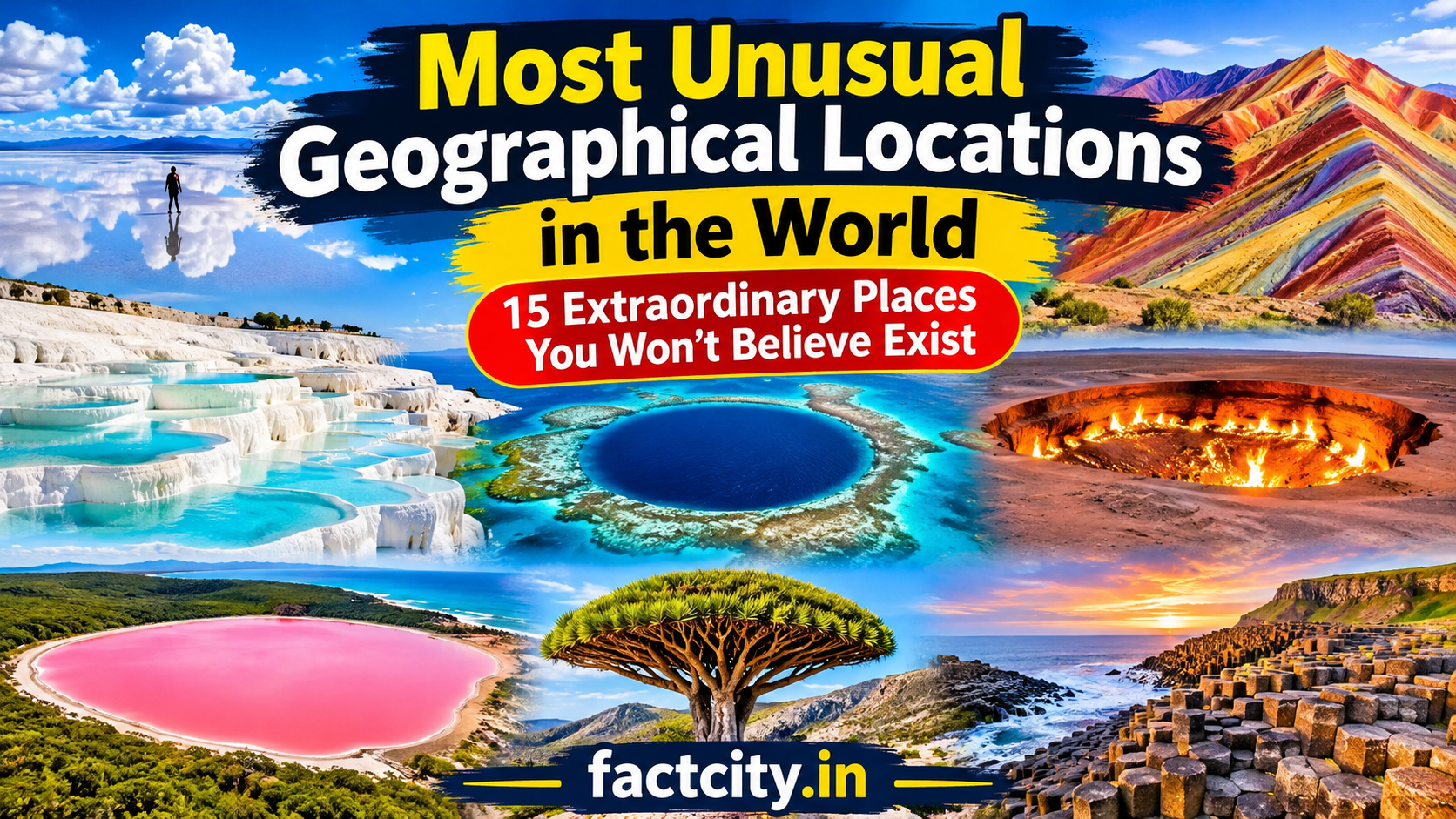
Most Unusual Geographical Locations in the World: The world is filled with extraordinary geographical locations that look so unusual they seem to belong to another planet. From colorful mountains and mysterious deserts to naturally formed underwater holes and landscapes covered with strange rock formations, our planet has countless places that surprise even the most experienced travelers. These unusual geographical locations are not created by human hands but are the result of millions of years of geological activity, erosion, volcanic movements, climate changes, and other natural processes. Some places are famous for their incredible colors, while others attract attention because of their unusual shapes, extreme temperatures, or unique environmental conditions. Exploring these remarkable destinations helps us understand how powerful and creative nature can be. In this article, we will discover some of the most unusual geographical locations in the world and learn what makes each of them special.
1. Salar de Uyuni, Bolivia – The World’s Largest Natural Mirror
Salar de Uyuni, located in southwestern Bolivia, is one of the most unusual geographical locations in the world and the largest salt flat on Earth, covering approximately 10,582 square kilometers. This enormous white landscape was formed when ancient lakes gradually dried up, leaving behind thick layers of salt and minerals across the region. During the dry season, the salt flat appears like an endless white desert, with beautiful geometric patterns stretching toward the horizon. However, during the rainy season, a thin layer of water covers the surface and creates a stunning natural mirror that reflects the sky, clouds, and surrounding mountains. The reflection becomes so perfect that visitors often find it difficult to distinguish the ground from the sky. Apart from its breathtaking appearance, Salar de Uyuni is also an important source of lithium, a mineral used in batteries and modern technology.
2. Zhangye Danxia, China – The Rainbow-Colored Mountains
Zhangye Danxia National Geological Park in China’s Gansu Province is famous for its spectacular mountains displaying shades of red, orange, yellow, green, and purple. These colorful formations look like giant paintings spread across the landscape and are among the most visually unusual geographical locations on Earth. The mountains developed over millions of years as layers of sandstone and other minerals accumulated, became compressed, and were later lifted by tectonic movements. Wind, rain, and erosion gradually shaped the rocks into the ridges and valleys visible today. The colors become especially vibrant when sunlight falls across the mountain slopes, creating dramatic patterns that change throughout the day. Zhangye Danxia is an extraordinary example of how geological processes can create natural landscapes that appear almost unreal.
3. Pamukkale, Turkey – The Natural Cotton Castle
Pamukkale, located in southwestern Turkey, is known for its bright white terraces that resemble frozen waterfalls or snow-covered hills. The name Pamukkale means “cotton castle,” and the landscape truly looks like a natural castle made from soft white material. These terraces formed when mineral-rich hot spring water flowed down the hillside and deposited calcium carbonate as it cooled. Over thousands of years, the mineral deposits created shallow pools, smooth steps, and beautiful white formations. The contrast between the white terraces and the blue water makes Pamukkale one of the most unusual geographical locations in the world. The nearby ancient city of Hierapolis adds historical importance to the area, which is recognized as a UNESCO World Heritage Site.
4. Socotra Island, Yemen – A Landscape from Another Planet
Socotra Island, situated in the Arabian Sea near the Horn of Africa, is one of the most unusual natural environments on the planet because of its isolated location and remarkable biodiversity. The island is famous for its dragon’s blood trees, which have thick trunks and unusual umbrella-shaped crowns that make them look like trees from a science-fiction movie. These trees produce a dark red resin that has been used for traditional purposes for centuries. Socotra also contains limestone plateaus, deep caves, rugged mountains, and beautiful beaches, creating a variety of landscapes within a relatively small area. Many of its plant species are found nowhere else on Earth, making the island scientifically important as well as visually extraordinary.
5. The Door to Hell, Turkmenistan – A Burning Desert Crater
The Darvaza Gas Crater in Turkmenistan is commonly known as the Door to Hell because of the flames that have been burning inside it for decades. Located in the middle of the Karakum Desert, this large crater creates a dramatic scene, especially at night when its glowing fire can be seen against the dark desert surroundings. The crater reportedly formed in 1971 after the ground collapsed during a drilling operation, exposing an underground natural gas cavern. The escaping gas was ignited in an attempt to prevent it from spreading, but the fire continued much longer than expected. This unusual geographical location demonstrates the powerful influence of underground geological resources and has become one of the most remarkable sights in Central Asia.
6. The Great Blue Hole, Belize – A Giant Underwater Sinkhole
The Great Blue Hole is a massive circular marine sinkhole located near Lighthouse Reef in Belize. Measuring approximately 300 meters across and around 124 meters deep, it stands out as one of the most unusual underwater geographical formations in the world. From above, the deep blue water creates a striking contrast with the shallow turquoise sea surrounding it. The formation originally developed as a limestone cave system during periods when sea levels were much lower. As sea levels rose, the caves became flooded, and parts of the structure collapsed, creating the deep circular hole visible today. Divers visit the Great Blue Hole to explore its underwater limestone walls and ancient formations, making it an important destination for marine exploration.
7. Antelope Canyon, United States – The Wave-Shaped Canyon
Antelope Canyon, located in Arizona near the town of Page, is famous for its narrow passageways and smooth sandstone walls that appear to flow like waves. This unusual geographical location was shaped by flash floods and erosion over thousands of years, gradually carving the sandstone into beautiful curves and narrow corridors. The canyon’s walls display shades of orange, red, pink, and gold, while sunlight entering from above creates dramatic lighting effects. During certain times of the day, beams of sunlight illuminate the canyon floor and highlight the natural patterns in the rock. Antelope Canyon is a remarkable example of how water and wind can transform solid rock into a landscape that resembles a natural sculpture.
8. Lake Hillier, Australia – The Naturally Pink Lake
Lake Hillier is located on Middle Island off the coast of Western Australia and is famous for its unusual bright pink water. The lake creates a stunning contrast with the surrounding green vegetation and the deep blue ocean, making it one of Australia’s most distinctive geographical features. Its pink color is associated with salt-loving microorganisms, including certain algae and bacteria that produce colorful pigments. The intensity of the color may vary depending on environmental conditions, but the lake has maintained its remarkable appearance for long periods. Lake Hillier is also relatively remote, which adds to its mysterious attraction. Its unusual color demonstrates how microorganisms and environmental conditions can influence the appearance of natural water bodies.
9. The Dead Sea, Jordan and Israel – The Lowest Land Elevation on Earth
The Dead Sea is one of the most unusual geographical locations in the world because of its extreme elevation and exceptionally high salt concentration. Located between Jordan and Israel, its shores lie more than 430 meters below sea level, making them the lowest exposed land elevation on Earth. The lake receives water mainly from the Jordan River, but much of its water disappears through evaporation, leaving behind large amounts of dissolved minerals and salt. Because of its high salinity, most aquatic organisms cannot survive in the lake, which explains its name. The dense water also allows people to float more easily than in ordinary freshwater lakes. The surrounding desert mountains, mineral-rich shores, and unusual water conditions make the Dead Sea a fascinating natural destination.
10. The Chocolate Hills, Philippines – Thousands of Unusual Natural Hills
The Chocolate Hills are located on the island of Bohol in the Philippines and consist of more than a thousand rounded hills spread across a wide landscape. These hills are unusual because many of them have similar shapes and heights, creating a distinctive pattern that looks almost artificial. During the rainy season, the hills are covered in green grass, but during the dry season, the vegetation turns brown and gives them their chocolate-like appearance. Scientists believe the formations developed through the weathering and erosion of limestone over a long period. The Chocolate Hills are one of the most recognizable geographical landmarks in Southeast Asia and demonstrate how erosion can create remarkable natural patterns.
11. Wadi Rum, Jordan – The Valley of the Moon
Wadi Rum is a spectacular desert region in southern Jordan that features enormous sandstone mountains, red sand dunes, natural arches, and narrow valleys. Its landscape looks so unusual that it has often been used as a filming location for movies set on other planets. The region was shaped by millions of years of wind and water erosion, which gradually created its dramatic cliffs and unusual rock formations. The red and orange colors become especially beautiful during sunrise and sunset, when sunlight spreads across the desert. Despite its harsh conditions, Wadi Rum has supported human communities for thousands of years and contains important archaeological evidence of ancient civilizations.
12. Mount Roraima, South America – The Giant Tabletop Mountain
Mount Roraima is an extraordinary tabletop mountain located near the borders of Venezuela, Guyana, and Brazil. It belongs to a group of ancient geological formations known as tepuis, which are characterized by their flat summits and steep vertical cliffs. Unlike ordinary mountains with pointed peaks, Mount Roraima has a broad, flat top that contains unusual rock formations, small waterfalls, pools, and distinctive plant life. Its isolated summit has created unique habitats where several plant species are found nowhere else in the world. The mountain’s dramatic appearance and mysterious atmosphere have inspired explorers and writers for generations, making it one of the most unusual geographical locations in South America.
13. The Eye of the Sahara, Mauritania – A Giant Natural Circle
The Richat Structure, commonly known as the Eye of the Sahara, is located in the Sahara Desert of Mauritania and measures approximately 40 kilometers across. From the ground, it may appear like an ordinary rocky landscape, but satellite images reveal a remarkable circular pattern resembling a giant eye. Scientists once considered the possibility that it was formed by a meteorite impact, but research indicates that the structure developed through geological uplift and erosion of different rock layers. Over millions of years, erosion exposed the circular layers of rock, creating the unusual pattern visible today. The Eye of the Sahara is one of the most recognizable geological features in satellite imagery and provides valuable information about the Earth’s geological history.
14. Danakil Depression, Ethiopia – One of the Most Extreme Places on Earth
The Danakil Depression in northeastern Ethiopia is one of the hottest and most geologically active regions on Earth. It lies within the Afar Triangle, where tectonic plates are gradually moving apart and creating intense geological activity. The region contains colorful hydrothermal pools, salt flats, volcanic features, and sulfur-rich formations that display bright shades of yellow, green, and orange. These unusual colors are created by minerals and chemical reactions occurring in the extreme environment. The area experiences very high temperatures and challenging conditions, making it difficult for visitors to explore. Despite its harsh environment, the Danakil Depression is scientifically important because it helps researchers understand volcanic activity, tectonic movements, and the development of new geological landscapes.
15. Giant’s Causeway, Northern Ireland – Thousands of Natural Stone Columns
The Giant’s Causeway is located along the northern coast of Northern Ireland and is famous for its approximately 40,000 interlocking basalt columns. These unusual formations developed around 60 million years ago when volcanic lava flowed across the region and gradually cooled. As the lava contracted, cracks formed and divided the rock into mostly hexagonal columns that fit together like a natural stone pavement. The formations create a staircase-like landscape leading toward the sea and are especially striking when waves move around the dark columns. Local legends connect the site to a giant named Finn McCool, but its true origin is explained by volcanic geology. The Giant’s Causeway is recognized as a UNESCO World Heritage Site and remains one of Europe’s most extraordinary natural landmarks. world-facts-that-sound-fake-but-are-actually-true
Why Are These Geographical Locations So Unusual?
The most unusual geographical locations in the world are shaped by a combination of geological processes, environmental conditions, and natural forces that operate over millions of years. Volcanic activity creates mountains, craters, and lava formations, while erosion gradually shapes cliffs, valleys, and canyons. Mineral deposits can produce colorful landscapes, and tectonic movements can lift ancient rock layers into extraordinary formations. Climate, water, temperature, and microorganisms also influence the appearance of many natural locations. Some places are unusual because of their extreme elevation or depth, while others stand out because of their colors, shapes, or unique ecosystems. These geographical wonders provide scientists with valuable information about Earth’s history and help us understand how the planet continues to change.
Conclusion
The most unusual geographical locations in the world reveal the incredible diversity and beauty of our planet. From the mirror-like salt flats of Bolivia and the rainbow-colored mountains of China to the mysterious Eye of the Sahara and the naturally pink waters of Australia, each destination offers something extraordinary. These places are not only fascinating travel destinations but also important examples of geological history, environmental change, and the power of natural processes. Exploring unusual geographical locations helps us appreciate the remarkable planet we live on and reminds us of the importance of protecting its unique landscapes for future generations. Whether you are interested in geography, science, adventure, or travel, these extraordinary places offer endless opportunities to discover the wonders of Earth.