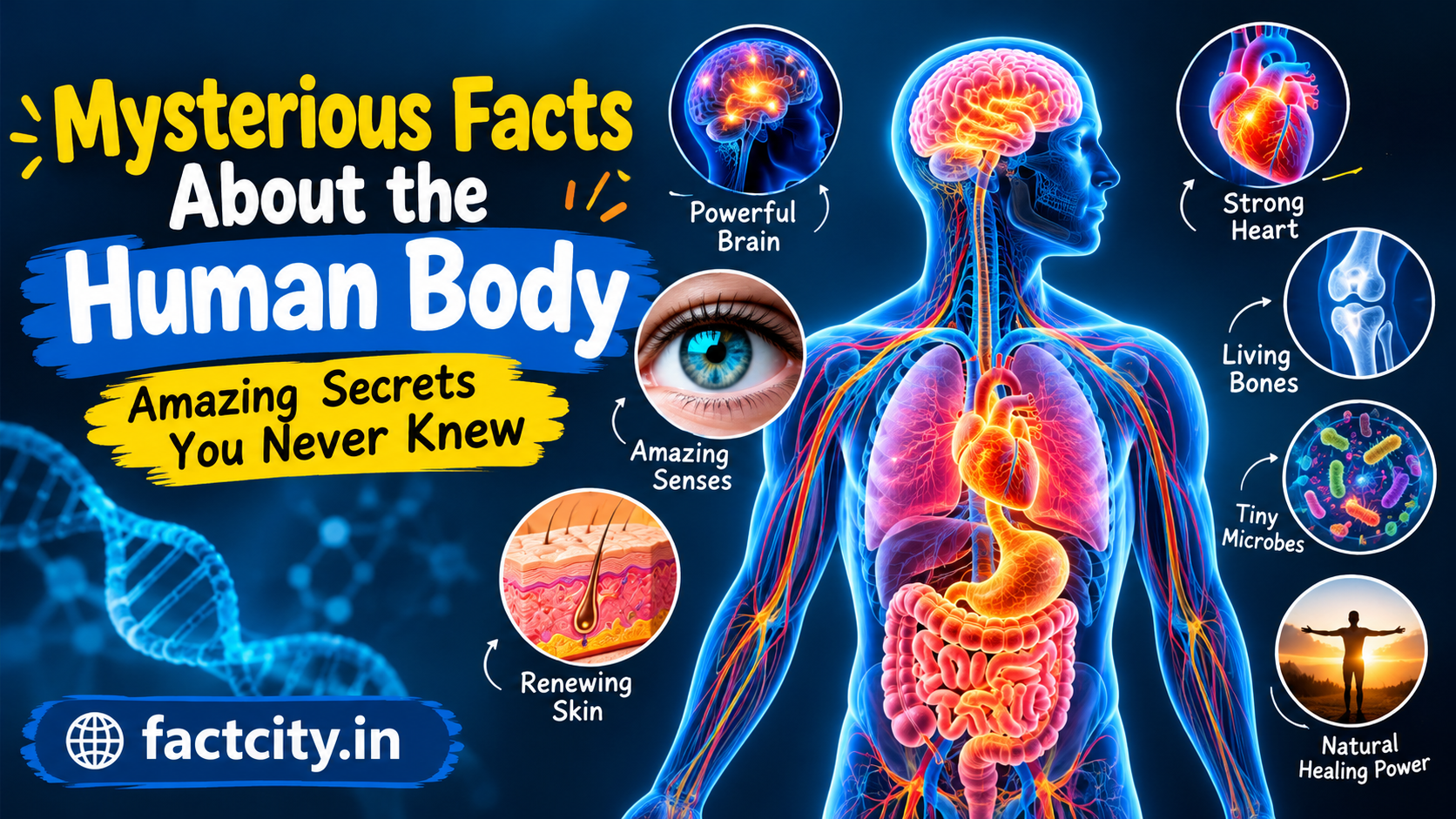
Mysterious Facts About the Human Body: The human body is one of the most complex and fascinating systems in nature. Millions of processes are taking place inside us every second without any conscious effort. Our heart beats, our lungs exchange gases, our brain processes information, and our immune system is always on the lookout for threats.
Much has been learned about human biology by scientists, but the body still has many mysteries and surprises. From the way our brains create dreams to the weird way our senses behave, our bodies can do things that seem almost unbelievable.
In this article, we explore some strange facts about the human body that remind us how amazing we are.
While you sleep, your brain can generate brand new experiences
Dreaming is one of the most mysterious things the human brain does. During some phases of sleep, especially during REM sleep, the brain is capable of generating vivid images, sounds, feelings, and scenarios. Dreams sometimes put together familiar people, places, and memories in strange ways. Sometimes you might have a completely foreign story, which is real when you are dreaming. While scientists know a lot about sleep, how every dream is made and why we dream specific dreams are active areas of research.
Your Body Is Always Making Heat
Your body is producing heat even when you are sitting quietly. This is because your cells are constantly using energy. The brain, heart, liver, and muscles all generate heat. Your body reacts to this by sweating and altering blood flow to keep your internal temperature steady. This is the reason why the human body can stay warm even when the surroundings are a lot colder.
Your stomach has a powerful defence system
Hydrochloric acid is in your stomach, and it breaks down food and helps in digestion. The acid is so powerful it can damage normal tissues of the body. So why doesn’t your stomach just digest itself? The stomach is protected by a mucus barrier and other mechanisms that protect the stomach lining. Cells in the lining of the stomach are also continually replaced. This balance of powerful digestive chemicals and the tissues that protect them is one of the body’s remarkable biological systems.
Your bones are a living tissue.
Bones appear to be hard and dead, but they are alive and filled with blood vessels, nerves and special cells. Old bone tissue is broken down and replaced by new tissue throughout your life. This process is called bone remodelling. Your skeleton is therefore not just a fixed framework. It is always changing in response to physical activity, hormones, nutrition, age, and things like that.
Your skin is constantly rejuvenating
Your skin is an important protective barrier between your body and the outside world. It regulates temperature. It also allows you to feel touch, pressure, and temperature. As older cells are shed, newer cells move upward, constantly replacing the outer layers of the skin. This means the skin you have today is slowly changing over time, though it happens so gradually you typically don’t notice it.
Your Heart Can Keep Beating Without You Thinking About It
One of the coolest facts about the human body is that your heart doesn’t need to be told what to do by your brain for every heartbeat. In the heart, there are specialised cells that produce electrical signals that coordinate the contractions of the heart. The heart has its own intrinsic rhythm, but the heart rate can be influenced by the nervous system. This is why your heart keeps beating when you are sleeping or not thinking about it.
Your Brain Uses a Lot of Energy (Surprisingly)
The brain, which represents only a small percentage of the total body weight, uses a lot of energy from the body. Your brain is busy even when you are resting. It keeps nerve cells talking to each other, processes sensory information, controls vital functions, and manages countless internal processes. To think, remember, learn, and even daydream, biological activity inside the brain is necessary.
Trillions of microorganisms live inside your body
We are not completely alone inside our bodies. There are trillions of microorganisms living on and inside us, especially in our digestive system. Many of these microbes are harmless or even helpful. The community of microorganisms living in the body is often referred to as the microbiome. Scientists are still discovering how these little guys influence digestion, immunity, metabolism and other aspects of human biology. There are still many questions about the relationship between humans and their microscopic companions.
Your sense of smell is tightly linked to memory
Have you ever smelt a certain food, perfume or place and suddenly remembered something from years ago? That can happen for biological reasons. The parts of the brain that process smells are closely connected to parts that process memory and emotion. Consequently, certain smells can trigger surprisingly vivid memories. This is one of the more mysterious ways the brain correlates our senses with our personal experiences.
Your body can heal itself
The human body has an incredible capacity to heal damaged tissues. For example, when you get a minor cut, your body initiates a carefully choreographed healing process. Blood clotting stops blood loss, immune responses protect the damaged area, and new tissue is formed over time. Different tissues have different regenerative capacities. Some heal pretty well. Others have a more limited ability to repair. This is the natural healing process that reminds us that the body is always working on itself.
Goosebumps Are a Vestige of Biology
Goosebumps are another weird thing about the human body. When you’re cold, scared, or emotionally fired up, tiny muscles attached to hair follicles contract, and the hairs on your skin stand up. In humans, this response has little practical effect, since we have relatively little hair on our bodies. In furry animals, however, these similar responses can make their coats appear thicker and help with insulation, or make them appear larger when threatened.
How Your Eyes and Brain Work Together to Produce Vision
Your eyes gather light, but seeing is not merely your eyes taking pictures. The eye picks up light and converts it into electrical signals. These signals are sent by the optic nerve to the brain, where they are processed into the visual experience that you perceive. Your eyes take in the data; your brain makes sense of it. Or, in other words, the process is so rapid and automatic that we seldom pause to consider the complexity of vision.
Your body has a built-in balance system.
Standing and walking may seem easy, but they require the coordination of a number of systems to maintain balance. Inside your ear are structures that help you sense movement and position. Your eyes give you visual information, and sensors in your muscles and joints tell you where your body is. Your brain interprets these signals, helping you maintain your balance and control your movements. This complex system is constantly functioning, often without our being aware of it.
Your brain can change over your lifetime
The human brain isn’t fully set after childhood. It can change its structure and connections in response to learning, experiences, practice, and environmental influences. This ability is called neuroplasticity.
Repeating an activity, learning a new skill, or using some mental abilities can change the connections between neurons. This remarkable plasticity is part of why we can continue learning and adapting during our lifetimes.
There are many unknowns about the human body
Perhaps the most mysterious fact of all is that scientists still learn new things about the human body. Consciousness, memory, ageing, immunity, the microbiome, brain function, regeneration and many other biological processes are still being researched. Modern medicine has learned a great deal about human biology, but there is still much more to learn.
Why the human body remains so mystifying
The human body is not a collection of organs working independently. It is a network of networks in which billions of cells communicate and cooperate.
The brain communicates with the body, hormones communicate with organs, the immune system answers threats, muscles react to nerve signals, and cells are always repairing and replacing themselves. Many of these processes happen automatically, without our being aware of them at all. interesting-facts-amazing-things-you-may-not-know-2
And that’s why the mysterious facts about the human body are so interesting. Something as mundane as breathing, sleeping, remembering, healing, or keeping balance calls for complex biological systems working together all the time.
Final Thoughts
The human body has many amazing mechanisms that we often don’t appreciate. Our biology is more complex than it seems, from the mysterious world of dreams to the body’s capacity to heal wounds and maintain balance.
These weird facts about the human body show that we don’t know everything about ourselves yet. “The more we learn about human biology, the more we learn about the amazing systems that are going on inside every single person,” says a scientist.