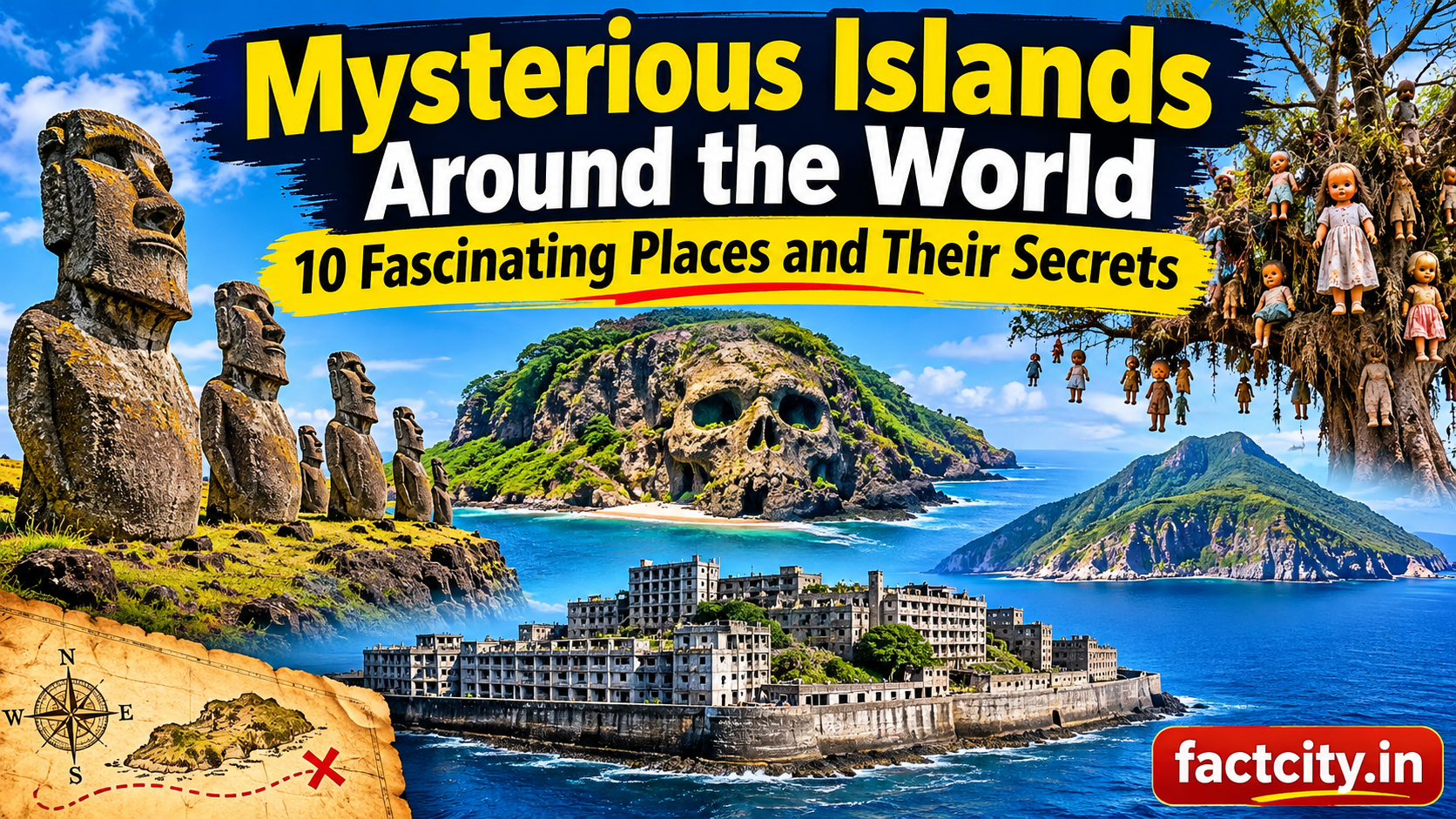
Mysterious Islands Around the World: The world is filled with beautiful islands, but some are famous for much more than their beaches, forests, and breathtaking landscapes. Certain islands have unusual histories, unexplained discoveries, mysterious wildlife, ancient ruins, and legends that continue to attract the curiosity of travelers and researchers. From remote islands surrounded by dangerous waters to places hiding forgotten civilizations, these destinations offer fascinating stories that make them different from ordinary tourist locations.
Mysterious islands around the world have captured human imagination for centuries. Some are connected with tales of lost civilizations, while others are known for strange natural formations, abandoned settlements, or unusual traditions. Although many of their mysteries have scientific explanations, a few questions remain unanswered or continue to inspire debate. Let us explore some of the most fascinating mysterious islands on Earth and discover what makes each one so special.
1. Easter Island, Chile: The Mystery of the Giant Stone Statues
Easter Island, also known as Rapa Nui, is one of the most mysterious islands in the Pacific Ocean. It is famous for its enormous stone statues called moai, which were created by the island’s ancient inhabitants. Hundreds of these statues stand across the island, with some reaching several meters in height and weighing many tons.
The most fascinating question is how the islanders carved, transported, and positioned these massive figures without modern machinery. Archaeological research suggests that the statues were moved using carefully organized techniques, including ropes and controlled rocking movements. However, the exact methods may have varied between locations.
The moai are believed to represent important ancestors and leaders, reflecting the spiritual beliefs of the Rapa Nui people. Their presence across the island creates an extraordinary atmosphere, especially when viewed against the ocean. Easter Island remains a remarkable destination where ancient engineering, cultural traditions, and historical mysteries come together.
2. North Sentinel Island, India: One of the World’s Most Isolated Places
North Sentinel Island is located in the Andaman Sea and is part of India’s Andaman and Nicobar Islands. It is home to the Sentinelese people, one of the world’s most isolated Indigenous communities. They have maintained their traditional way of life and generally reject contact with outsiders.
The island is surrounded by coral reefs and dense forests, making access difficult. Very little is known about the Sentinelese language, customs, or population because outside contact is extremely limited.
Its mystery comes not from supernatural stories but from the limited information available about its inhabitants and their history. The Indian government protects the island and restricts access to safeguard the Sentinelese people from outside diseases and unwanted interference. North Sentinel Island is a powerful reminder that some communities have the right to remain isolated from the modern world.
3. Socotra, Yemen: An Island That Looks Like Another Planet
Socotra is an extraordinary island in the Arabian Sea, belonging to Yemen. Its unusual landscape has made it one of the most visually distinctive islands on Earth. The island is famous for its dragon’s blood trees, which have umbrella-shaped crowns and produce a deep red resin.
Socotra’s isolation has allowed many unique plants and animals to evolve. A significant proportion of its plant species are found nowhere else in the world. Strange-looking trees, rocky mountains, white sand beaches, and dramatic coastal cliffs create an almost otherworldly environment.
The island’s unusual biodiversity is the result of millions of years of geographical isolation. Its landscapes may appear mysterious, but they also provide valuable evidence of how life adapts to different environments. Socotra is recognized as a UNESCO World Heritage Site and is considered one of the world’s most important natural treasures.
4. Poveglia Island, Italy: The Haunted Island of Venice
Poveglia Island is located in the Venetian Lagoon in Italy. It is widely associated with ghost stories, abandoned buildings, and disturbing historical legends. Over the centuries, the island was used for different purposes, including as a place connected with plague quarantine and later as a hospital facility.
Its abandoned structures and overgrown pathways have contributed to its frightening reputation. Stories about restless spirits and unexplained events have made Poveglia popular in paranormal discussions.
However, many dramatic claims about the island’s haunted history are difficult to verify. Its real historical significance is connected with public health, isolation, and changing uses of the island over time. Poveglia remains a fascinating example of how historical events and abandoned architecture can create a powerful atmosphere of mystery.
5. The Island of the Dolls, Mexico: A Strange and Unsettling Destination
Located in the canals of Xochimilco near Mexico City, the Island of the Dolls, known as Isla de las Muñecas, is famous for hundreds of old dolls hanging from trees and buildings.
According to local stories, a caretaker named Julián Santana Barrera began placing dolls around the island after discovering the body of a young girl in the nearby water. He reportedly believed the dolls would protect the place and calm the girl’s spirit.
Over time, the collection grew, with dolls becoming weathered, damaged, and covered in insects and vegetation. Their empty eyes and unusual positions create an eerie appearance that attracts visitors interested in unusual destinations.
Although supernatural stories surround the island, its unsettling atmosphere mainly comes from its unusual decorations and the history associated with its caretaker. It is one of the most distinctive and mysterious places in Mexico.
6. Hashima Island, Japan: The Abandoned City in the Sea
Hashima Island, also called Gunkanjima or Battleship Island, is located off the coast of Nagasaki, Japan. It was once a thriving coal-mining community with apartment buildings, schools, shops, and other facilities packed into a small area.
When coal production declined and the mine closed in 1974, the island was rapidly abandoned. Today, its deteriorating concrete buildings stand empty, creating the appearance of a forgotten city surrounded by the sea.
The island’s mystery comes from its sudden transformation from a busy industrial settlement into an abandoned landscape. Its history also includes the difficult experiences of workers, including forced labor during Japan’s colonial period and World War II.
Hashima is now a historic site and a UNESCO World Heritage location as part of Japan’s industrial heritage. Its empty buildings offer a powerful glimpse into the rise and decline of an industrial community.
7. Bermeja Island, Mexico: The Island That Disappeared From Maps
Bermeja Island is associated with one of the most unusual geographical mysteries in the Gulf of Mexico. It appeared on some historical maps for centuries, but modern surveys have failed to locate a clearly identifiable island at the expected position.
The disappearance of Bermeja has attracted speculation and political discussion because of its potential relevance to maritime boundaries and offshore resources. Some theories suggest that the island may have been incorrectly mapped, while others propose that natural processes could have changed the area.
There is no confirmed evidence that a substantial island was deliberately destroyed or hidden. Many researchers believe the mystery may be connected with historical mapping errors and inaccurate geographical information.
Bermeja remains an intriguing example of how old maps can create questions that modern technology struggles to resolve completely.
8. Flannan Isles, Scotland: The Mystery of the Missing Lighthouse Keepers
The Flannan Isles are a remote group of islands in the Atlantic Ocean, west of Scotland. They became famous because of the disappearance of three lighthouse keepers in December 1900.
When a relief vessel arrived at the lighthouse, the keepers were missing. The lighthouse was found empty, and the men had apparently left behind their normal duties. Investigators later considered the possibility that powerful waves had swept them away while they were working near the shore.
Despite official explanations, the event has inspired many stories about supernatural forces, mysterious disappearances, and unusual circumstances. The remote location and harsh ocean conditions make the incident especially haunting.
The disappearance of the Flannan Isles lighthouse keepers remains one of the most famous maritime mysteries in British history.
9. Oak Island, Canada: The Search for Buried Treasure
Oak Island is located off the coast of Nova Scotia, Canada. It has attracted treasure hunters for more than two centuries because of stories about a mysterious underground structure known as the Money Pit.
According to historical accounts, early explorers discovered unusual features in the ground that appeared to suggest a hidden deposit. Subsequent excavations uncovered layers of materials and underground passages, although many interpretations remain disputed.
Some treasure hunters believe the island may contain pirate treasure, historical documents, or valuable artifacts. Others argue that the underground features may be natural formations or the result of earlier excavation attempts.
Despite extensive searches, no universally accepted discovery has solved the mystery. Oak Island continues to attract researchers and visitors fascinated by the possibility of hidden history.
10. Bouvet Island, Norway: The World’s Remote Island Wilderness
Bouvet Island is a small volcanic island in the South Atlantic Ocean and is considered one of the most remote islands on Earth. It is covered largely by glaciers and surrounded by steep cliffs, making access extremely difficult.
The island has no permanent human population and is rarely visited. Its harsh weather, icy terrain, and isolated location create an environment that feels almost untouched by human activity.
One unusual feature is a sheltered area near the island’s center that has led to questions about its geological formation. Scientists have studied its volcanic origins and changing ice cover, but the island remains difficult to explore in detail.
Bouvet Island’s mystery comes from its extreme remoteness and the limited opportunities people have to study it directly.
Why Are Mysterious Islands So Fascinating?
Mysterious islands attract attention because they combine isolation, unusual landscapes, forgotten histories, and stories that are difficult to verify. When a place is separated from the mainland, its people, wildlife, and environment can develop in unique ways.
Some islands preserve ancient traditions, while others reveal the remains of abandoned settlements or unexplained historical events. Natural forces such as volcanic activity, changing sea levels, erosion, and extreme weather can also reshape islands and create unusual features.
Modern science continues to uncover new information about these places. Archaeologists investigate ancient structures, biologists study rare species, and geologists examine how islands formed and changed over time. Each discovery helps separate reliable evidence from myths and speculation.
Conclusion
Mysterious islands around the world remind us that Earth still holds places filled with fascinating stories and unanswered questions. From the giant statues of Easter Island and the isolated community of North Sentinel Island to the abandoned buildings of Hashima and the strange history of Oak Island, every destination offers a different kind of mystery.
Some islands are famous for ancient civilizations, while others are connected with disappearances, unusual natural environments, or legends passed down through generations. Although many mysteries become clearer through scientific research, these islands continue to inspire curiosity and wonder.
Exploring their histories helps us understand not only the mysteries of the past but also the incredible diversity of our planet. These remarkable islands prove that the world is still full of places waiting to be understood. incredible-discoveries-found-beneath-the-earth
Frequently Asked Questions
What is the most mysterious island in the world?
Easter Island is often considered one of the world’s most mysterious islands because of its giant moai statues and the questions surrounding their construction and transportation. Other islands, such as North Sentinel Island and Oak Island, are also famous for their unique mysteries.
Which island is known for disappearing from maps?
Bermeja Island in the Gulf of Mexico is known for appearing on historical maps but not being clearly located through modern surveys.
Are there really haunted islands around the world?
Several islands, including Poveglia in Italy and the Island of the Dolls in Mexico, are associated with ghost stories. However, supernatural claims have not been scientifically verified.
Why do mysterious islands attract tourists?
People visit mysterious islands to explore unusual landscapes, learn about ancient cultures, discover abandoned places, and experience locations connected with fascinating historical stories.
Are all island mysteries unexplained?
No. Many island mysteries have been clarified through archaeology, geography, and scientific research. Others remain uncertain because historical records are incomplete or the locations are difficult to investigate.