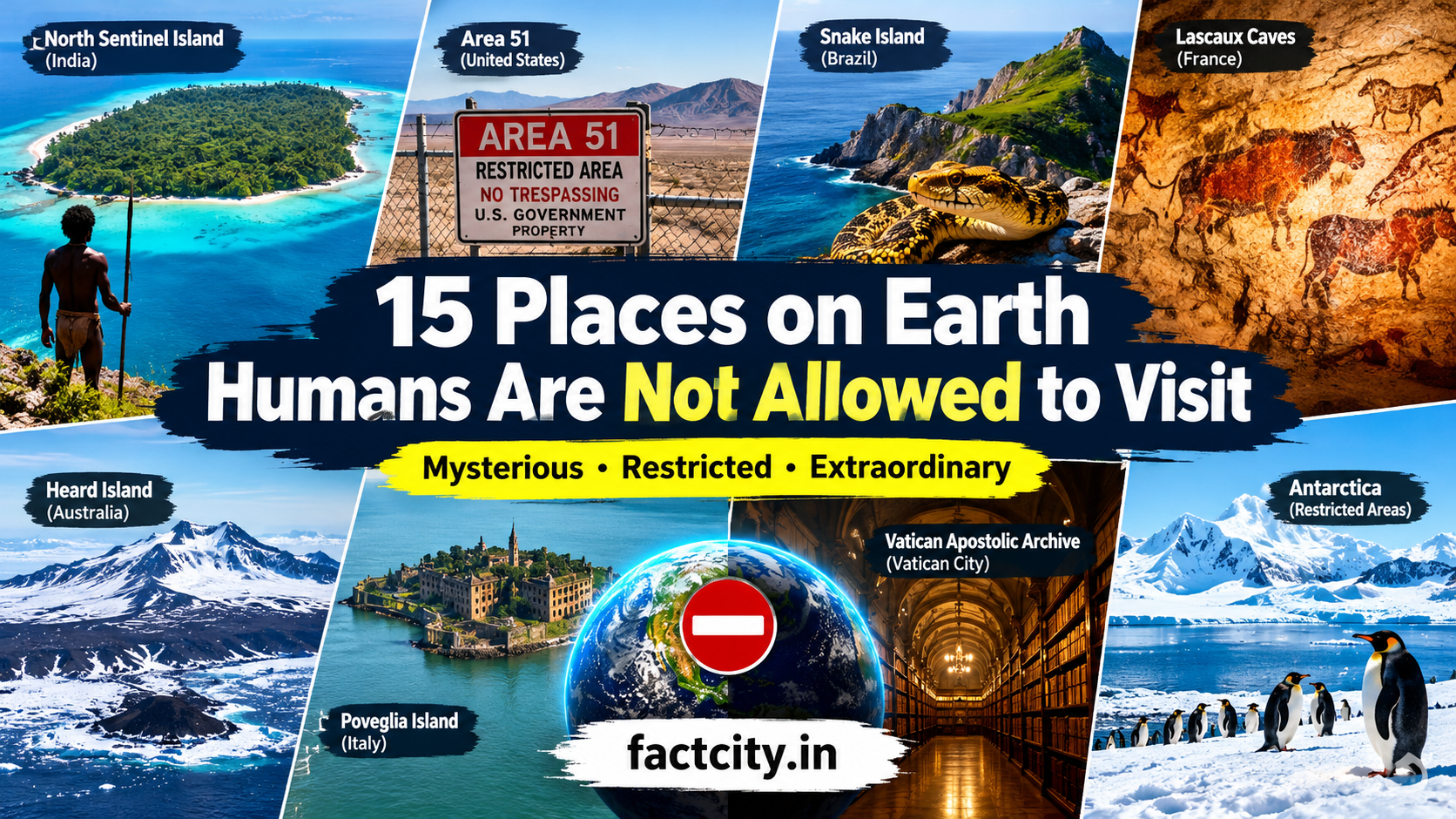
Places on Earth Humans Are Not Allowed to Visit: Have you ever wondered whether there are places on Earth that humans are not allowed to visit? Although people can travel to almost every corner of the world, some locations remain restricted because of dangerous conditions, national security, environmental protection, or cultural traditions. These places are often surrounded by mystery because ordinary travelers cannot enter them freely. From remote islands inhabited by isolated Indigenous communities to secretive military facilities and ancient archaeological sites, each location has a fascinating story behind its restrictions. Some places are completely closed to the public, while others allow entry only to authorized researchers, government officials, or religious representatives. Exploring these destinations through history and scientific knowledge helps us understand why certain parts of our planet must remain protected.
1. North Sentinel Island, India
North Sentinel Island is one of the most restricted places on Earth. Located in the Andaman and Nicobar Islands in the Bay of Bengal, this remote island is home to the Sentinelese, an Indigenous community that has maintained its isolation from the outside world for generations. The community has repeatedly shown that it does not welcome contact with outsiders, and approaching the island can create serious risks for both visitors and its inhabitants. The Indian government prohibits unauthorized visits and restricts access to the island and its surrounding waters to protect the Sentinelese from unwanted contact and potentially dangerous encounters.
One of the main reasons for these restrictions is the risk of infectious diseases. Because the Sentinelese have limited contact with the outside world, exposure to common infections could have devastating consequences for their population. Unwanted visits could also threaten their traditional way of life and violate their right to live independently. North Sentinel Island is therefore not a tourist destination, and travelers should never attempt to land there. Its protected status demonstrates why respecting Indigenous communities and their wishes is more important than satisfying curiosity about an isolated place.
2. Area 51, United States
Area 51 is a highly restricted military installation located in the Nevada desert in the United States. It is famous worldwide for its association with secret aircraft testing, advanced military technology, and stories about extraterrestrial life. For many years, limited public information about the facility encouraged speculation about what might be happening behind its security barriers. Although the location has become a popular subject of UFO discussions, there is no publicly verified evidence that aliens or extraterrestrial spacecraft are stored there.
The facility is associated with classified aerospace development and military research, which explains why unauthorized entry is prohibited. Security measures protect sensitive operations, and people who enter restricted areas without permission may face legal consequences. Visitors can explore certain publicly accessible roads and viewpoints in the surrounding desert, but they cannot legally enter the secured installation. Area 51 remains one of the most mysterious places on Earth because of its secrecy, its military importance, and the many unanswered questions surrounding its activities.
3. Snake Island, Brazil
Snake Island, officially known as Ilha da Queimada Grande, is located off the coast of Brazil and is famous for its population of golden lancehead pit vipers. These venomous snakes are native to the island, where their isolated habitat has contributed to the development of a distinctive population. The golden lancehead is considered endangered, making the island important for wildlife conservation as well as a potentially dangerous location for inexperienced visitors.
Access to Snake Island is tightly controlled because of its ecological importance and the risks associated with its venomous wildlife. Ordinary tourists cannot simply arrange a visit, and access is generally limited to appropriately authorized activities, such as legitimate scientific research. Stories about the island sometimes exaggerate the number of snakes or suggest that every part of it is covered with them, but the real situation is fascinating enough without sensational claims. Snake Island demonstrates how protecting a fragile ecosystem can be just as important as protecting human visitors from danger.
4. Lascaux Caves, France
The Lascaux Caves in southwestern France are famous for their extraordinary prehistoric paintings, which depict animals such as horses, bulls, and deer. These artworks were created thousands of years ago and provide valuable evidence of the artistic abilities and cultural lives of early humans. After the caves were discovered in 1940, they attracted visitors from many parts of the world. However, the growing number of people entering the caves gradually created environmental problems that threatened the preservation of the ancient paintings.
Changes in temperature, humidity, carbon dioxide levels, and microorganisms contributed to damage inside the cave system. To protect the artwork, the original caves were closed to ordinary public visits in 1963. Today, visitors can experience carefully created replicas and exhibitions that reproduce the appearance of the prehistoric paintings without exposing the originals to the same level of disturbance. The Lascaux Caves show that some places must remain closed not because they are inherently dangerous, but because human activity can permanently damage priceless historical treasures.
5. Surtsey Island, Iceland
Surtsey is a volcanic island that emerged from the Atlantic Ocean following underwater volcanic eruptions between 1963 and 1967. Located off the southern coast of Iceland, it provides scientists with a rare opportunity to observe how life develops on newly formed land. When the island first appeared, its surface consisted mainly of fresh volcanic material, with little vegetation or established wildlife. Over time, seeds, insects, birds, and other organisms began reaching the island, gradually creating a developing ecosystem.
Scientists study Surtsey to understand how plants and animals colonize new environments and how ecological communities change over time. Uncontrolled human activity could introduce foreign species, disturb wildlife, or interfere with the natural processes researchers want to observe. For this reason, access is restricted and generally limited to authorized scientific work. Although visitors may sometimes see the island from boats or aircraft, landing is not permitted without the necessary authorization. Surtsey is an excellent example of how limiting human access can help preserve nature and support important scientific discoveries.
6. North Brother Island, United States
North Brother Island is a small island in New York City’s East River that remains closed to ordinary public access despite being surrounded by a busy urban environment. During the nineteenth and early twentieth centuries, it housed Riverside Hospital, which was used to isolate people suffering from contagious diseases. One of its most famous former residents was Mary Mallon, commonly known as Typhoid Mary, who became associated with the spread of typhoid fever in the United States.
After the hospital closed, its buildings were gradually abandoned, and vegetation began covering parts of the island. Today, North Brother Island is protected as a wildlife sanctuary and provides important habitat for birds and other animals. Public access is restricted to reduce disturbance to wildlife and protect the sensitive environment. Its abandoned structures and overgrown landscape have made it an object of curiosity for urban explorers, but unauthorized entry is not permitted. North Brother Island is a reminder that even places located close to major cities can remain inaccessible for environmental and historical reasons.
7. Poveglia Island, Italy
Poveglia Island is located in the Venetian Lagoon near Venice, Italy. Its history includes periods when it was used during disease outbreaks, as well as later institutional activities. Over time, stories about plague victims, abandoned buildings, and alleged paranormal events helped establish its reputation as one of the world’s most mysterious islands. Numerous supernatural claims have appeared in books, documentaries, and online discussions, although there is no reliable scientific evidence proving that the island is haunted.
Despite its popularity among fans of mysterious destinations, Poveglia is not an ordinary tourist attraction. Access has been restricted, and anyone considering a visit should check current official requirements rather than assuming that landing is permitted. Its abandoned structures may also present safety concerns. Beyond the ghost stories, the island has genuine historical significance because it reflects the history of disease management, isolation, and institutional life in the Venetian Lagoon. Poveglia demonstrates how historical events and popular imagination can transform a restricted location into an internationally recognized mystery.
8. The Vatican Apostolic Archive, Vatican City
The Vatican Apostolic Archive is an important historical institution that preserves documents relating to the history of the Catholic Church and its interactions with governments, political leaders, and societies across centuries. Its collections include letters, manuscripts, official records, and other historical materials that help researchers understand important events and developments. Because many documents are extremely old and delicate, they require careful handling and appropriate preservation conditions.
The archive is not freely accessible to ordinary tourists. Access is granted under specific rules, primarily to qualified researchers who meet the institution’s requirements. Certain materials may remain restricted, and researchers must follow established procedures when examining the collections. Although the archive is sometimes described online as a mysterious place hiding every kind of historical secret, it is more accurately understood as a professional institution dedicated to preserving documentary heritage. Its restricted access helps protect valuable records while allowing approved scholars to investigate the past.
9. Heard Island, Australia
Heard Island is a remote Australian territory in the southern Indian Ocean, known for its glaciers, rugged coastline, severe weather, and volcanic landscape. The island is dominated by Big Ben, a volcanic massif that includes Mawson Peak. Because it lies thousands of kilometers from major population centers, reaching the island requires careful expedition planning, suitable equipment, and considerable preparation.
Heard Island and the nearby McDonald Islands support important populations of seabirds, seals, and other wildlife. Their relatively undisturbed ecosystems make them valuable for environmental research and conservation. Access is highly controlled under Australian regulations, and visits generally require appropriate authorization. The island is not completely impossible for humans to visit, but it is certainly not a destination where travelers can arrive without permission or preparation. Its isolation and protected status help preserve one of the world’s most remarkable natural environments.
10. The Tomb of Qin Shi Huang, China
The tomb complex of Qin Shi Huang, China’s first emperor, is one of the most important archaeological sites in the world. Located near Xi’an in Shaanxi Province, the complex is internationally famous for the Terracotta Army, a collection of thousands of life-sized clay soldiers, horses, and chariots created more than 2,000 years ago. The figures were buried to accompany the emperor in the afterlife and demonstrate the remarkable craftsmanship and organizational abilities of ancient Chinese society.
Although visitors can explore designated archaeological areas and view many of the Terracotta Warriors, the emperor’s central burial chamber remains unopened. Archaeologists are concerned that opening the chamber without suitable conservation methods could expose delicate objects to oxygen, moisture changes, and other environmental conditions that might cause irreversible damage. The decision to leave the chamber undisturbed reflects the importance of preserving historical evidence for future generations. This ancient tomb continues to inspire curiosity because it contains unanswered archaeological questions, but responsible research places preservation ahead of immediate access.
11. Diego Garcia, British Indian Ocean Territory
Diego Garcia is an island in the Indian Ocean that hosts a strategically important military installation operated by the United States under an agreement with the United Kingdom. Its geographical position makes it significant for military logistics and regional operations. Because of its strategic role, the island is not an ordinary tourist destination, and entry is subject to strict authorization requirements.
The island also has a complicated political and historical background involving the displacement of the Chagossian people, who were removed from communities in the Chagos Archipelago during the twentieth century as the military facility was established. Their history remains central to discussions about human rights, the territory’s future, and the rights of displaced communities. Travel to Diego Garcia is restricted, and access rules differ from those that apply to normal holiday destinations. The island demonstrates how military security, international agreements, and historical disputes can combine to make a location inaccessible to most travelers.
12. The Inner Sacred Areas of Ise Grand Shrine, Japan
Ise Grand Shrine, located in Mie Prefecture, Japan, is one of the country’s most important Shinto religious sites. Dedicated to Amaterasu, a major deity in Shinto tradition, the shrine has deep spiritual and cultural significance. It consists of several sacred structures surrounded by carefully maintained natural landscapes and attracts visitors interested in Japanese history, architecture, and religious traditions.
However, not every part of the shrine is open to the public. Access to its innermost sacred areas is restricted, and visitors must respect the boundaries established by shrine authorities. The shrine’s buildings are traditionally reconstructed at regular intervals, following customs that preserve architectural knowledge and maintain a connection between generations. Unlike locations restricted because of dangerous wildlife or military activity, the inner areas of Ise Grand Shrine are protected primarily because of their religious importance. The site demonstrates that respecting sacred traditions can be just as important as preserving historical buildings or natural environments.
13. Fort Knox Bullion Depository, United States
Fort Knox Bullion Depository in Kentucky is one of the most famous secure storage facilities in the United States. It is associated with the storage of a substantial portion of the country’s official gold reserves and has become a symbol of financial security. Its reputation for strict protection has inspired countless stories in movies, books, and popular culture.
Ordinary members of the public cannot enter the depository as tourists. Access is tightly controlled because the facility is responsible for protecting valuable government assets. Although stories about its security often include exaggerated claims, its restricted status has a straightforward explanation: the government must safeguard the property stored there. Fort Knox is an example of how national financial interests can require strict security measures. Its reputation continues to attract curiosity, even though the facility is not open for ordinary sightseeing.
14. Bohemian Grove, United States
Bohemian Grove is a private property in California associated with the Bohemian Club, a private organization whose members have included prominent figures from business, politics, and other fields. The property is known for its secluded forest setting and private gatherings, particularly the club’s annual summer encampment. Because access is limited, the location has attracted public curiosity and become the subject of numerous theories and rumors.
As private property, Bohemian Grove is not open to people who wish to enter without permission. Its exclusivity and the high-profile backgrounds of some attendees have contributed to its mysterious reputation. However, claims about secret political decisions or unusual activities should be distinguished from verified information about the organization. The location illustrates how privacy, limited access, and public fascination can turn a private property into one of the world’s most discussed restricted destinations.
15. Restricted Areas of Antarctica
Antarctica is a continent of extreme cold, enormous ice sheets, and remarkable wildlife. Although scientific expeditions and organized tourism operate in certain areas, some locations are protected or require special permits before anyone can enter. Under the Antarctic Treaty System and related environmental rules, designated protected areas have entry requirements intended to preserve sensitive ecosystems, safeguard scientific research sites, and protect historically significant locations.
The Antarctic environment is particularly vulnerable to human disturbance because its ecosystems develop under extreme conditions. Introducing non-native species, leaving waste, or disturbing wildlife can have consequences that are difficult to reverse. In addition, dangerous terrain, deep crevasses, unstable ice, and severe weather can make travel hazardous. It would be inaccurate to say that all of Antarctica is forbidden to humans; instead, access depends on the location, relevant permissions, environmental regulations, and safety conditions. Antarctica demonstrates why responsible exploration requires careful planning and respect for environmental protection measures.
Why Are Some Places on Earth Humans Are Not Allowed to Visit?
There are several reasons why certain places on Earth are restricted to the public. One of the most common is environmental protection. Fragile ecosystems, rare wildlife, and isolated habitats can be damaged by uncontrolled tourism, sometimes causing changes that are difficult to reverse. Places such as Surtsey Island and Snake Island demonstrate why protecting nature may require strict limits on human activity.
National security is another important reason for restricting access. Military installations and secure government facilities may contain sensitive equipment, classified information, or valuable assets that require protection. Cultural and religious traditions can also determine who may enter particular locations, especially when a site contains sacred areas that are intended only for specific individuals or authorized participants. In other cases, restrictions help preserve archaeological discoveries, prevent damage to historical buildings, or protect visitors from dangerous conditions. These rules may change over time, but their purpose is often to balance public curiosity with safety, preservation, and respect. psychological-facts-about-human-emotions
Can Tourists Visit These Forbidden Places Legally?
Whether a tourist can visit a restricted location depends on the specific rules that apply to it. Some places are completely closed to ordinary visitors, while others permit limited access for authorized researchers, conservation specialists, or approved expeditions. For example, visitors can explore replicas of the Lascaux Caves, but the original cave system remains closed to ordinary public visits. Similarly, certain parts of Antarctica can be visited through organized expeditions, while designated protected areas may require special authorization.
Before planning a trip, travelers should check official regulations and access requirements rather than relying only on social media posts or travel blogs. Entering restricted locations without permission may lead to fines, legal action, or serious physical danger. It can also harm wildlife, damage cultural heritage, or threaten communities that have chosen to remain isolated. Learning about these places is a wonderful way to explore the world, but respecting their boundaries is essential.
Conclusion
The places on Earth humans are not allowed to visit reveal how much of our planet remains protected for important reasons. Some locations contain rare wildlife and fragile ecosystems, while others are restricted because of national security, religious traditions, or the need to preserve historical treasures. North Sentinel Island highlights the importance of protecting isolated Indigenous communities, Surtsey Island demonstrates the scientific value of undisturbed nature, and the Lascaux Caves show why ancient artwork sometimes needs to remain beyond public reach.
These destinations may inspire curiosity, but not every mystery needs to be explored in person. Understanding why a place is restricted can be just as fascinating as visiting it. By learning about these remarkable locations and respecting the rules that protect them, we can appreciate the world’s hidden wonders while helping preserve them for future generations.