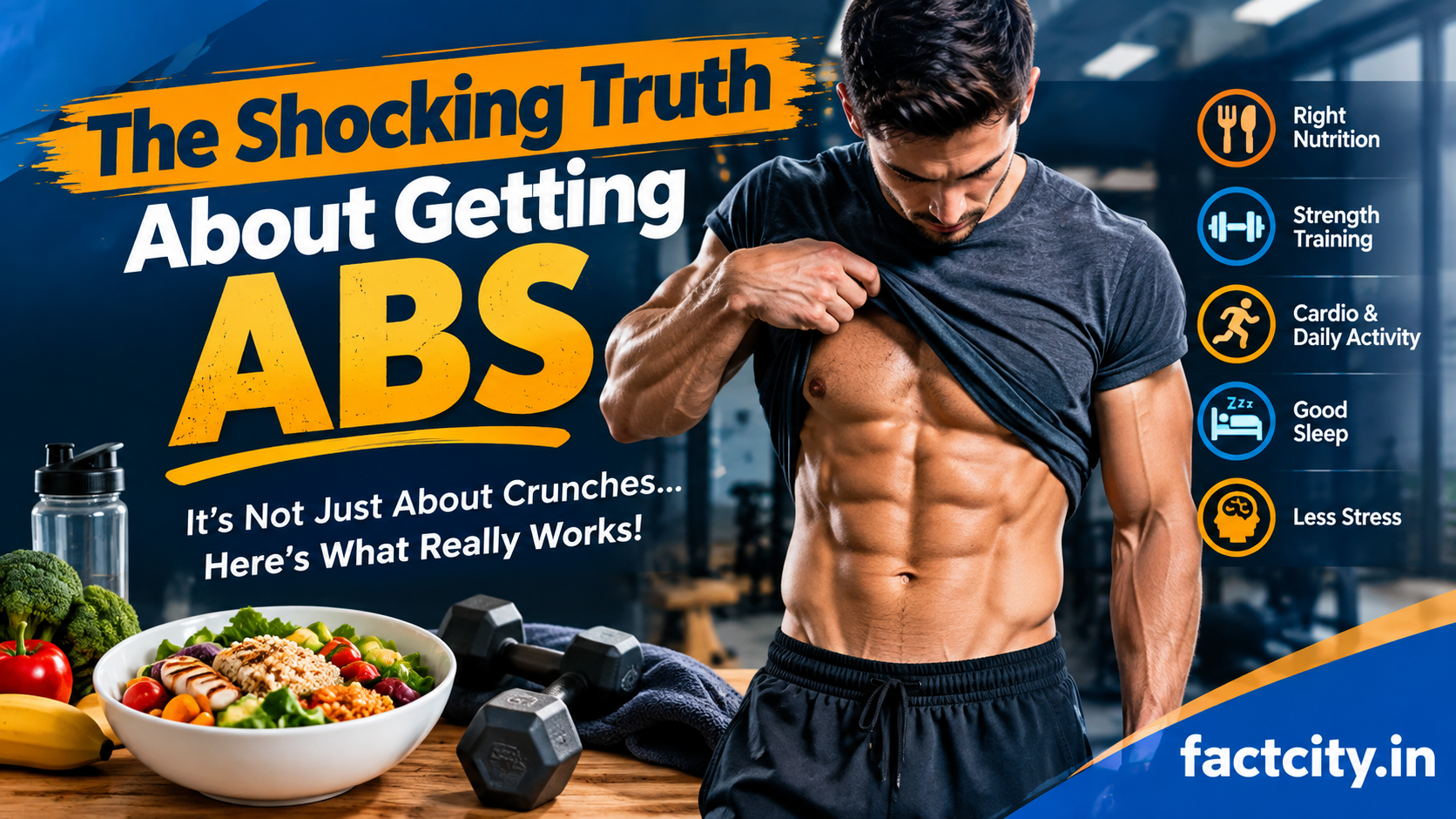
The Shocking Truth About Getting Abs, Visible abs are one of the most desired fitness goals, but there’s a lot of misinformation out there. Getting a six-pack is often made to look quick and easy on social media. You see fitness influencers doing a few ab exercises and promising great results, you see advertisements for supplements, workout programs and shortcuts.
The shocking truth about getting abs is that you can’t just do crunches. Having a visible six-pack depends on so many things like your overall body-fat percentage, diet, muscle growth, workout routine, sleep, consistency, and genetics.
If you’re doing hundreds of crunches and not seeing the results you want, it doesn’t mean that you’re doing everything wrong. Perhaps you’re just looking at the process in the wrong way.
This guide will explain what is really behind abdominal definition, and how you can chase your goal in a realistic and sustainable way. The Shocking Truth About Getting Abs
Why Getting Abs Is Harder Than You Think
Most people already have abs. The trick is to develop them enough and to cut through the layer of body fat that can hide their definition.
The muscle responsible for the “six-pack” look is the rectus abdominal. But your core also contains muscles like the transverse abdominis and obliques that help with stability, posture and overall core strength.
Having stronger abs can improve your physical performance, but stronger abs won’t automatically give you visible abs. The Shocking Truth About Getting Abs
Two people can do the exact same workout and have completely different looking midsections, due to differences in genetics, body composition, fat distribution, muscle development, lifestyle, etc.
The Biggest Myth: More Crunches Will Show Your Abs
One of the most common myths about getting abs is that you can burn belly fat simply by performing ab exercises over and over again.
Unfortunately, the body doesn’t do that.
Doing hundreds of crunches can strengthen your abdominal muscles, but it doesn’t tell your body to burn fat in your stomach area.
This is often called spot reduction and is one of the biggest misconceptions in fitness.
If you want more definition in your abdomen, it all comes down to your body composition. Biology decides where you store and lose fat so you can’t really decide to lose fat from one area.
This means that a better approach would be to combine resistance training, physical activity, proper nutrition and adequate recovery.
Nutrition Plays a Big Part
You want abs? You need to pay attention to your diet as much as you pay attention to your workouts.
You don’t have to eliminate all carbs, stay away from every dessert, or subsist on salads. Extreme diets are hard to maintain and can make it harder to enjoy a normal lifestyle.
Instead, think about an eating pattern that includes enough protein, fibre, carbohydrates, healthy fat, vitamins and minerals.
Prioritise Protein Foods
Protein is important for building and maintaining muscle.
Some good choices are:
Low Fat Meat Chicken Fish Eggs
Greek yoghurt. Milk.
Cottage cheese
Lentil Tofu Legume
Other high protein foods
Eat some protein with your meals so you are satisfied after eating.
Eat More Real Food
It is easier to control total calorie intake with a diet that is based primarily on minimally processed foods.
Add as a rule:
- Vegetables
Fruits
Wholegrains
Potato
Oatmeal Rice Beans
Seeds and nuts
High protein foods
That doesn’t make the processed foods inherently “bad.” It’s the overall pattern of your diet that’s most important, not whether individual foods are “good” or “bad.”
You Can’t Choose Where Your Body Loses Fat
This is maybe one of the most frustrating facts for people trying to get abs.
You may wish to lose stomach fat first, but your body may lose fat from other areas before your waist noticeably leans out.
Genetics affects where fat is stored and the order in which areas get leaner.
For some people, they can get abdominal definition fairly quickly. Others will need more time before seeing a visibly defined stomach.
So comparing your progress with someone else’s body can be misleading.
Building Your Abdominal Muscles Also Matters
Cutting bodyfat is only part of the equation. The Shocking Truth About Getting Abs
If you want to see more developed abs, you also need to train them like other muscles.
You don’t have to spend an hour to get a good abdominal workout.
You might want to check out exercises like:
1.Variations on Crunch
Crunches, when performed with controlled movement, can train the rectus abdominis.
Rather than speeding through repetitions, concentrate on maintaining control and using your abs throughout the movement.
2.Reverse Crunches:
Reverse Crunches “Reverse crunches are a great way to bring the pelvis to the rib cage and challenge the abs.
3.Boardrooms
Planks work your core’s ability to stabilise your body.
You can increase the difficulty gradually instead of just holding a plank for a really long time.
4.Hanging Knee to Tucks
Hanging knee raises challenge the abdominal muscles while requiring grip and upper-body stability.
5.Dead Bugs
Dead bugs are a great exercise to practise controlled core movement with stability.
6.Cable/Resistance Exercises
If you have access to a gym, resistance-based abdominal exercises can be a way to gradually challenge your muscles.
The core principle is progressive overload. Your muscles need to be challenged more and more in the right way.
You Should Train Your Full Body
Another surprising part of getting abs is that your whole workout routine matters.
A program that does nothing but abdominal exercises probably isn’t the best way to go.
Strength training with squats, rows, presses, lunges, and hip-hinge movements can target big muscle groups and help develop the body as a whole.
And a stronger body makes it easier to perform many core exercises with good form.
You don’t have to become a competitive bodybuilder. Even a simple full-body resistance-training routine can help.
Cardio Can Help, but it’s not magic
Cardiovascular exercise can help you stay fit and increase energy expenditure.
“An active lifestyle can comprise walking, cycling, swimming, jogging, sports and other activities.
But don’t use cardio as a punishment for eating.
You don’t have to spend hours on the treadmill every day working toward visible abs.
For many, a more practical long-term strategy is to combine regular strength training with consistent daily movement.
Your daily activities are more important than you think
The workout is one part of the activity that you do each day.
You work out for 45 minutes and then sit the rest of the day, so your overall activity level may be pretty low.
Easy activities like walking, climbing stairs, doing chores, standing up often and participating in recreational activities all help to increase your daily movement.
You don’t have to make every minute of your day a workout.
The aim is to create an active lifestyle you can follow.
Sleep Is a Part of the Abs Equation
Sleep is often overlooked in discussions about fitness.
After training your body needs to recover properly and sleep is important for your general health and physical performance.
A chronic lack of sleep can make it harder to keep up with your fitness routine. It can also affect appetite, energy, mood and exercise performance.
Rather than exercising more to make up for bad sleep, make regular sleep part of your overall fitness strategy.
You may be able to improve your sleep habits by sticking to a consistent bedtime routine, sleeping in a comfortable environment, and decreasing unnecessary late-night screen time.
How Stress Can Impact Your Exercise Program
Stress doesn’t mean you can’t get abs, but high and sustained stress can make it more difficult to develop healthy habits.
When life gets stressful, people may:
Reduced sleep
Decrease exercise frequency
Eat more often
pick simple foods
Lack of motivation
Jump to recover
Don’t try to achieve a perfect stress-free life. Find manageable habits instead.
General well-being can be enhanced by walking, hobbies, social activities, breathing exercises, relaxation and adequate sleep.
Genetics Matters
Here is another part of the conversation that is often missed.
Genetics may play a role in:
Where your body keeps fat
The visibility of your abdominal muscles
shape of muscle
Waist structure
Metabolism 3.
Proportions of the body
Your genetic code is locked in.
But, there’s a lot of behaviours you can control that affect your body composition and fitness.
So your goal should be to improve your own health and physique, not to try and copy someone else’s body.
How Long to Get Abs?
There is no universally applicable timeline.
Anyone telling you that every person can have a six-pack in exactly 30 days, 60 days or some other fixed period is oversimplifying a very individual process.
Your beginning body composition, training history, diet, genetics, age, sleep, activity level and consistency can impact your progress.
Instead of asking, “How quickly can I get abs?”, a better question to ask is:
“What are some routines I can follow routinely for the next few months?”
That mentality breeds sustainable progress vs extreme short-term behaviour.
Common Mistakes Doing hundreds of ab exercises
Doing repetitions more often does not always give better results. It’s about quality, it’s about progression, it’s about training overall.”
Too Little Eating
Cutting calories drastically can make it tough to sustain your energy, training performance and nutrition.
Eliminate Entire Food Groups
Generally you don’t have to get rid of carbohydrates or fat completely to improve your body composition.
Looking in the mirror every day
Day-to-day changes are hard to see. Other things that can be helpful are progress photos, waist measurements, improvements in strength and how your clothes fit.
Following All The Fitness Fads
Just because you see a new workout or diet on social media doesn’t mean it’s effective or right for you.
Ignoring the Recovery
harder training is not always better. Your body needs time to heal.
Building Visible Abs – A Practical Guide
If you want more definition in your midsection, make these basics the foundation of your routine:
- Weight train regularly.
Train your whole body and include direct abdominals. - Have a healthy diet.
Make healthy food choices and portion sizes. - Eat enough protein.
Eat protein-rich foods throughout the day. - Take some exercise.
Walk, ride a bike, play sports or do activities you like. - Sleep well.
Don’t forget recovery in your fitness plan. - Realistically track progress.
Don’t judge yourself on one day, look at trends over weeks and months. - Have patience.
“Changes in body composition take time.
The Real Secret to Abs!
The “secret” isn’t some special supplement, high-priced machine or magical ab workout.
The main factor is consistency.
And you have to do it over a long enough period of time that your body adapts . You have to make reasonable choices repeatedly .
It’s not as exciting as a quick transformation program, but it’s much more realistic.
Over time, strengthening yourself, making positive changes to your eating habits, staying active, sleeping well and sticking to your routine can make meaningful changes.
And remember: visible abs don’t equal health.
You can have a person who is fit without a six-pack, and a person with a six-pack doesn’t necessarily have great health overall.
So your fitness goals should be strength, cardiovascular fitness, mobility, energy, nutrition and overall wellbeing, not just how your stomach looks.
Ultimately
The brutal truth about getting abs is that there is no one exercise or shortcut that will guarantee you a six-pack.
Abdominal definition is a combination of body composition, muscle development, nutrition, genetics, activity, recovery, and consistency.
Crunches and planks will strengthen your core but they won’t help you lose belly fat on their own. A more realistic scenario is to balance resistance training, proper nutrition, regular movement, adequate recovery and patience.
Most importantly, don’t compare your body to carefully posed or edited images you see online. Your progress should be measured against where you began.
Rather than seeking the quickest path to abs, concentrate on creating habits that you can sustain for months and years. Doing this can help you get stronger, fitter and healthier, while giving your body the best chance to build the definition you are looking for.