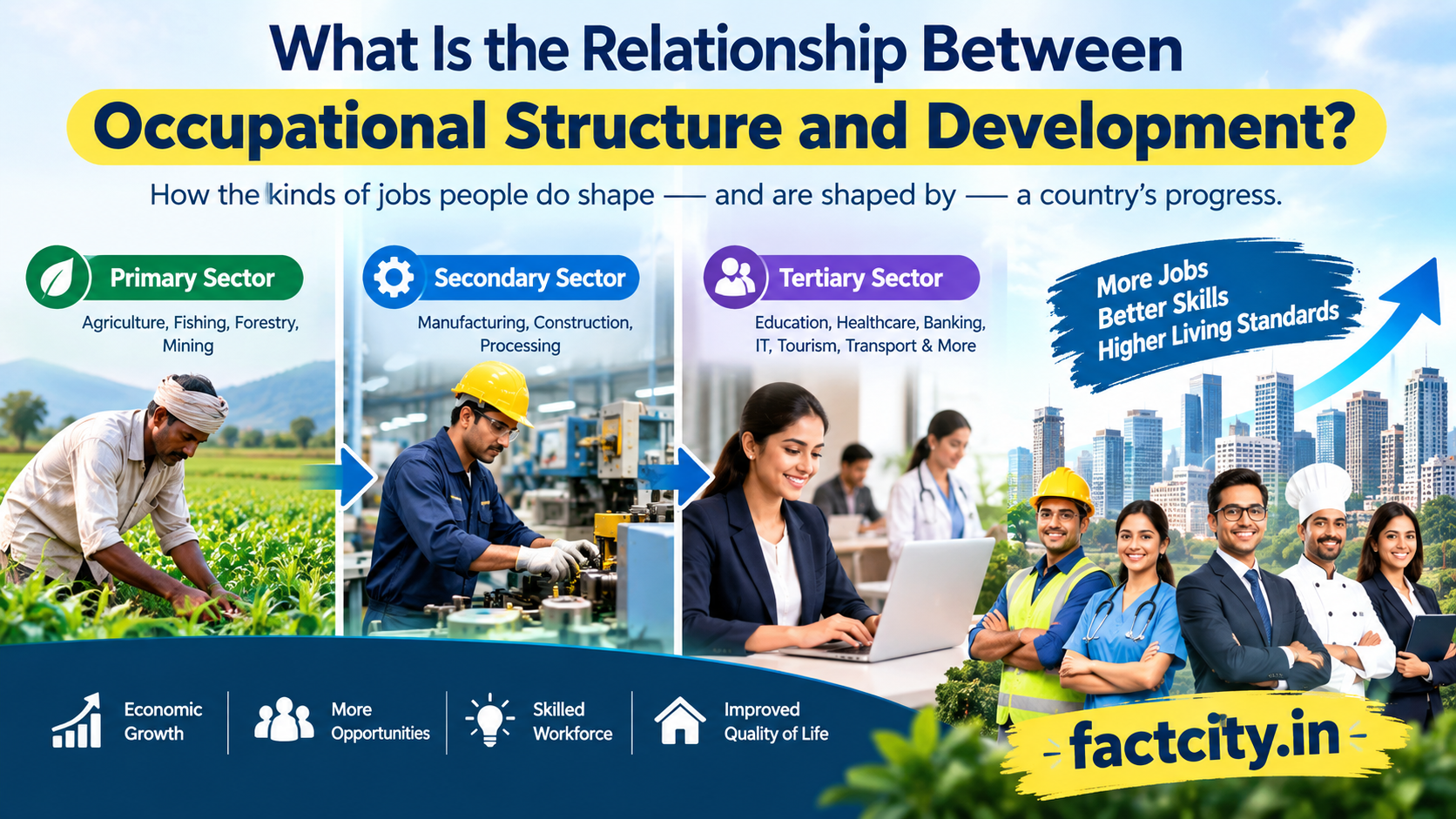
The occupational structure of a country shows the distribution of people across different types of work. Some work in agriculture, some work in manufacturing and construction, and many work in services such as education, healthcare, banking, technology, transport and tourism.
But what is the connection between occupational structure and development? The two are closely related, for the kind of jobs that people have often reflect the level of economic and social development of a country. As an economy matures, employment tends to shift from traditional activities to manufacturing, services, technology, and other higher productivity sectors.
This relationship is important for understanding how economies change over time and why employment patterns can be a useful indicator of development.
Occupational Structure Explained
The occupational composition is the distribution of workers across different occupations or economic sectors. It can be studied in different ways, but a common approach is to divide economic activities into three broad sectors:
Primary sector: agriculture, fishing, forestry, mining, and other resource-based activities.
Secondary sector: Industry, construction, processing, and other industrial activities.
Tertiary sector: Services including education, healthcare, banking, retail, transportation, tourism, communication and information technology. What is the relationship between occupational structure and development?
Some modern economies also consider knowledge-based activities like research, advanced technology, data services and professional management to be part of a wider quaternary sector.
Thus, the occupational composition of a country can tell us a lot about how its economy operates.
How does occupational structure relate to development?
The economic transformation provides the means for understanding the relationship between occupational structure and development.
In a number of low-income economies, a relatively large share of workers may depend on agriculture or other primary activities. Employment opportunities can be generated in manufacturing and services with growth of productivity, infrastructure, education, investment and industrialisation.
Over time, workers may shift from low-productivity activities to higher-productivity jobs that require more specialised skills.
This does not imply that all developing countries are following the same path. Countries can have different patterns depending on their natural resources, government policies, technology, education, population structure and global trade.
1. Economic Development May Reduce Dependence on Agriculture
Agriculture is an important part of food production and rural livelihoods, but the share of employment in agriculture in total employment generally declines as economies become more diversified.
Technological advances allow farmers to produce more with fewer workers. At the same time, companies in the industrial and service sectors can create alternative jobs.
For example, the person who worked only in agriculture may end up working in food processing, transportation, retail, construction, banking, education, or some other service.
Thus, a change in the occupational structure may be an indication of economic transformation.
2. Industrialisation Alters Employment Trends
Another important part of the relationship is industrialisation.
Factories and manufacturing companies are expanding, creating jobs in production, machine operation, maintenance, logistics, quality control, engineering, management and administration.
Also, the importance of the secondary sector in the economy can be highlighted.
Industrial development can create indirect jobs as well. A factory may require transportation companies, suppliers, warehouse workers, repair services, financial services, and other businesses.
This means that one growing industry can have an effect on employment in many parts of the economy.
3. The Growing Importance of Services in Developing Economies
One of the most striking changes in many modern economies has been the increasing significance of the service sector.
The service sector includes a wide range of jobs such as:
- University staff, teachers
- Doctors and health workers
- Bank workers
- Software engineers
- Retail workers’
- Lawyers Accountants
- Hotel and restaurant workers
- Workers in transportation
- Marketers
- Customer service employees
Economic development often increases the demand for these services.
With an increase in household income, people may spend more on education, healthcare, travel, entertainment, financial services, communication, and other activities. And businesses need more and more specialised professional services.
This can make the service sector a big source of jobs.
4. Educational Impact on Occupational Structure
Education is one of the main determinants of the types of occupations found in an economy.
A better educated and trained workforce can fill jobs that require special knowledge and skills. These may involve engineering, medicine, information technology, scientific research, finance, management and skilled trades.
With the development of countries’ education and training systems, there can be more diverse and specialised occupational structures.
But good quality jobs do not automatically result from education alone. We need businesses, investment, infrastructure and institutions that can create opportunities for skilled workers.
5. Technology Alters the Nature of Work
Another major factor relating occupational structure with development is technology.
Some tasks are repetitive and can be replaced by machines and digital systems, creating demand for new skills and occupations. Computers, automation, artificial intelligence, robotics, and digital communication have transformed the nature of jobs in manufacturing, banking, transportation, retail, media, and so many other fields.
For instance, a modern plant may need fewer people to perform the manual work of production but more technicians, engineers, software specialists, maintenance workers, and quality-control personnel.
This means that development does not just change the number of jobs. It can also change the skills required to do those jobs.
6. Occupational Composition and Productivity
Productivity is a broad term used to describe the efficiency of producing goods and services.
A country may have many workers working in agriculture, but if each produces only a small amount of output, productivity overall may be quite limited.
When workers shift into more productive industries and occupations, the economy can generate greater output with the same supply of labour.
This process is sometimes called structural transformation.
A successful transformation of the economy’s structure can bring higher incomes, better living standards and more economic opportunities. But the benefits depend on wages, working conditions, productivity, access to education and the availability of decent employment.
7. Urbanisation Has an Impact on the Occupational Structure
Urbanisation is often connected with economic development.
Cities tend to have a broader distribution of jobs in manufacturing, construction, transportation, retail, finance, education, health care, technology, and professional services.
As people migrate from rural to urban areas, their employment patterns may change.
This can create a cycle where urban economic activity drives jobs and a growing workforce drives demand for housing, transport, education, healthcare, and other services.
But fast urbanisation can also pose challenges such as informal employment, overcrowding, housing shortages, and pressure on public infrastructure.
8. How does occupational structure help in measuring development
The share of employment per sector can be a good indicator of the development of an economy.
For instance, an economy heavily dependent on low-productivity agriculture might have a very different occupational structure than an economy where most workers are employed in manufacturing, professional services, technology, healthcare, education and other specialised activities.
Economists therefore look at patterns of employment along with other indicators such as income, productivity, education, health, infrastructure, poverty and living standards.
Occupational structure should not be regarded as a complete measure of development by itself. A country may have a large services sector but still have inequality, informal employment or limited access to good jobs.
Occupational Structure and Change: A Simple Example
Let’s imagine two economies.
Economy A has a large number of people working in subsistence agriculture and not many people working in manufacturing or specialised services.
Economy B has more mechanisation in agriculture and a larger share of workers in manufacturing, health, education, finance, technology, transportation and other services.
The different occupational structures imply different stages and patterns of economic transformation.
But the comparison is not everything. We would also need to look at wages, productivity, working conditions, education, inequality, infrastructure, and the quality of public services.
Does development always decrease agricultural workers?
No, not really.
There is no rule that every country has to follow in the same way. Even a very developed country can be one where agriculture is economically important.
Technology can make agriculture very productive and at the same time use a relatively small share of the workforce. In some countries, agricultural products may also be an important part of exports.
Similarly, a large service sector does not mean that all service jobs are high-wage or high-productivity jobs.
“Not only the sector of employment, but also the quality and productivity of employment is important.
Why This Relationship Is Important
Understanding the relationship between occupational structure and development is useful to government, business, educators, and workers.
Governments can use employment information to identify skills shortages and plan education, infrastructure, and employment policies.
Businesses can see where potential workers and customers might be clustered in the future.
Educational institutions can prepare educational programs meeting the changing labor-market requirements.
Workers also benefit from understanding how technology, industrialisation and economic change are affecting demand for different skills.
Conclusion
So what is the relationship between occupational structure and development? Occupational structure, in a simple sense, is about the way people work in an economy; development, by contrast, often means changing the types of work available and the skills they require.
As economies transform, employment may become less tied to traditional primary activities and more diversified across manufacturing and services. This is affected by education, technology, urbanisation, investment, productivity and changing consumer demand.
At the same time, there is no common occupational structure of a developed economy. Countries can follow different development paths. We need to look at employment statistics as well as income, productivity, education, health, inequality, infrastructure and working conditions.