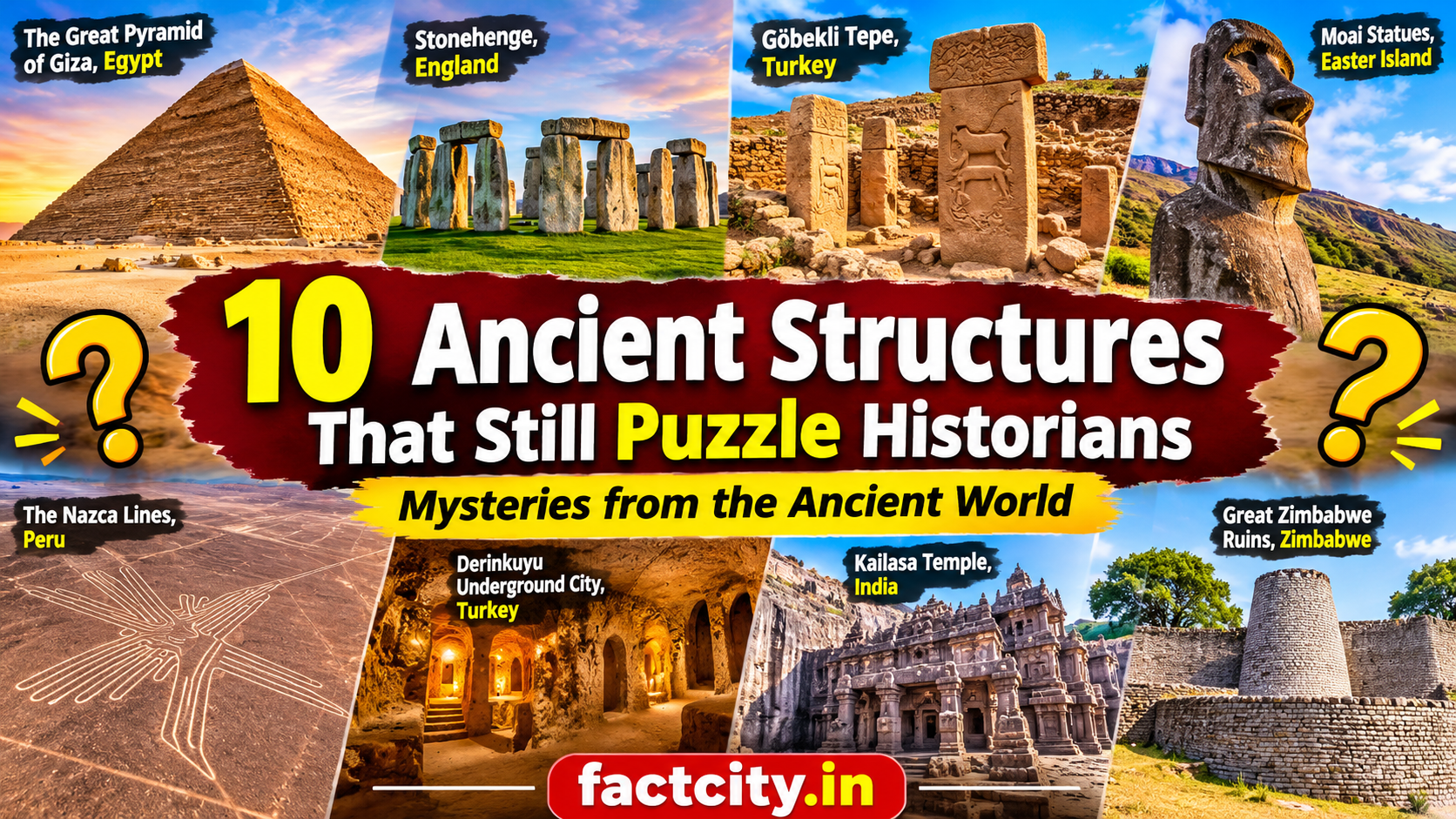
10 Ancient Structures Throughout human history, ancient civilizations have built extraordinary structures that continue to amaze people even thousands of years later. From enormous stone monuments and mysterious underground cities to temples carved directly into mountains, these remarkable creations show how intelligent, creative, and skilled ancient people were. Many of these structures were constructed without modern machines, electricity, or advanced construction equipment, making their achievements even more impressive.
Although historians and archaeologists have spent decades studying these ancient sites, several questions remain unanswered. Researchers still debate why certain structures were built, how enormous stones were transported, and what special purposes these places served. In many cases, scientists have discovered important clues, but the complete stories behind these monuments remain unclear.
These mysteries have inspired countless theories and attracted researchers from around the world. However, an unexplained detail does not mean an ancient structure was impossible to build. Ancient people had knowledge, practical skills, and engineering abilities that are sometimes underestimated today.
Here are 10 ancient structures that still puzzle historians and continue to reveal fascinating secrets about the past.
1. Göbekli Tepe, Turkey
Göbekli Tepe, located in southeastern Turkey, is one of the most fascinating archaeological discoveries in the world. This ancient site contains enormous T-shaped stone pillars arranged in circular and oval structures. Some pillars feature detailed carvings of animals, including foxes, snakes, birds, and other wild creatures. 10 Ancient Structures
What makes Göbekli Tepe especially interesting is its age. Archaeological evidence indicates that its monumental structures were built between approximately 9600 and 8200 BCE. This means the site was created more than 11,000 years ago, long before the construction of many famous monuments in Egypt and other ancient civilizations.
One of the biggest questions surrounding Göbekli Tepe is why hunter-gatherer communities invested so much effort in building such impressive monuments. Researchers believe the structures were probably connected with religious ceremonies, social gatherings, or other ritual activities. However, their exact purpose is still debated.
Another interesting mystery concerns how ancient communities organized themselves to quarry, transport, carve, and position such heavy stones. The discovery challenges older ideas about the development of organized societies and monumental architecture. Göbekli Tepe demonstrates that prehistoric communities were capable of remarkable construction projects.
2. Stonehenge, England
Stonehenge is one of the most recognizable ancient monuments in the world. Located on Salisbury Plain in Wiltshire, England, this prehistoric stone circle attracts millions of people through its history, architecture, and mysterious appearance.
The monument was constructed over several stages, beginning around 3000 BCE. Its enormous standing stones are arranged in a carefully planned formation, with some of the largest stones weighing approximately 25 tonnes. The smaller bluestones were transported from locations in Wales, hundreds of kilometers away.
The biggest mystery surrounding Stonehenge is how ancient people moved these enormous stones over such long distances. Without modern transportation equipment, lifting machines, or heavy vehicles, moving and positioning these stones would have required considerable planning and cooperation.
Researchers have also discovered that Stonehenge has important connections with the movement of the Sun. Its main axis is aligned with the direction of the midsummer sunrise and midwinter sunset. This suggests that the monument may have been used for seasonal ceremonies, religious gatherings, or astronomical observations.
Another question concerns the people who built it and the exact meaning of the monument in their society. Archaeologists have found evidence suggesting that Stonehenge was associated with burial practices and ceremonial activities. Nevertheless, its complete cultural significance remains uncertain.
3. The Great Pyramid of Giza, Egypt
The Great Pyramid of Giza is among the most impressive structures ever created by human civilization. Located near Cairo, Egypt, it was constructed during the reign of Pharaoh Khufu around the 26th century BCE. It originally stood approximately 146.6 meters tall, making it the tallest human-made structure in the world for thousands of years.
The pyramid contains millions of limestone blocks, with some granite blocks used in its internal chambers. Its enormous size, carefully arranged stones, and remarkable proportions continue to attract historians, architects, and engineers.
One of the most interesting questions is how ancient Egyptian workers transported and positioned such large quantities of stone. Researchers have proposed different construction methods involving ramps, sledges, ropes, and organized labor. Archaeological evidence also shows that ancient Egyptians had sophisticated knowledge of construction and resource management.
Another subject of discussion is the pyramid’s internal design. It contains several chambers and passages, including the King’s Chamber and Grand Gallery. Modern scanning technologies have also identified previously unknown internal spaces, creating new questions about the structure’s design.
Although historians understand that the Great Pyramid served as the tomb of Pharaoh Khufu, some details about its construction process remain uncertain. Its remarkable accuracy and enormous scale make it one of the most fascinating ancient structures in human history.
4. The Nazca Lines, Peru
The Nazca Lines are enormous drawings created across the desert plains of southern Peru. These mysterious geoglyphs include animals, geometric patterns, straight lines, and human-like figures. Some designs extend hundreds of meters across the ground.
They were created mainly by the ancient Nazca culture between approximately 500 BCE and 500 CE. The people made these designs by removing the dark surface stones to reveal the lighter-colored ground underneath.
One of the most fascinating features of the Nazca Lines is their enormous size. Many designs are difficult to recognize from ground level, which raises questions about how their creators planned and measured such large images.
The most famous figures include a hummingbird, spider, monkey, and condor. Researchers have suggested that the lines may have been connected to religious ceremonies, water-related beliefs, agricultural practices, or ritual journeys through the desert.
Some researchers believe certain designs may have had astronomical connections, although not every proposed alignment has strong scientific support.
The exact meaning of many figures remains uncertain. Why did the Nazca people create such enormous drawings, and what did these designs represent in their culture? These questions continue to make the Nazca Lines one of the world’s most interesting archaeological mysteries.
5. Puma Punku, Bolivia
Puma Punku is an ancient archaeological complex located near Lake Titicaca in Bolivia. It forms part of the larger Tiwanaku archaeological site, which was an important center of an ancient Andean civilization.
The site is famous for its unusually shaped stone blocks. Some stones feature carefully cut surfaces, precise corners, and complex geometric shapes. Certain blocks also contain carved openings and interlocking designs that make the construction especially interesting.
One reason Puma Punku continues to attract attention is the apparent precision of its stonework. Visitors often wonder how ancient builders managed to shape hard stones without modern industrial machinery.
Archaeological research connects Puma Punku with the Tiwanaku civilization, which developed in the region over many centuries. The construction of the complex is generally associated with the first millennium CE, particularly its later centuries.
However, questions remain about the exact construction techniques used, how the stones were transported, and how the different sections of the complex originally fitted together.
The site has also suffered damage and stone removal over time, making it more difficult to reconstruct its original appearance. Although many popular stories exaggerate its mysteries, Puma Punku remains an impressive example of ancient engineering and craftsmanship.
6. The Moai Statues of Easter Island
Easter Island, also known by its Polynesian name Rapa Nui, is famous for its enormous stone statues called Moai. These impressive figures were carved by the island’s Polynesian inhabitants and are among the most recognizable ancient monuments in the world.
Hundreds of Moai statues are scattered across the island. Many were carved from volcanic rock at the Rano Raraku quarry, while others were transported to different locations and placed on ceremonial platforms known as ahu.
Some statues weigh many tonnes, and the largest completed examples are especially impressive because of their enormous size.
One of the biggest questions about the Moai statues is how ancient islanders transported them from the quarry to their final locations. Different explanations have been suggested, including the use of wooden equipment, ropes, and coordinated groups of workers.
Experiments have demonstrated that some statues could potentially be moved upright using ropes and a rocking motion. This supports traditional ideas that the island’s inhabitants developed practical methods suited to their environment.
Another interesting question concerns the cultural and religious meaning of the statues. Many researchers believe the Moai represented important ancestors and were connected with the social and spiritual life of the Rapa Nui people.
Although researchers understand much more about their history today, questions about individual statues, transportation methods, and ceremonial practices remain.
7. The Underground City of Derinkuyu, Turkey
Derinkuyu is one of the most extraordinary underground structures ever discovered. Located in the Cappadocia region of central Turkey, this ancient underground city extends deep beneath the surface and contains numerous interconnected rooms, tunnels, storage areas, and ventilation systems.
The underground complex has several levels, with archaeological investigations revealing a sophisticated arrangement of spaces. It includes areas believed to have served as kitchens, living quarters, storage rooms, and places of worship.
One of its most interesting features is the ventilation system. Vertical shafts helped bring fresh air into the underground areas, allowing people to occupy spaces far below ground level.
Large circular stone doors were also used to block certain passageways from the inside. These features suggest that the underground city could provide protection during dangerous periods.
Although the region has a long history of underground habitation, the exact development of Derinkuyu and the dates of its earliest sections are not completely established. The underground city was expanded and used during different historical periods.
Historians believe it provided shelter during times of conflict and insecurity. However, questions remain about how its original sections were planned, how large groups were organized underground, and how people managed daily life in such an unusual environment.
Derinkuyu is a powerful example of how ancient communities adapted architecture to protect themselves and survive difficult conditions.
8. The Temple of Baalbek, Lebanon
Baalbek is an ancient archaeological site in Lebanon, famous for its enormous Roman temples and impressive stone foundations. In ancient times, the city was known as Heliopolis and became an important religious center.
The Temple of Jupiter is particularly famous for its enormous supporting stones. Three massive limestone blocks, known as the Trilithon, form part of the temple’s foundation. Each block weighs hundreds of tonnes, making their size remarkable even by modern engineering standards.
Nearby quarries also contain some of the largest ancient stone blocks ever discovered. One unfinished block, often called the Stone of the Pregnant Woman, weighs more than 1,000 tonnes.
The biggest question is how ancient builders managed to extract, transport, and position stones of such extraordinary size. Historians have proposed different explanations involving ramps, rollers, levers, and large organized labor forces.
However, the exact methods used for moving the heaviest blocks remain a subject of investigation.
Baalbek is not an unexplained construction from an unknown civilization. Its major monumental buildings are strongly associated with Roman-period architecture, although the site has a much longer history of human activity.
Its enormous stones continue to demonstrate the engineering abilities and organizational skills of ancient builders.
9. The Great Zimbabwe Ruins, Zimbabwe
Great Zimbabwe is one of Africa’s most important archaeological monuments. Located in modern-day Zimbabwe, this ancient stone city was a major center of political, economic, and cultural activity between approximately the 11th and 15th centuries CE.
The site is famous for its enormous dry-stone walls, which were constructed without using mortar. The stones were carefully arranged to create strong and impressive structures, including the Great Enclosure and Hill Complex.
The Great Enclosure is particularly remarkable because of its massive curved walls and impressive architectural design. Some sections of the walls rise several meters above the ground.
For many years, Great Zimbabwe was connected with different historical theories, but archaeological evidence clearly establishes that it was built by African communities associated with the Shona-speaking peoples of the region.
One important question concerns how the city was organized and how its economy supported such a large settlement. Archaeological discoveries, including imported objects, suggest that Great Zimbabwe participated in extensive trading networks connecting the African interior with coastal regions and the wider Indian Ocean world.
Researchers continue to investigate its political structure, social organization, and the factors that contributed to its decline.
Great Zimbabwe is a reminder that ancient African societies developed sophisticated architecture, trade systems, and political centers long before the modern period.
10. The Kailasa Temple, India
The Kailasa Temple at Ellora in Maharashtra, India, is one of the most extraordinary examples of ancient rock-cut architecture. Unlike ordinary temples built by placing stones together, this remarkable structure was carved directly out of a massive rock formation.
The temple is traditionally associated with the Rashtrakuta ruler Krishna I and is generally dated to the 8th century CE. It forms part of the Ellora Caves, a remarkable collection of Buddhist, Hindu, and Jain monuments.
The Kailasa Temple is dedicated to Lord Shiva and was designed to resemble Mount Kailash, which holds great importance in Hindu religious traditions.
One of its most impressive features is its construction method. Workers removed enormous quantities of rock from the surrounding hillside to reveal the temple within the original stone. The complex includes detailed sculptures, pillars, courtyards, gateways, and beautifully decorated architectural elements.
The biggest question for many visitors is how ancient craftsmen planned such a complicated structure before beginning the excavation. Because the temple was carved from the top downward, mistakes could have been extremely difficult to correct.
Historians understand much about its historical background and religious importance, but the precise sequence of construction, workforce organization, and detailed engineering methods continue to attract scholarly attention.
The Kailasa Temple demonstrates the extraordinary artistic vision and technical skills of ancient Indian craftsmen.7-strange-time-related-facts-around-the-world
Why Do Ancient Structures Still Puzzle Historians?
Ancient structures continue to fascinate researchers because they provide only part of the story of the civilizations that created them. Buildings, stone carvings, inscriptions, and archaeological remains offer valuable evidence, but they do not always explain the original intentions of their builders.
In many cases, written records have disappeared or were never created. This makes it difficult to understand exactly how people organized large construction projects, what certain symbols represented, and how important monuments were used in everyday life.
Another reason is that ancient engineering techniques were often different from modern methods. Builders relied on human labor, simple tools, careful planning, and generations of practical experience. Modern researchers can recreate some of these techniques through experiments, but the precise methods used at every individual site are not always known.
Climate change, natural disasters, wars, and centuries of human activity have also damaged many ancient structures. As a result, archaeologists sometimes have to reconstruct the original appearance of monuments using incomplete evidence.
New technologies such as satellite imaging, laser scanning, ground-penetrating radar, and advanced dating methods are helping researchers discover details that were previously difficult to identify.
Conclusion
The 10 ancient structures that still puzzle historians show just how remarkable human creativity and engineering have been throughout history. From the prehistoric stone pillars of Göbekli Tepe to the enormous pyramids of Egypt and the rock-cut Kailasa Temple in India, these monuments reveal the intelligence, determination, and cultural achievements of ancient communities.
Although modern archaeology has answered many questions about these places, some mysteries remain. Researchers are still investigating their construction techniques, cultural meanings, and original purposes.
Perhaps the most fascinating lesson is that ancient people were far more capable than many people once imagined. They created extraordinary monuments using the knowledge, tools, and resources available to them. As new discoveries continue to emerge, these ancient structures may reveal even more secrets about the civilizations that shaped human history.