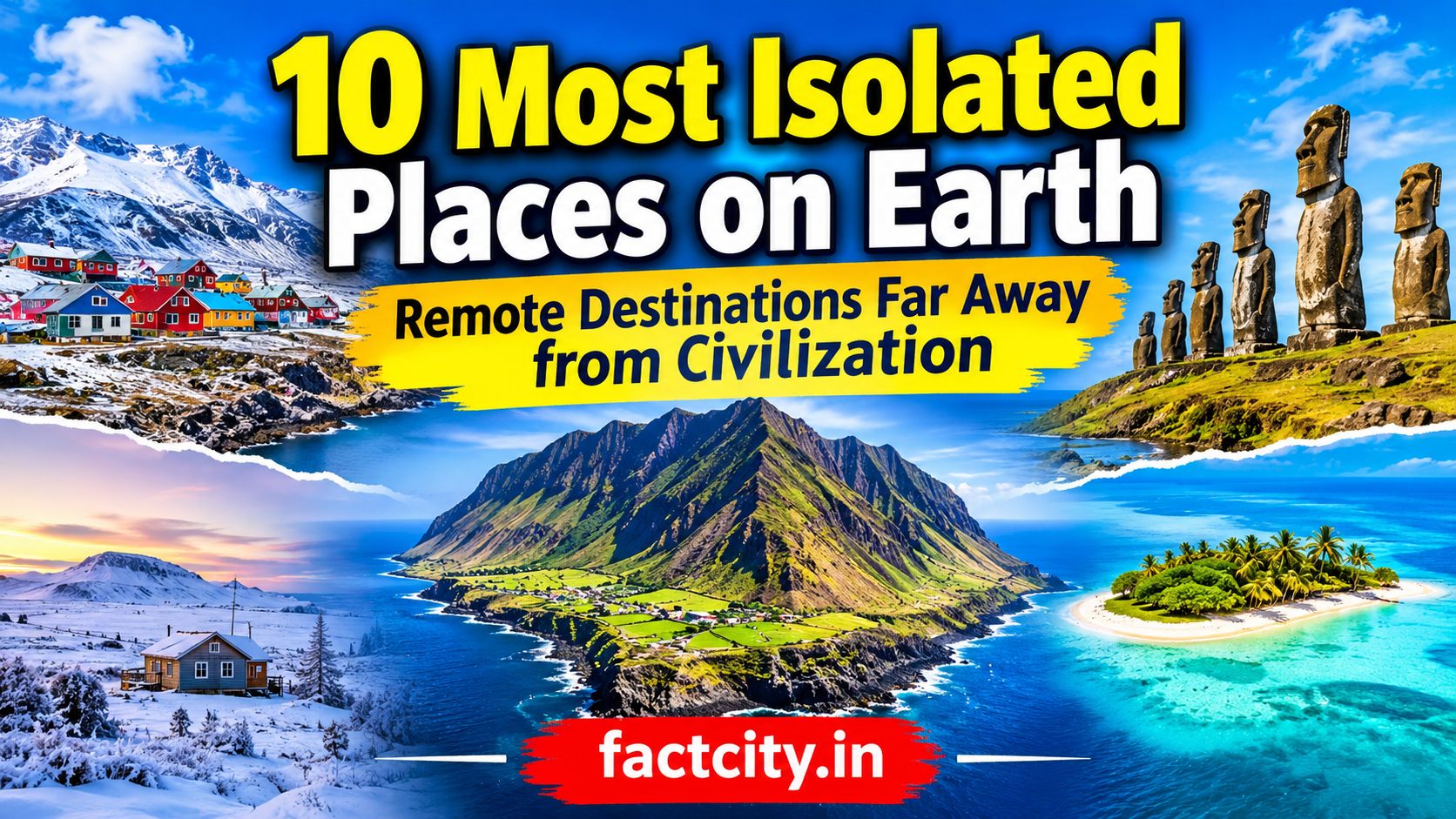
10 Most Isolated Places on Earth: Our planet is full of incredible destinations, but some places are so remote that reaching them can take days of travel. Far away from crowded cities, busy roads, shopping centres, and modern conveniences, these locations offer a completely different way of life. Some are surrounded by endless oceans; others are hidden among frozen landscapes, towering mountains, or vast deserts. In many of these places, nature remains powerful, and human settlements are extremely small.
The most isolated places on Earth are fascinating for several reasons. Some have only a handful of permanent residents, while others are home to communities that have preserved their traditional lifestyles for generations. A few are so difficult to reach that visitors must depend on ships, small aircraft, or long journeys across challenging terrain.
Although modern technology has made the world more connected, these remote destinations remind us that there are still places where life moves slowly and nature dominates everyday existence. Here are 10 of the most isolated places on Earth that will make you appreciate just how diverse and extraordinary our planet really is.
1. Tristan da Cunha, South Atlantic Ocean
Tristan da Cunha is widely recognised as one of the most isolated inhabited places on Earth. Located in the South Atlantic Ocean, this volcanic island is approximately 2,400 kilometres from Saint Helena and around 2,800 kilometres from the coast of South Africa. Its remote location makes ordinary travel extremely difficult, even for people who enjoy exploring unusual destinations.
The island’s main settlement is called Edinburgh of the Seven Seas. It is home to a small community of residents who live a relatively simple lifestyle. There is no commercial airport on the island, so visitors generally have to travel by ship, often taking several days from Cape Town. Weather conditions can also affect travel schedules, making journeys unpredictable.
Despite its isolation, Tristan da Cunha has a school, a hospital, a small shop, and other essential facilities. Fishing, farming, and local community activities play important roles in everyday life. Its dramatic volcanic scenery, green landscapes, and surrounding ocean make it one of the most extraordinary remote destinations in the world.
2. Pitcairn Islands, Pacific Ocean
The Pitcairn Islands are among the smallest and most isolated inhabited island communities in the world. Located in the southern Pacific Ocean, this British Overseas Territory consists of four main islands, but only Pitcairn Island has a permanent population.
The settlement of Adamstown is the centre of everyday life on the island. Its population is very small, with residents living in a close-knit community where people often know one another. The island is particularly famous for its historical connection to the mutiny on the HMS Bounty in 1789. Descendants of the mutineers and their Tahitian companions make up much of its population.
Reaching Pitcairn is not easy because the island does not have an airport. Travellers generally fly to French Polynesia before continuing their journey by sea. The surrounding waters are beautiful, with clear ocean views, marine life, and rugged coastal landscapes. Life here is very different from life in a modern city, as residents depend on community cooperation and carefully managed supplies.
3. Easter Island (Rapa Nui), Chile
Easter Island, also known by its Indigenous name Rapa Nui, is one of the most mysterious and geographically isolated inhabited islands in the Pacific Ocean. It belongs to Chile and is famous throughout the world for its enormous stone statues, known as moai.
The island is located thousands of kilometres from mainland Chile, making it one of the most remote inhabited territories in the world. Its isolation has helped preserve a distinctive cultural identity, including traditional stories, language, archaeological sites, and local customs.
The moai statues are the island’s most recognisable attraction. These impressive stone figures were created by the early Rapa Nui people and are believed to have represented important ancestors or community leaders. Some stand along the coastline on large ceremonial platforms, creating an unforgettable view.
Although Easter Island is remote, it has an airport and receives visitors from different parts of the world. Tourism is an important part of its economy, but protecting its cultural heritage and natural environment remains essential. Its combination of ancient history, mysterious monuments, and isolated location makes it a fascinating destination.
4. Ittoqqortoormiit, Greenland
Located on the eastern coast of Greenland, Ittoqqortoormiit is one of the most isolated settlements in the Arctic. Surrounded by mountains, frozen landscapes, and enormous fjords, this small town experiences some of the harshest living conditions found in inhabited communities.
The settlement is home to a small population, and its location makes regular transportation difficult. There are no ordinary roads connecting it to other Greenlandic towns. Travel often depends on helicopters, boats, and snowmobiles, depending on the season and weather conditions.
During winter, the surrounding sea may become covered with ice, while temperatures can fall far below freezing. The region is also close to Northeast Greenland National Park, one of the largest protected natural areas on the planet.
Traditional hunting and fishing have historically played important roles in local life. Today, residents also depend on modern services and supplies brought from outside the community. For visitors, Ittoqqortoormiit offers an unusual opportunity to experience Arctic landscapes, wildlife, and a way of life shaped by extreme weather.
5. Supai Village, United States
Supai Village is one of the most unusual remote communities in the United States. Located deep inside the Grand Canyon in Arizona, it is the home of the Havasupai people. Unlike most American settlements, Supai is not connected to the outside world by an ordinary road.
Visitors generally have to reach the village by hiking along a challenging trail, travelling by helicopter when available, or using other authorised transportation arrangements. Supplies and mail have traditionally been transported using pack animals, including mules.
One of the most beautiful features of the area is its turquoise-coloured waterfalls, especially Havasu Falls. The bright blue-green water contrasts with the surrounding red canyon walls, creating a spectacular natural landscape.
Despite its remote location, Supai is a living community with its own culture, traditions, and local administration. Visitors must follow tribal rules and obtain the required permits before travelling. The village demonstrates how some communities continue to maintain their identity and connection to their land despite being surrounded by difficult terrain.
6. Oymyakon, Russia
Oymyakon is a small settlement in the Sakha Republic of eastern Siberia, Russia. It is internationally known for its extremely cold winters and is often described as one of the coldest permanently inhabited places on Earth.
Winter temperatures can fall below minus 50 degrees Celsius, and the region has recorded temperatures close to minus 67.7 degrees Celsius. Such freezing conditions make ordinary activities challenging. Cars may need special attention, water pipes can freeze, and residents must wear heavy winter clothing to protect themselves from the cold.
The village is surrounded by mountains and vast natural landscapes. Its distance from major cities and its severe climate make travelling there a difficult experience, particularly during winter.
Despite the harsh environment, people continue to live and work in Oymyakon. Reindeer herding, animal husbandry, and other traditional activities have historically been important to the local economy. The settlement is a remarkable example of how human communities can adapt to some of the coldest conditions on the planet.
7. Alert, Canada
Alert is one of the northernmost permanently staffed settlements in the world. Located on Ellesmere Island in Nunavut, Canada, it lies approximately 817 kilometres from the North Pole. Its extreme northern location makes it one of the most isolated places where people regularly live and work.
Unlike ordinary towns, Alert is primarily a military and research station rather than a traditional residential community. The people stationed there work in areas such as military communications, weather monitoring, and scientific research.
The environment is extremely challenging. Winters are long and dark, temperatures can drop dramatically, and the landscape is covered in snow and ice for much of the year. During the polar night, the sun remains below the horizon for an extended period, while summer brings continuous daylight.
Getting to Alert is difficult because it has no regular commercial passenger flights. Access is generally arranged through specialised military or government transportation. Its location makes it particularly valuable for Arctic monitoring and scientific observations.
8. Kerguelen Islands, Southern Indian Ocean
The Kerguelen Islands are among the most isolated island groups in the southern Indian Ocean. They belong to the French Southern and Antarctic Lands and are located far away from major continents and busy shipping routes.
Often called the Desolation Islands, Kerguelen is famous for its rugged mountains, enormous glaciers, strong winds, and dramatic coastline. The landscape looks almost untouched, with very little permanent human development.
Unlike many remote destinations, Kerguelen does not have a normal permanent civilian population. Instead, researchers, technical workers, and support staff stay at the Port-aux-Français research station, usually for limited periods.
The islands are scientifically important because researchers study the climate, glaciers, ocean conditions, and wildlife found in the region. Seabirds, penguins, seals, and other marine animals are part of its remarkable ecosystem.
There is no commercial airport serving the islands. Access is mainly provided by specialised research and supply vessels, which makes reaching Kerguelen a major logistical challenge. Its isolation has helped preserve an unusual natural environment that is valuable for scientific research.
9. Palmerston Island, Cook Islands
Palmerston Island is a tiny coral atoll located in the South Pacific Ocean and forms part of the Cook Islands. It is surrounded by a beautiful turquoise lagoon, coral reefs, and open ocean. Despite its tropical beauty, the island is extremely isolated from the outside world.
The island has a very small community, and many residents are descendants of William Marsters, an Englishman who settled there in the nineteenth century. Over generations, this small population developed a close-knit society with strong family connections and shared traditions.
There is no commercial airport on Palmerston, so reaching the island usually requires a long journey by boat. Supply ships do not arrive every day, which means residents must plan carefully and make the best use of available resources.
Fishing and community cooperation remain important parts of everyday life. Although modern communication has improved connections with the outside world, the island still offers a lifestyle that is very different from that of large cities.
Palmerston is a reminder that a beautiful tropical location does not necessarily mean easy access or modern convenience.
10. Point Nemo, Pacific Ocean
Point Nemo is perhaps the most fascinating location on this list because it is not an island, town, or village. It is a geographical point in the South Pacific Ocean known as the oceanic pole of inaccessibility. In simple words, it is the point in the ocean that lies farthest from any land.
Point Nemo is approximately 2,688 kilometres from the nearest landmasses. These include Ducie Island, Motu Nui near Easter Island, and Maher Island near Antarctica. The surrounding region is so remote that there are often no ships or human settlements nearby.
The name Nemo comes from Captain Nemo, the fictional character from Jules Verne’s famous novel Twenty Thousand Leagues Under the Sea. It is also associated with the Latin word meaning “no one.”
One particularly interesting fact about Point Nemo is its connection to space exploration. Because the area is extremely far from populated land, it has been used as a target region for controlled spacecraft re-entries. Some retired satellites and space equipment have been directed towards this remote part of the Pacific.
Unlike the other places on this list, Point Nemo has no permanent residents, buildings, or tourism facilities. It is simply an isolated location in the middle of an enormous ocean, showing just how vast and unexplored parts of our planet can be.
Why Are Some Places on Earth So Isolated?
There are several reasons why certain destinations remain separated from the rest of the world. Geography is one of the biggest factors. Islands surrounded by thousands of kilometres of ocean have limited transportation options, while mountain settlements may be difficult to reach because of steep roads, snow, and dangerous weather.
Climate also plays an important role. Extremely cold destinations such as Oymyakon and Alert experience freezing temperatures that make construction, transportation, and everyday activities challenging. In some regions, the weather is so unpredictable that travel becomes impossible for certain periods.
Another important reason is the desire to protect traditional lifestyles and natural environments. Some remote communities prefer to maintain their cultural identity and limit outside development. Others are protected areas where human activity is restricted to preserve wildlife and ecosystems.
What Makes These Remote Places So Interesting?
The most isolated places on Earth offer something that busy cities cannot easily provide: a closer connection with nature and a completely different experience of everyday life. Some are famous for their beautiful beaches and clear waters, while others attract attention because of their extreme temperatures, unique wildlife, or fascinating history.
These locations also help scientists understand the natural world. Researchers travel to remote islands, Arctic settlements, and isolated oceans to study climate change, wildlife, glaciers, and environmental conditions. Their findings can help us understand how our planet is changing.
At the same time, these destinations remind us that modern facilities and easy transportation are not available everywhere. People living in isolated communities often depend on cooperation, careful planning, and traditional knowledge to manage everyday challenges.
Frequently Asked Questions (FAQs)
1. What is the most isolated inhabited place on Earth?
Tristan da Cunha is widely recognised as one of the most isolated permanently inhabited island communities on Earth. It is located in the South Atlantic Ocean, approximately 2,400 kilometres from Saint Helena.
2. Which is the most isolated place in the Pacific Ocean?
Point Nemo is the oceanic pole of inaccessibility in the South Pacific Ocean. It is approximately 2,688 kilometres from the nearest land.
3. What is the coldest inhabited place on Earth?
Oymyakon in eastern Siberia, Russia, is widely known as one of the coldest permanently inhabited settlements in the world. Winter temperatures can fall below minus 50 degrees Celsius.
4. Can tourists visit the most isolated places on Earth?
Yes, some remote destinations, including Tristan da Cunha, Pitcairn Island, Easter Island, and Supai Village, can be visited. However, travellers may need special permits, advance arrangements, and suitable transportation. incredible-discoveries-found-beneath-the-earth
5. Why do people live in isolated places?
People live in remote locations for many reasons, including family history, cultural traditions, employment, fishing, farming, and scientific research. Many communities have existed in these locations for generations.
Final Thoughts
The 10 most isolated places on Earth show that our planet is much bigger and more diverse than most people imagine. From the volcanic island of Tristan da Cunha to the frozen landscapes of Greenland and the endless waters surrounding Point Nemo, every destination has its own unique story.
Some places are difficult to reach because of their geographical location, while others are challenging because of extreme weather and natural conditions. Yet people continue to live, work, and explore these extraordinary environments.
In a world where technology connects almost everyone, these remote destinations remind us that there are still corners of Earth where nature remains in control and life follows a completely different rhythm.