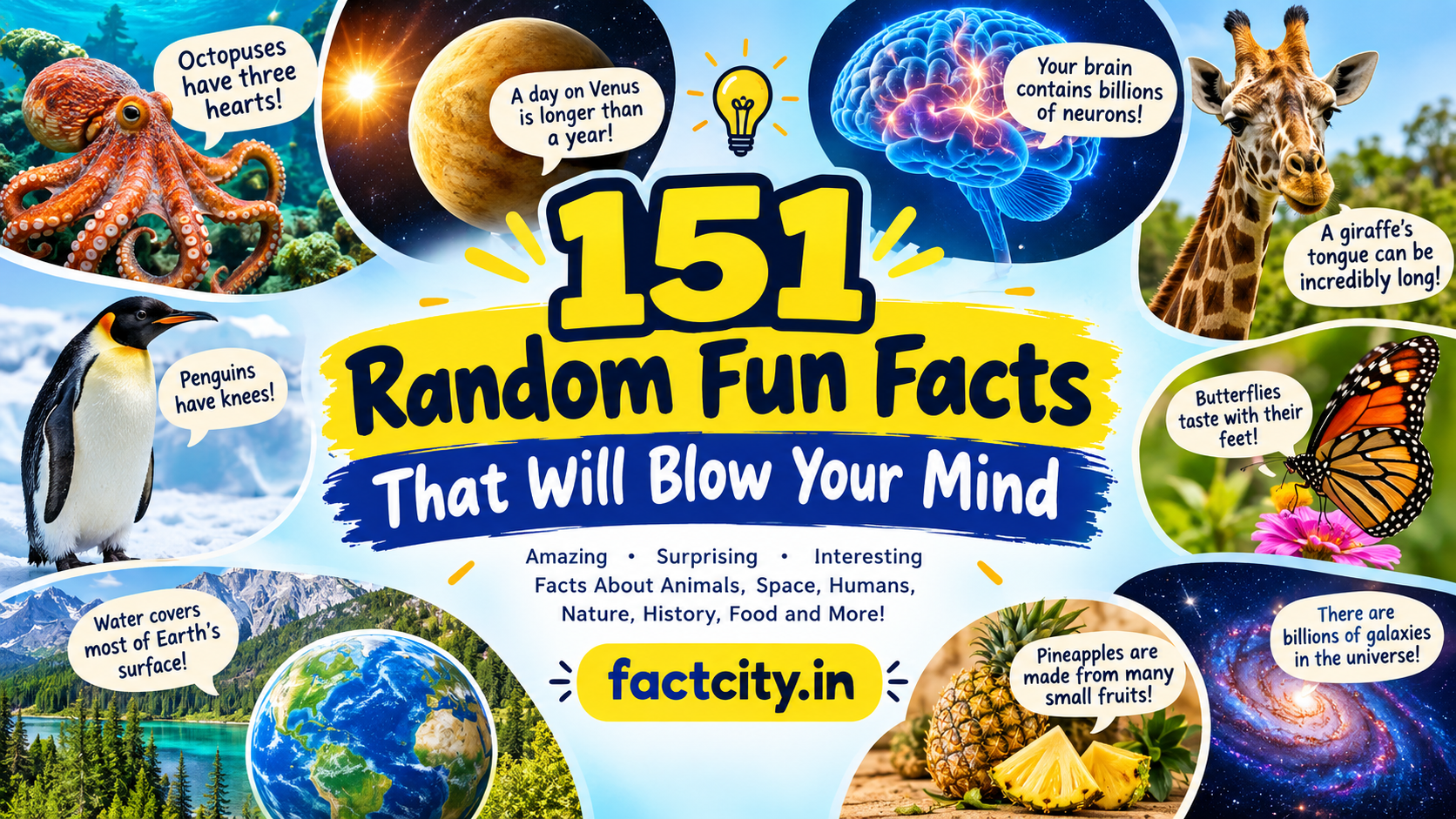
151 random fun facts that will blow your mind. There are many strange, surprising, and fascinating details in the world that can totally alter the way we see everyday life. There is always something fascinating to discover, from animals with strange powers to amazing discoveries about space, nature, food, history, and the human body. If you love learning information that makes you stop and say “Wow!”, these 151 random fun facts that will blow your mind are just right for you.
Awesome Animal Facts
Animals can do some really amazing things. Octopuses are a great example; they have three hearts, and two of those hearts are primarily used to help push blood to their gills. Even more remarkably, butterflies have taste sensors on their feet. This enables them to find suitable plants when they visit flowers or leaves. “151 random fun facts that will blow your mind“
Giraffes have very long tongues to help them reach leaves on trees, and penguins have knees, but they are hidden inside their bodies. Only a few birds can fly backward, and hummingbirds are among them, so their flying skills are very impressive. Goats have rectangular pupils which give them a wide field of vision.
Sometimes sea otters hold hands when they sleep or rest in groups so they don’t drift apart. Wombats are one of the weirdest animal facts out there, as they poop in cubes. Male seahorses carry developing babies in a special pouch. Female seahorses transfer eggs to the male.
Ravens have a good memory for particular people and situations. Crows have been observed using tools and solving problems. Dolphins use a variety of sounds to communicate, and elephants are able to recognize themselves in mirrors. Some frogs can live through being frozen, and axolotls can regrow parts of their bodies.
But butterflies are not the only animals with weird senses. Cats use their whiskers to feel things and places around them. Snakes have special organs to sense heat from other animals. Some spiders can fly through the air by spinning silk threads, and ants can establish systems of farming by cultivating fungi for food.
Amazing Human Body Facts
Another fascinating topic with many interesting facts is the human body. Your skin is the largest organ in your body, and it’s always replacing old cells. Human bones are living tissues that constantly repair and remodel themselves during life.
Most adults have 206 bones, but babies are born with more. Some bones fuse together as you get older. Your teeth are one of the hardest things in your body. Your ears do more than help you hear. They also play an important role in balance.
The average human heart beats millions of times in a lifetime. Your brain has billions of neurons communicating with each other via electrical and chemical signals. Interestingly, the brain itself has no pain receptors, although it processes pain signals from the rest of the body.
We blink our eyes thousands of times a day, usually without even knowing it. Fingernails usually grow faster than toenails, and fingerprints form before birth. Another interesting body response, and one that’s linked to an old biological reaction that was more useful to our ancestors, is goosebumps.
Your stomach makes strong acid to help break down food. Your liver has hundreds of important functions. The human body is also host to trillions of microorganisms that live on and inside us. These little organisms are part of the human microbiome and can affect many parts of our biology.
Mind-Boggling Space Facts
Some of the most astonishing facts known to science are in space. Sunlight takes about eight minutes to travel from the Sun to Earth, which contains almost all the mass in our solar system.
Mercury is closer to the Sun, but Venus is the hottest planet in the solar system. One of the oddest things about Venus is that it rotates more slowly on its axis than it travels around the Sun. Mars has a day that’s just a little bit longer than the day on Earth. Jupiter is the largest planet in our solar system.
Saturn is well known for its stunning rings. These are composed largely of innumerable chunks of ice and rocky debris. Mars boasts Olympus Mons, one of the largest known volcanoes in the solar system, while Neptune is known for its extremely powerful winds.
Every year the Moon is slowly moving away from the Earth, but the difference is tiny. And astronauts can also get a little taller in space as their spines stretch in microgravity. The universe itself is expanding too, and scientists believe that there are a huge number of galaxies in the observable universe.
Black holes are one of the most mysterious things in space. Their gravity is so strong that once something is past the horizon of the event, not even light can escape. Stars are in a constant state of change as well, being born, evolving, and eventually dying.
Amazing Nature Facts
There are natural wonders on Earth that seem almost impossible. Earth is seen as a blue planet from space because about 71 percent of the Earth’s surface is covered by water. Rainbows are beautiful colors in the sky caused by sunlight bouncing off water droplets.
The molecular makeup of frozen water usually causes snowflakes to form six-sided crystal patterns. Lightning can heat the air around it to extremely high temperatures, making it briefly much hotter than the surface of the Sun.
Bamboo is a member of the grass family, but some species can grow taller than most trees. Venus flytraps are carnivorous plants that catch insects. Some plants can close their leaves when they are touched.
Trees can reach out to fungi in the soil to create networks that allow plants to trade nutrients and chemical signals. And some seeds can lie dormant for years until the right conditions arrive in the environment. Tectonic plates move slowly and change the Earth’s surface. Volcanoes can form new land.
The deepest parts of the oceans are still difficult to explore. Scientists are still discovering strange marine creatures and unknown ecosystems in deep water. Some clouds may look light and fluffy from the ground, but they can contain a lot of water.
Surprising Facts About Food
Food holds a lot of interesting secrets. Botanically speaking, bananas and cucumbers are fruits, while strawberries are not technically berries. Tomatoes are also fruits, but are usually treated as vegetables in cooking.
Pineapples are made up of many tiny fruits that have fused together. Apples float because a lot of their volume is air. Peanuts are nuts, but they are actually legumes, and cashews grow attached to the bottom of the cashew apple.
Vanilla comes from an orchid and chocolate is from the seed of a cacao pod. Popcorn pops because the moisture inside each kernel turns to steam when heated. Bees produce honey from nectar, and if stored correctly, it will stay edible for a long time.
In the history of carrots, there have been a rainbow of colors, from purple to yellow. Potatoes were first cultivated in South America thousands of years ago. Salt has been used as a seasoning and food-preservation agent by humans for centuries.
Interesting Facts About History
Discoveries and inventions have taken place throughout the course of human history that affect our lives today. The ancient Egyptians wrote on papyrus. The Romans built great roads, buildings, bridges, and water systems.
The Great Pyramid of Giza, thousands of years old, still stands as one of the world’s most renowned ancient structures. These ancient civilizations also made great advances in mathematics, astronomy, agriculture, architecture, and medicine.
Paper was developed in ancient China and later made its way to other parts of the world. Later, the invention of the printing press revolutionized communication by making it much easier to reproduce written material.
People have used calendars for thousands of years to understand the seasons and schedule important dates. Archeologists are discovering lost settlements, artifacts, and cities and ancient libraries that long predate the modern public library.
The Olympic Games originated in ancient Greece, and modern technology often builds on ideas thought of centuries ago. Some ancient Roman concrete structures have lasted for an astonishingly long time, showing how advanced construction methods could be.
Random facts about daily life
“Even everyday things and experiences can be surprisingly interesting. When you shuffle a deck of playing cards, there is an extremely large number of arrangements of the cards. A standard deck contains 52 cards.
SOUND moves faster in water than it does in air, and light moves much faster than SOUND. That’s why when a storm’s coming, you see the lightning before you hear the thunder.
Solid water is less dense than liquid water, so ice floats. Water expands when it freezes, so freezing water can sometimes break containers or damage rocks.
Magnets have two basic poles, called north and south. It’s the static electricity that makes your hair stand up. Soap works because the molecules can “attach” to the water and the oils
The smell that often follows rain is called petrichor. In fact, a rainbow can form a complete circle, but people standing on the ground see only an arc. Glass can be recycled over and over again without any loss in quality. facts-characteristics
While a smartphone may appear to be a small device, it is made up of many parts and materials that come from complex global supply chains. The internet also connects billions of people and devices across the globe, making information available almost instantly.
More Fun Facts To Keep You Wondering
Some things are simply fun facts. Flamingos are known to collect in flocks called flamboyances, and crows are most often called murders. The Eiffel Tower can be a little taller on hot days. When metal heats up, it expands.
Sharks are older than trees, predating them on Earth, and are much older than many people think. Koala fingerprints are amazingly similar to human fingerprints. Some turtles can breathe through special tissues while they are under the water for long periods.
The nose of a person can detect a wide range of odors, and the tongue has thousands of taste buds. Even while you sleep, your body is constantly producing heat. An object placed between a surface and a source of light blocks some or all of the light from reaching the surface, resulting in a shadow.
Chess is actually much more complex than it looks. The number of possible game variations is astonishing. Light from distant stars takes years to reach the Earth, so when we look at distant objects in space, we are also looking at the past.
Conclusion
These 151 mind-blowing fun facts will show you just how amazing our world really is. Surprising facts are everywhere – from three-hearted octopuses and cube-shaped wombat poops to expanding metal, mysterious black holes, ancient civilizations, odd foods and incredible human biology.
Fun facts are not just entertaining; they can also spark curiosity and make learning more enjoyable. One interesting fact can lead to another question, and that question can open the door to a whole new topic. So the next time you hear a strange fact, take a moment to investigate. The world is full of discoveries waiting to amaze you. There are always more fascinating facts to learn.