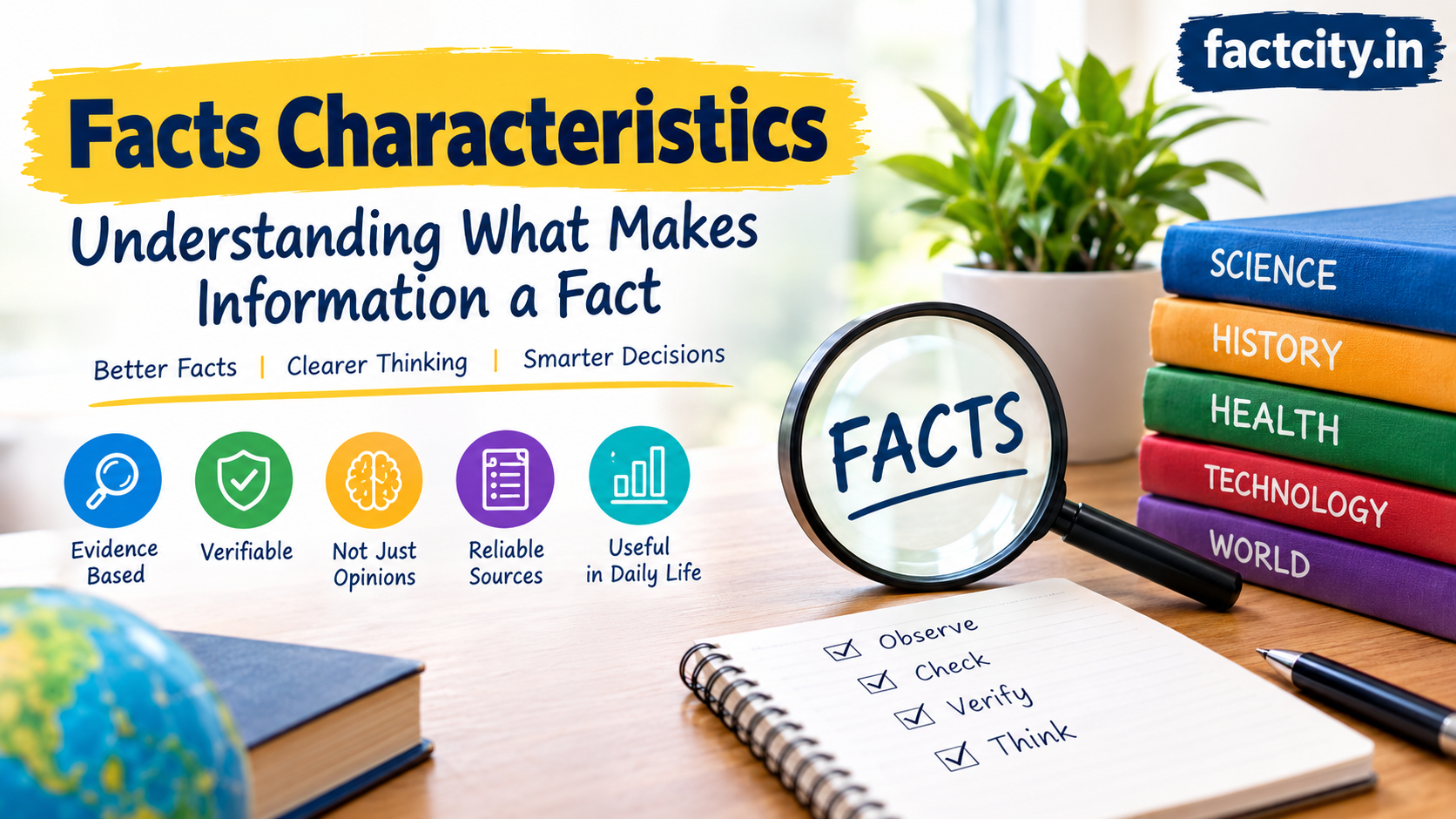
Facts Characteristics: Facts are an essential part of everyday life. When we study, make decisions, talk, read the news, research a topic, or try to understand something new, we use facts. But not everything we hear and read is true. Some remarks are opinions, beliefs, assumptions, predictions, or personal experience.
Grasping what facts are can help us to identify trustworthy information and become more critical consumers of the information we encounter online. Knowing how to tell a fact from a lie is an important skill in a world that moves very fast through websites, social media, videos, and other sources.
In this article, we will look at the main characteristics of facts, how facts differ from opinions, why evidence is important, and how you can spot factual information in everyday life.
What Is a Fact?
A fact is a statement that can be proved. It is a statement of information that can be verified. Facts are generally things that have occurred, exist, or can be shown by observation, measurement, records, or other reliable investigation. For example, ” The Earth revolves around the Sun” is a fact, based on scientific evidence. Similarly, “Water freezes at 0°C under standard atmospheric pressure” is a fact which can be tested and observed under the right conditions. Just because someone says something confidently doesn’t mean it’s true. It needs proof to back it up. Or a way of verifying it reliably. “Facts Characteristics“
Facts are evidence-based
One of the most important features of facts is that they are linked to evidence. Evidence supports a statement, and the evidence helps people see if the statement is true. Evidence can be a lot of things. Evidence may be scientific experiments, photographs, official records, measurements, historical documents, research works, and direct observations. For instance, if someone says a certain amount of rainfall fell in a certain city, then weather records and measurements can be used to verify that claim. Evidence can take us beyond speculation and personal belief.
Facts are verifiable.
Another important characteristic is that facts are generally verifiable. Verification is the process of confirming that the information is correct. Different types of facts call for different modes of verification. Scientific facts are proved through experiments, and historical facts are verified by looking at documents, photographs, artefacts, and various historical sources.
For example, if you want to know the date of an important historical event, you can check reliable historical records. You can take a thermometer reading to see the temperature outside or check a reliable weather report. One reason facts are different from unsupported claims is that facts can be verified.
Facts versus opinions
Facts and opinions are often mixed, especially in online content. Critical thinking is knowing the difference. Evidence supports a fact, whereas an opinion expresses a person’s feelings, preferences, or judgment.
For instance, “The Pacific Ocean is the largest ocean on Earth” is a fact that can be proven. In contrast, “The Pacific Ocean is the most beautiful ocean” is an opinion because beauty is a matter of personal judgement. People can disagree, but a factual statement should be evaluated with evidence, not like/dislike.
Facts are not a matter of personal feelings
Facts are not what people like or dislike, agree with or don’t agree with. “Personal feelings can impact how people interpret information, but feelings don’t change evidence. For example, one person may not like mathematics, but their personal preference does not change the result of a mathematical calculation. Similarly, someone could like a sports team, but that does n’t change the score of a game already played . This trait can be especially useful when evaluating information that elicits a strong emotional response. Just stop and look at the evidence. You can then tell the difference between facts and feelings.
Reliable Sources Can Produce Facts
Reliable sources are important for finding and confirming facts. Depending on the topic, government sites, scientific organisations, universities, research publications, official documents, and reputable educational resources are all good places to look. For example, if you want to find official information about a country’s population, a government census or recognised statistical organization may be more useful than an anonymous social media post.
But just because something is on the Internet doesn’t mean it’s true. It is important to think about who published the information, when it was published, what evidence was given, and if other reliable sources say the same thing.
Facts Are Observable or Measurable
Many facts relate to things that can be seen, measured, counted, or recorded. For instance, the length of a table may be measured with a measuring stick. The number of students in a classroom can be enumerated. You can use a thermometer to find out how hot or cold a room is.
Measurements make information more exact and provide other people a way to substantiate the same information. However, the results should also be interpreted in the right context since the results might be affected by different methods or conditions.
All facts are updatable with new evidence
Our view of the world can change when new evidence comes to light. This is especially common in research-based fields such as science, medicine, technology and history. New results may provide additional information or may show that an earlier explanation was incomplete. Now scientists can change their explanations in view of the stronger evidence.
That doesn’t mean facts are only opinions. Rather, it shows how reliable knowledge depends on evidence and that people should be prepared to correct their errors when better evidence comes to hand.
Facts May Be Quantitative or Qualitative
Facts can describe qualities as well as numbers. Quantitative facts are facts that can be measured (distance, weight, temperature, population, time, or quantity). For example, the statement that a certain object weighs 2 kilograms is a quantitative statement.
Qualitative facts refer to qualities or characteristics. This could be information about appearance, texture, shape, or other observable features. Both kinds of information can be useful. Numbers can give exact measurements, but qualitative descriptions can help people understand characteristics that numbers alone cannot always describe.
Facts Assist With Everyday Decision-Making
Facts are not confined to classrooms or scientific laboratories. People use facts all the time. For example, you may compare the price, size, features, warranty, and specifications of a product before you buy it. You can check the transport schedules, the weather and the opening hours before you set off. This information can help you make decisions based on evidence, not assumptions.
Facts do not necessarily tell people what decision to make, because personal goals and preferences are also important. But accurate facts can provide a useful basis for informed choices.
Facts Support Critical Thinking
The understanding of the nature of facts can promote critical thinking. Critical thinking is not believing all that you hear, but looking closely at the information. When you see a shocking statement online, you can ask yourself some questions. Where did this information come from? Is there any evidence of it? Is the source trustworthy? Is the information up to date? Is this confirmed elsewhere? These simple questions will help you avoid misinformation and make better judgements about what information you encounter.
Facts in the Digital Era
The internet makes it easier than ever to get information. At the same time, it has made it easier for misinformation to spread. A headline, social media post, video, or viral message can sound convincing, but it doesn’t necessarily provide trustworthy evidence. Hence the increasing importance of fact-checking.
See something interesting being claimed? Take a moment to check the source and evidence before sharing. Also, taking the time to cross-reference information from several good sources can give you a better grip on a subject.
Why It Matters to Understand Characteristics of Facts
Learning about the characteristics of facts can help students, professionals, researchers, and even the average internet user. It fosters the questioning of unsubstantiated claims and the seeking of evidence prior to the acceptance of information. It can also aid communication. When people clearly distinguish between facts and opinions, it makes discussions much easier to understand. Someone can have a different opinion and still agree on the basic evidence. And maybe most importantly, knowledge promotes curiosity. You learn to question what you hear and know to look for reliable answers instead of taking it at face value.
Wrap Up
The key facts characteristics are: They are evidence-based. They are verifiable. They are independent of personal feelings. They are linked to reliable information. Facts may be observed, measured, recorded, or confirmed using the appropriate method, but it is contingent upon the subject of the fact.
Today, when we are exposed to great quantities of information every day, it is especially important to be able to discern true information. By checking sources, looking for evidence, thinking about context, and separating facts from opinions, you can be a more careful, informed reader. Use this knowledge to make more responsible and confident use of information, whether you’re studying for school, researching a topic, reading online, or making an everyday decision.