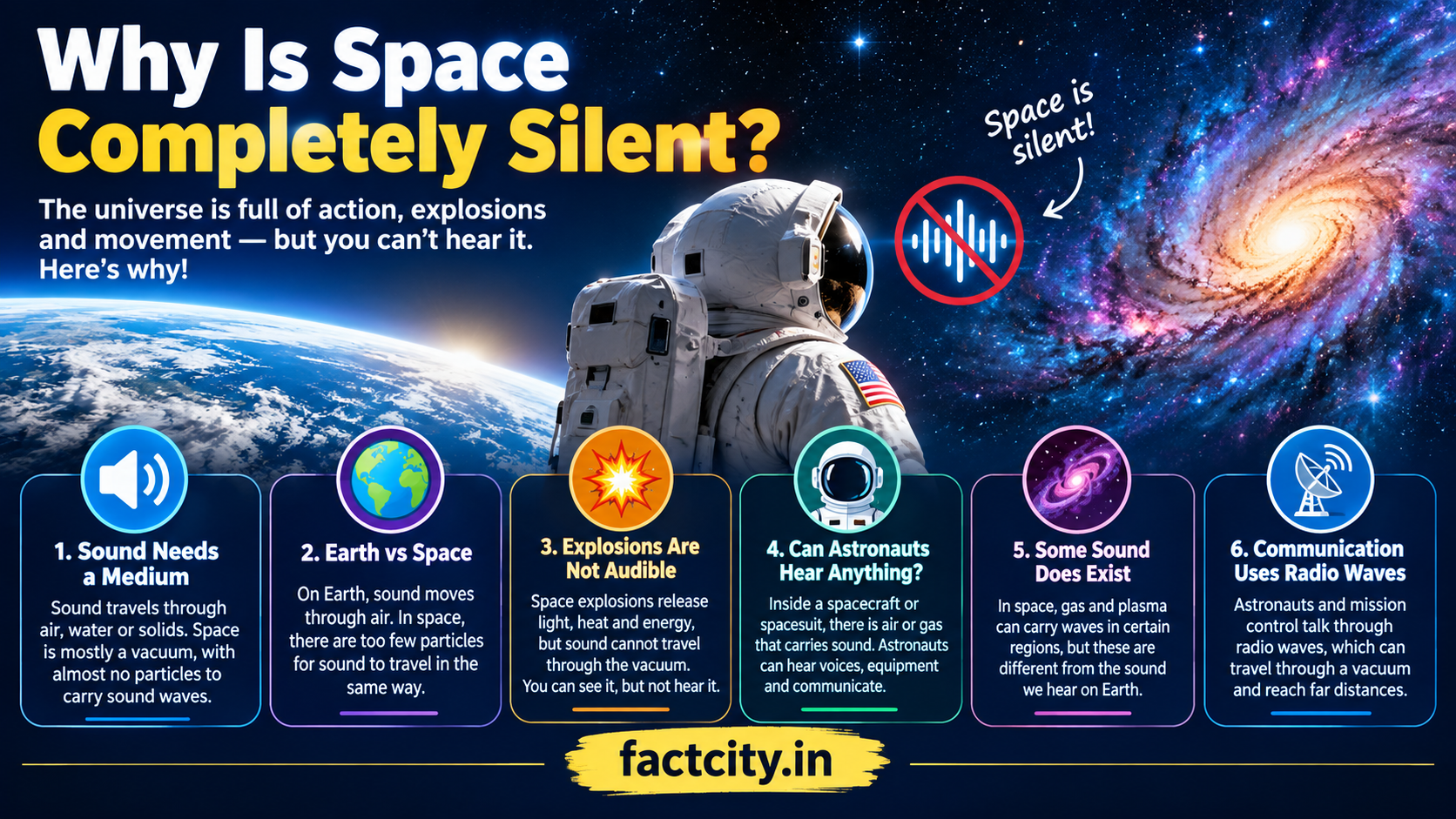
Why Is Space Completely Silent? Have you ever wondered what it would be like to travel through space? Imagine floating near a distant planet, watching stars shine brightly, and seeing a massive explosion happening thousands of miles away. You might expect to hear loud noises, powerful blasts, or the sound of objects moving through the universe. Surprisingly, you would hear nothing. Space is almost completely silent, even when some of the most powerful events in the universe are taking place.
But why is space silent when so many things are happening in it? The answer has to do with the way sound travels. On Earth, we hear sounds every day because air carries sound waves from one place to another. In space, however, there is no atmosphere in most areas to carry these waves. This simple difference explains why the universe looks incredibly active but remains silent to human ears.
In this article, we will explore why space is silent, how sound travels, what happens during explosions in space, and whether astronauts can hear anything while exploring the universe.
Why Is Space Completely Silent?
Space is silent because most of it is a vacuum, which means it contains extremely little matter compared with Earth’s atmosphere. Sound needs a material medium, such as air, water, or solid objects, to travel. Without enough particles to pass along vibrations, ordinary sound cannot travel from one location to another. On Earth, sound usually travels through air. When someone speaks, their vocal cords create vibrations that move nearby air particles. These particles pass the vibrations to other particles, allowing sound waves to reach your ears. Your brain then interprets those vibrations as voices, music, or other sounds.
Outer space works differently. The areas between planets, stars, and galaxies contain very few particles compared with the air around us. As a result, sound waves cannot travel through most of space in the familiar way they do on Earth. This does not mean that nothing happens in space. Stars explode, planets move, black holes interact with their surroundings, and powerful solar storms occur. These events can produce enormous amounts of energy, but their energy does not automatically become sound that humans can hear.
How Does Sound Travel on Earth?
To understand why space is silent, it helps to understand how sound works on our planet. Sound is produced when something vibrates. For example, when you hit a drum, its surface moves back and forth. This movement creates pressure changes in the surrounding air. The air particles carry these changes outward as sound waves. When the waves reach your ears, they cause your eardrums to vibrate. Your hearing system converts these vibrations into signals that your brain recognizes as sound.
Different materials carry sound at different speeds. Sound generally travels faster through water than through air and often travels even faster through many solids. This happens because the particles and physical properties of each material affect how vibrations move. The important point is that sound needs particles or a material medium to carry its vibrations. Because most of space lacks enough particles for ordinary sound transmission, sound cannot travel across the vacuum between distant objects as it does through Earth’s atmosphere.
Why Can’t You Hear Explosions in Space?
Movies often show spacecraft exploding with dramatic, thunderous sounds. These scenes may look exciting, but they are not scientifically accurate when it comes to sound traveling through empty space. Imagine a spacecraft exploding far away from you in a region with almost no gas. The explosion would release energy, heat, radiation, and rapidly moving pieces of material. You might see the flash of light if you had a clear view, but you would not hear the explosion through the vacuum separating you from it. Light and sound behave differently. Light is electromagnetic radiation and can travel through a vacuum. Sound is a mechanical wave and requires a material medium.
This is why an explosion in space can be visible without being audible. A science-fiction film might add sound effects to make a scene more dramatic, but those sounds are usually added for the audience rather than representing what someone would actually hear in the vacuum of space. There is one important exception to remember. If an explosion occurs inside a spacecraft, the sound can travel through the air inside the cabin and may also pass through solid structures. An astronaut inside the spacecraft could hear it, depending on the circumstances.
Can Astronauts Hear Anything in Space?
Astronauts do not experience complete silence in every situation. Their ability to hear depends on where they are and what is carrying the sound. Inside a spacecraft, astronauts have air that allows sound waves to travel. They can talk to one another, hear equipment operating, and listen to alarms. Their voices can also be transmitted through communication systems. During a spacewalk, astronauts wear specially designed spacesuits that provide oxygen, pressure, and protection from the harsh environment. Inside the suit, there is gas that can carry sound. Astronauts can hear their own breathing, equipment sounds, and communication audio through their headsets.
However, if an astronaut were exposed directly to the vacuum of space without protection, sound from a distant object would not travel through the vacuum into their ears. Such exposure would also be life-threatening because the human body cannot survive unprotected in space. Communication between astronauts and mission control relies on radio waves rather than ordinary sound traveling through empty space. Radio waves can travel through a vacuum, making them essential for space exploration.
Does Sound Exist Anywhere in Space?
Although most of space is nearly empty, it is not entirely empty everywhere. Some regions contain gas, plasma, dust, and other particles. Under the right conditions, these materials can carry pressure waves or other disturbances related to sound. For example, clouds of gas surrounding stars and galaxies can support waves. The gas in these regions is often much thinner than Earth’s atmosphere, so the waves behave differently from ordinary sounds we hear on our planet.
Scientists can study these waves to learn about the structure, temperature, and behavior of distant cosmic objects. In some cases, researchers convert measurements of space phenomena into audio that humans can hear. This process is often called sonification. Sonification does not necessarily mean that a microphone recorded an audible sound traveling through space. Instead, scientists may translate data about radiation, pressure changes, or other physical measurements into sound so that patterns become easier to understand. This approach allows researchers and the public to explore certain aspects of the universe through audio, even when the original signals were not audible to human ears.
Can You Hear the Sun in Space?
The Sun is a massive, active star. Its surface constantly moves, and waves travel through its interior. These movements help scientists understand how the Sun works. However, the Sun does not produce a normal sound that travels directly through the vacuum to Earth. The space between the Sun and our planet is far too empty to carry ordinary sound waves in that way.
Scientists study solar vibrations using instruments that measure changes in the Sun’s surface. These observations are part of a field known as helioseismology. By examining the patterns of movement, researchers can investigate conditions deep inside the Sun. Scientists can also convert solar data into audio for educational or research purposes. The resulting recordings may sound like humming, rumbling, or other unusual noises. These sounds are representations of measured data, not proof that ordinary sound is traveling from the Sun to Earth through empty space.
Why Can We See Stars but Not Hear Them?
One of the most interesting facts about space is that light can cross enormous distances while sound cannot cross the vacuum in the same way. When you look at a star in the night sky, the light entering your eyes may have traveled for years, decades, or even thousands of years. Light does not require air or another material medium to travel.
Sound, on the other hand, depends on vibrations passing through matter. If there is no suitable material between a distant star and an observer, ordinary sound cannot travel that distance. This difference explains why astronomy relies heavily on light and other forms of electromagnetic radiation. Telescopes collect visible light, infrared radiation, radio waves, X-rays, and other signals to reveal what is happening across the universe.
Astronomers can learn about stars, planets, galaxies, and black holes without needing to hear them directly.
Are There Any Sounds Near Black Holes?
Black holes are among the most fascinating objects in the universe. Their gravity is so strong that, beyond a boundary called the event horizon, nothing can escape to the outside, not even light. Although black holes themselves are not heard through empty space, their surroundings can contain hot gas and plasma. These materials may produce waves and disturbances that scientists can investigate.
In 2003, astronomers studying the Perseus galaxy cluster identified pressure waves associated with a supermassive black hole. The waves were moving through extremely hot gas, not through a completely empty vacuum. Their frequency was far below the range of human hearing. Scientists have sometimes shifted or translated such measurements into audible frequencies to help people experience the data. The resulting audio can sound strange or deep, but it should not be confused with a sound that a person could naturally hear across the vacuum of space.
What Would Space Sound Like to a Human?
If you could safely float in a region of space with no atmosphere and no nearby vibrating object connected to you through a solid structure, the environment would be silent to your ears. You might see planets, stars, and distant galaxies, but their light would not bring their sounds with it. A nearby spacecraft could appear to be operating normally, yet you would not hear its engine through the vacuum outside.
Inside your spacesuit, however, you could hear breathing, communication audio, and some sounds transmitted through the suit’s materials. Inside a spacecraft, you could hear voices and equipment because the cabin contains air and solid surfaces that transmit vibrations. So, the experience of silence depends on the environment. Space itself does not prevent all sound under every possible condition; rather, the vacuum between objects prevents ordinary sound waves from traveling through it. 7-amazing-secrets-of-the-world-that-you-cannot-see
Conclusion: Why Is Space Completely Silent?
Space is considered silent because most of the universe consists of regions with too little matter to carry ordinary sound waves. On Earth, sound travels through air, water, and solid materials. In the vacuum of space, those vibrations cannot travel from distant objects to your ears in the same way.
This is why an explosion can flash brightly without producing a sound you could hear from far away. It is also why astronauts use radio communication and why scientists rely on telescopes and instruments instead of listening directly to distant stars. Although space is mostly silent to human ears, scientists can still study waves and disturbances in gas and plasma, and they can turn astronomical data into audio for research and education.