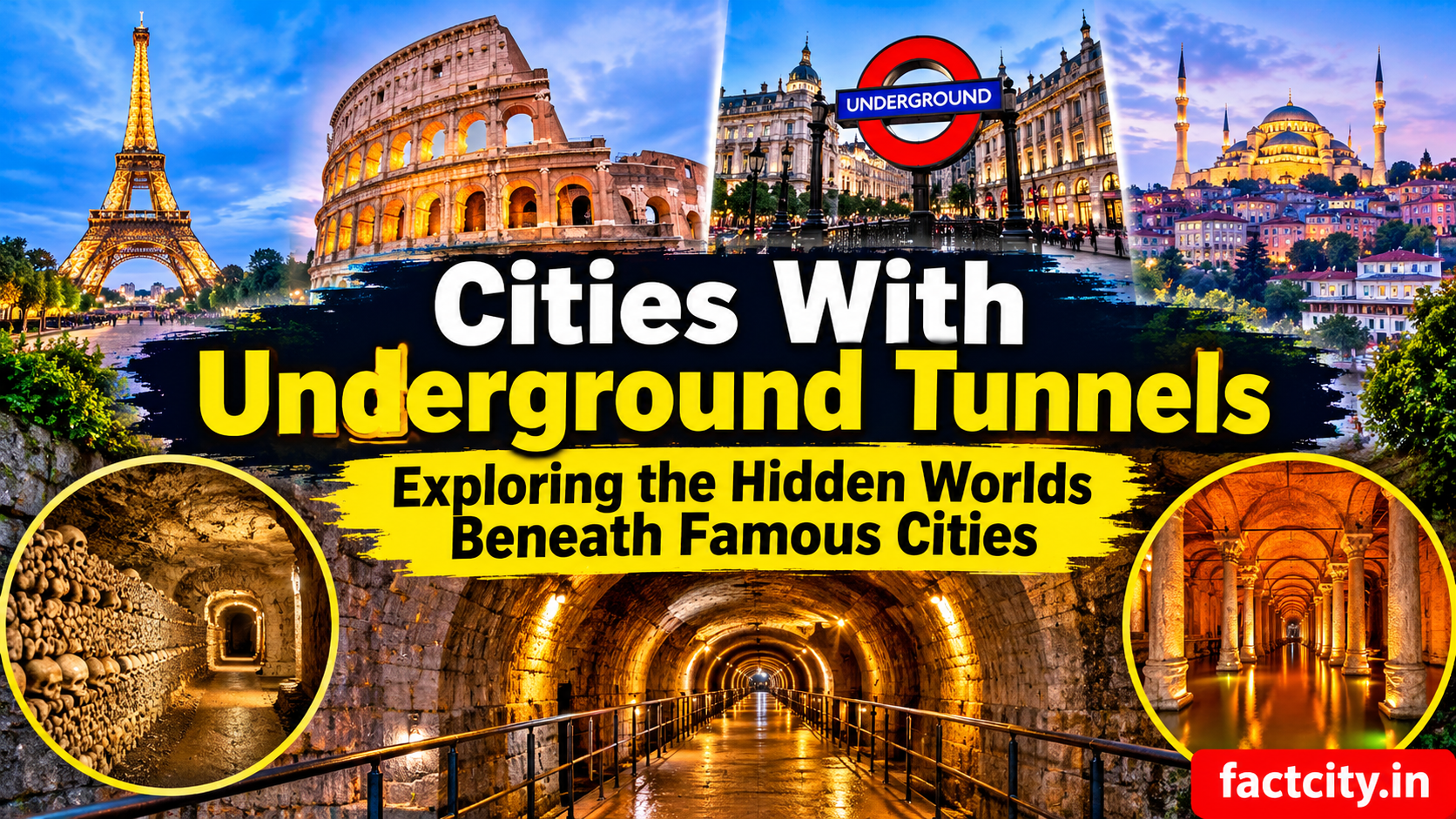
Cities With Underground Tunnels: When people think about famous cities around the world, they usually imagine beautiful streets, impressive buildings, busy markets, and popular tourist attractions. However, some of the most fascinating places are hidden beneath the ground. Many cities have underground tunnels that were built hundreds of years ago for transportation, protection, storage, water management, and other important purposes. Some tunnels were created during ancient civilizations, while others were constructed during wars or developed as modern underground transportation networks.
These hidden structures tell interesting stories about how people lived, worked, travelled, and protected themselves throughout history. Some underground tunnels are open to visitors, allowing them to explore forgotten streets, historical chambers, and mysterious passageways. Others remain restricted because they are still used for essential services or have important historical value.
From the famous underground passages of Paris to the mysterious tunnels beneath Edinburgh, several cities have fascinating underground worlds waiting to be discovered. Let’s explore some of the most interesting cities with underground tunnels and learn why these hidden places are so special.
1. Paris, France: A City Built Above a Hidden Underground World
Paris is famous for its romantic streets, historic monuments, museums, and beautiful architecture. However, beneath the city lies an extensive network of underground tunnels that has developed over many centuries. One of the most famous underground attractions in Paris is the Catacombs, which contain the remains of millions of people.
The Paris Catacombs were created during the late eighteenth century when overcrowded cemeteries became a serious public health problem. Authorities decided to transfer human remains into abandoned limestone quarries beneath the city. Over time, these underground spaces became one of the most unusual historical attractions in the world. Cities With Underground Tunnels
Today, visitors can explore selected sections of the Catacombs and see carefully arranged walls of bones and skulls. Paris also has an extensive network of historic quarries, underground service passages, and sewer tunnels. These structures reveal a completely different side of the French capital that most visitors never see.
2. Edinburgh, Scotland: Mysterious Underground Streets and Vaults
Edinburgh is known for its medieval architecture, historic castles, and narrow streets. Beneath parts of this beautiful Scottish city are underground vaults that date back to the eighteenth century. These spaces were originally built beneath the arches of the South Bridge and were used by businesses, workers, and residents.
As the city developed, some vaults became storage areas, workshops, and places where people carried out different commercial activities. Poor living conditions, dampness, and overcrowding eventually caused many of these underground spaces to become abandoned.
Today, the Edinburgh Vaults attract visitors interested in history, architecture, and local legends. Guided tours allow people to discover the dark chambers and learn about the difficult conditions experienced by some of the city’s former residents. These underground spaces provide an unusual look at Edinburgh’s past and show how much history can exist beneath an ordinary city street.
3. Rome, Italy: Ancient Tunnels Beneath a Historic City
Rome is one of the most historically important cities in the world. It was once the centre of the Roman Empire, and its underground structures reveal how advanced ancient Roman engineering could be.
Beneath modern Rome are ancient catacombs, underground burial chambers, tunnels, and remains of buildings that date back thousands of years. The Roman Catacombs were primarily used as burial places by early Christian and Jewish communities. These underground cemeteries contain long passageways, small burial spaces, inscriptions, and historical artwork.
Rome also has underground remains of ancient houses, temples, and public buildings. Some archaeological sites allow visitors to explore different levels of the city’s history, showing how modern streets were constructed above older settlements.
One fascinating feature of Rome is that its underground history is not limited to a single location. Different parts of the city contain layers of ancient construction, making Rome a remarkable destination for anyone interested in exploring the past.
4. Montreal, Canada: A Huge Underground Pedestrian City
Montreal is home to one of the world’s most impressive modern underground pedestrian networks, commonly known as the Underground City or RESO. Unlike historical tunnels built for defence or burial, this network was developed to make everyday life easier in a city that experiences extremely cold winters.
The underground network connects shopping centres, office buildings, hotels, metro stations, universities, and other important locations. People can walk between many destinations without having to deal with freezing temperatures, snow, or heavy rain outside.
The system has developed gradually over several decades and is particularly useful during winter. It includes shopping areas, restaurants, entertainment spaces, and convenient pedestrian connections.
Montreal’s Underground City demonstrates how underground spaces can become an important part of modern urban planning. Instead of simply hiding beneath the streets, these tunnels function as an extension of the city’s everyday public environment.
5. Seattle, United States: The Forgotten Underground City
Seattle has an unusual underground history that surprises many visitors. During the nineteenth century, parts of the city experienced major infrastructure and street-level changes after a devastating fire in 1889.
As Seattle rebuilt, streets and sidewalks were raised in certain areas to improve drainage and address sanitation problems. Some older building entrances and former street-level spaces were left below the new street level.
Over time, these abandoned spaces became part of what is now known as the Seattle Underground. Visitors can explore selected underground passageways through guided tours and learn how the city developed above its original streets.
The underground spaces offer a fascinating look at Seattle’s early history, including the challenges faced by residents and business owners during the city’s transformation. Although not every underground area is accessible, the preserved sections provide an unusual historical experience.
6. Beijing, China: The Underground City Built for Protection
Beijing has an extraordinary underground structure known as the Underground City. It was constructed during the Cold War period when China was concerned about the possibility of a military attack.
The underground network was designed as a large shelter system that could provide protection during emergencies. It reportedly included tunnels, storage rooms, meeting spaces, and other facilities intended to support people during difficult situations.
The project reflected the security concerns of its time and demonstrated the enormous effort involved in preparing a major city for potential conflict.
Although access to the underground complex has been limited and its public availability has changed over the years, it remains an interesting example of how governments have used underground construction for civil defence.
7. Istanbul, Turkey: Ancient Underground Tunnels and Water Reservoirs
Istanbul is a city where European and Asian cultures meet, and its history stretches across several major civilizations. Beneath its streets are remarkable underground structures that reveal the engineering achievements of the Byzantine and Ottoman periods.
One of the most famous underground attractions is the Basilica Cistern. Built during the Byzantine era, this enormous underground water reservoir was designed to store and supply water to important buildings in the city.
The cistern features hundreds of columns supporting its ceiling, creating an impressive underground environment. Its atmospheric lighting and ancient architecture make it one of Istanbul’s most popular historical attractions.
Other underground remains and archaeological structures can also be found throughout the city. These places show how underground engineering played an essential role in supplying water and supporting urban life centuries ago.
8. Naples, Italy: A Fascinating Underground Network
Naples is another Italian city with an extensive underground world. Beneath its busy streets are tunnels, caves, ancient water systems, and archaeological remains that have developed over thousands of years.
The underground network known as Napoli Sotterranea allows visitors to explore selected sections of the city’s hidden history. Some tunnels originated from ancient Greek and Roman quarrying activities, while other underground structures were later used for water storage and transportation.
During the Second World War, certain underground spaces were also used as air-raid shelters. These areas provided protection for residents during bombing raids.
Today, guided underground tours reveal different stages of Naples’ history. Visitors can see ancient stone passages, large chambers, and remains of infrastructure that once supported everyday life.
Naples is a perfect example of a city where the underground world is closely connected to its cultural and historical identity.
9. Derinkuyu, Turkey: An Ancient Underground City
Although Derinkuyu is not a major modern city, it is one of the most remarkable underground settlements ever discovered. Located in the Cappadocia region of Turkey, this ancient underground city was carved deep into volcanic rock.
Derinkuyu contains multiple underground levels with rooms, storage areas, ventilation shafts, kitchens, and other facilities. The complex was designed to support communities seeking shelter from outside dangers.
Some estimates suggest that the underground settlement could accommodate thousands of people under suitable conditions, although its exact population capacity is difficult to establish.
One of its most interesting features is the ventilation system, which helped provide fresh air to the lower levels. Large circular stone doors were also used to block certain passageways and improve security.
Derinkuyu demonstrates the creativity and engineering skills of ancient communities that developed ways to live beneath the surface.
10. London, England: Underground Tunnels Beneath a Global Capital
London has an extensive underground infrastructure that includes railway tunnels, pedestrian passages, service networks, and historical underground spaces.
The London Underground, commonly called the Tube, is one of the oldest underground railway systems in the world. It began operating in 1863 and transformed the way people travelled across the growing city.
Beyond the railway system, London also contains historical tunnels and underground structures connected to government buildings, transport infrastructure, and wartime history.
During the Second World War, several underground railway stations and specially developed shelters provided protection for civilians during air raids. Some underground spaces were also used for important government and military operations.
Today, London’s underground network remains essential to everyday transportation, while its historical tunnels offer fascinating insights into the city’s past.
11. Budapest, Hungary: Underground Caves and Historical Passages
Budapest is famous for its beautiful architecture, thermal baths, and historic riverfront. However, beneath the Hungarian capital lies an interesting network of natural caves and underground spaces.
The city is built over limestone formations that have developed extensive cave systems over thousands of years. Some caves were formed by thermal water, while others contain passages and chambers shaped by natural geological processes.
The Castle Hill area also has underground historical structures, including cellars, tunnels, and caves that have been used for different purposes throughout history.
Some of these underground locations are accessible through guided tours, giving visitors an opportunity to explore the hidden geological and historical features beneath Budapest.
The underground world of Budapest highlights the relationship between natural formations and human construction.
12. Coober Pedy, Australia: An Underground Way of Living
Coober Pedy is a small mining town in South Australia that is famous for its unusual underground lifestyle. Although it is not known for a traditional tunnel network, many of its residents live in underground homes called dugouts.
The town experiences extremely hot summer temperatures, making underground living a practical solution. Homes, churches, accommodation facilities, and other spaces have been created inside excavated areas of the surrounding rock.
These underground buildings help maintain relatively comfortable indoor temperatures throughout the year. They also demonstrate how communities can adapt their architecture to challenging environmental conditions.
Coober Pedy is particularly famous for its opal mining industry, and underground spaces remain an important part of its local identity.
Why Do Cities Build Underground Tunnels?
Cities develop underground tunnels for several different reasons. One of the most important purposes is transportation. Underground railway systems help move large numbers of people without requiring additional surface roads.
Another major reason is protection. Throughout history, underground spaces have been used as shelters during wars, natural disasters, and other emergencies. Their enclosed structure can provide protection from certain external dangers.
Some tunnels are also created for water supply, drainage, electricity, communication systems, and other essential services. Historical underground spaces may have served as storage areas, burial chambers, or hidden passageways. 10-ancient-structures-that-still-puzzle-historians
Modern cities increasingly use underground construction because available surface space is limited. Building below the ground allows urban areas to expand without using additional land.
Are Underground Tunnels Safe to Visit?
Many underground tunnels are safe to visit when they are officially managed and open to the public. Popular attractions usually provide guided tours, safety information, and controlled visitor routes.
However, not every underground passage is suitable for exploration. Abandoned tunnels can contain unstable structures, poor ventilation, flooding risks, and other hazards. Some may also be privately owned or restricted for security reasons.
Visitors should always follow local regulations and avoid entering closed or unauthorized underground spaces. Choosing official tours is generally the best way to explore these hidden locations safely.
Conclusion: Discovering the Hidden World Beneath Cities
Cities with underground tunnels reveal an extraordinary side of human history, engineering, and urban development. From the ancient catacombs of Rome to the modern Underground City of Montreal, these hidden structures show how people have used underground spaces for protection, transportation, water storage, and everyday living.
Some underground networks were created thousands of years ago, while others were developed to solve modern urban challenges. Places such as Edinburgh, Seattle, Istanbul, Naples, and Beijing demonstrate how different societies have created fascinating structures beneath their streets.
Exploring these underground worlds helps us understand that a city is not limited to what we see above the ground. Beneath busy roads, historic buildings, and modern neighbourhoods, there are hidden stories waiting to be discovered. For travellers and history lovers, these underground tunnels offer a unique opportunity to explore the past and experience cities from an entirely different perspective.