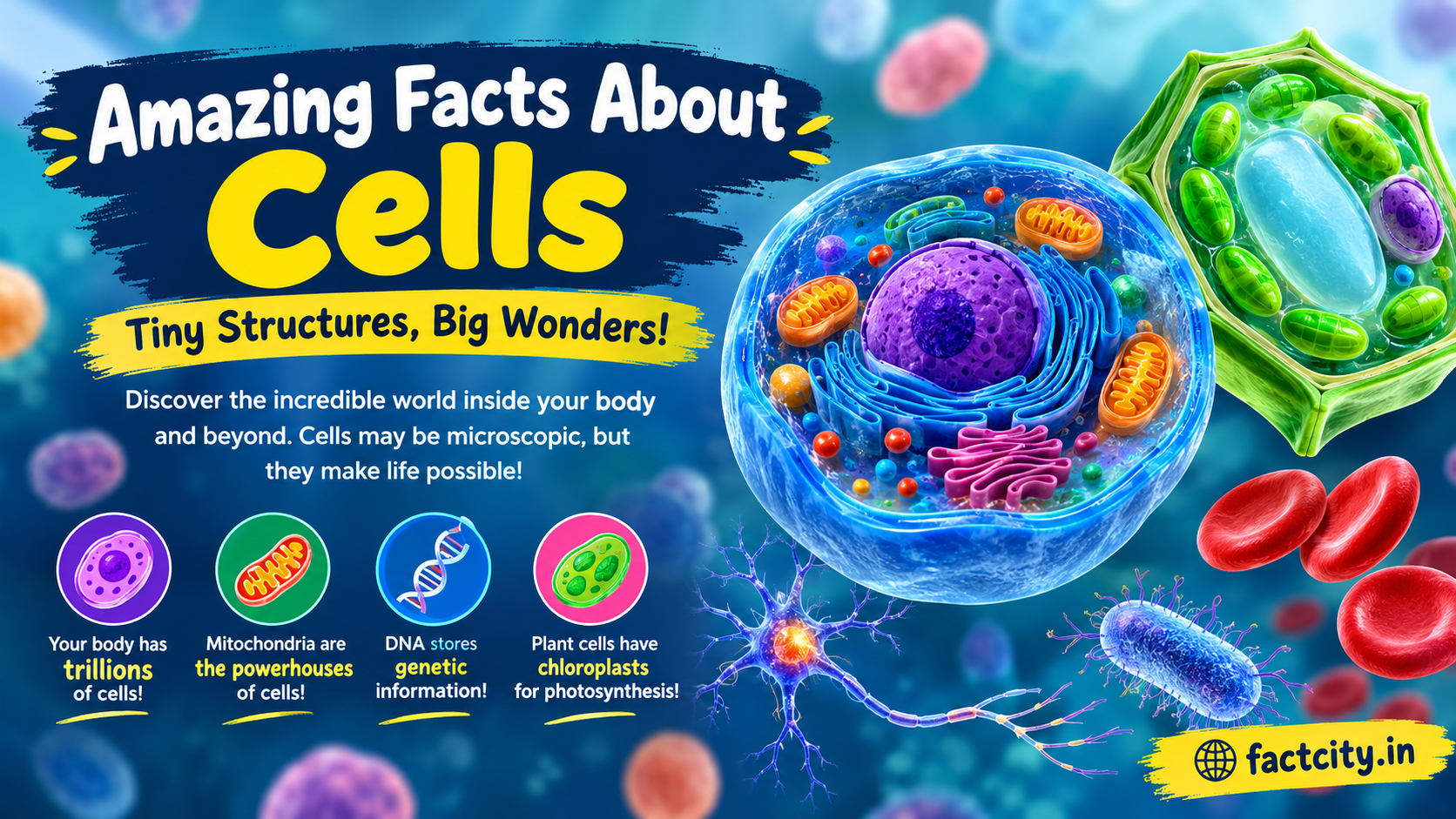
Amazing Facts About Cells: Cells are the small units that make life possible. All living things, whether they are plants, animals (including humans), or microscopic organisms, are composed of cells. Most cells are way too small to see with the naked eye, but they do thousands of important jobs every moment.
Cells are astonishingly complex, from generating energy and repairing tissues to transmitting genetic information. Studying them teaches us more about how our bodies function and why life is possible.
In this article, we are going to explore some amazing facts about cells in a simple and easy-to-understand way.
Cells Are the Fundamental Units of Life
One of the most important facts about cells is that they are seen as the fundamental structural and functional units of life. All living things are made of one or more cells. Some organisms, such as bacteria, consist of just one cell. Such organisms are called unicellular organisms. In multicellular organisms such as humans, plants, and many animals, many different cells work together to form the whole. Each cell performs specific functions that help the organism to survive.
You Have Trillions of Cells in Your Body
The human body is made up of a huge number of cells. Scientists estimate that an average human adult contains about tens of trillions of cells. Not all these cells are the same. There are many special kinds of cells in your body, such as nerve cells, muscle cells, blood cells, skin cells, and bone cells. The different kinds have different structures and jobs, but they work together to keep the body working.
Cells Can Be Very Small
Most cells are very small. That means you typically need a microscope to see them. Most human cells are only a few micrometres wide. For comparison, a micrometre is one millionth of a metre. But the sizes of the cells vary a lot. Some cells are very small, while others can be surprisingly large. Some nerve cells, for example, have long extensions that reach through the body.
The Cell Has a Protective Outer Membrane
A cell membrane, a structure that surrounds nearly all cells, is present. The cell membrane acts as a selective barrier. It controls what comes into and goes out of the cell. It can let nutrients and other useful things in. It can also let waste products out. Instead of a totally rigid wall, the membrane is flexible. This flexibility allows cells to interact with their environment and respond to changes.
Nucleus Contains Genetic Material
The nucleus is a structure that is found in most human cells. It is a control center and houses most of the cell’s DNA.DNA contains the genetic instructions that help determine how cells develop, function, and reproduce. Not every cell in the human body has a nucleus, interestingly. For example, during development, red blood cells lose their nucleus at maturity. This enables them to carry more oxygen.
Mitochondria: The Powerhouses of the Cell
One of the most famous facts about cells is about the mitochondria. They help cells to extract usable energy from nutrients. Mitochondria are often referred to as the “powerhouses” of the cells due to their significant role in energy production. Cells that require a lot of energy, such as muscle cells, tend to have many mitochondria. Another interesting fact is that mitochondria have their own DNA. Mitochondria are thought to have evolved from ancient bacteria that took up permanent residence within other cells.
Cells Have Their Own Recycling Centers
Cells are always building and consuming different molecules. They also have to get rid of any damaged or unnecessary materials. Lysosomes are structures that digest unwanted materials within animal cells. They have enzymes that can digest many different things. This recycling process assists in preserving a clean and functional environment inside the cell.
Plants Have Some Unique Structures in Their Cells
Plant cell types are like animal cells in many ways, but they also contain some structures that are especially important for plants. Cells in plants, for instance, have a cell wall that lies outside the cell membrane. It also gives extra support and helps to keep the shape of the cell.
Furthermore, cells in plants have chloroplasts, which are involved in photosynthesis. Plants use the sunlight they get from photosynthesis to help them make food from carbon dioxide and water. Like mitochondria, chloroplasts also have their own genetic material.
Proteins Can Be Made by Cells
Almost every living organism requires proteins. They help build tissues, support chemical reactions, carry substances, and do many other things. Ribosomes are structures that help cells produce proteins. Ribosomes read the instructions for genetic information and build the proteins from amino acids. This process is one of the basic things that keeps cells alive.
Your Cells Are Always Hard At Work
Even when you’re asleep, your cells don’t simply shut off. Your cells are still making energy and fixing damage and moving stuff around and talking to other cells and balancing things. Inside you. The human body is in this sense akin to a gigantic biological community in which myriad cellular processes are simultaneously taking place.
Cells talk to each other
Cells do not work in isolation. They always talk to the cells around them and to other parts of the body. They can send and receive chemical signals that influence activities such as growth, movement, metabolism, and immune responses. For instance, nerve cells communicate with each other and send information throughout the nervous system by way of electrical and chemical signals. This communication is important to control the activities of the entire body.
Red blood cells have a special shape
The special shape helps the red blood cells to do their main job. They are rather like flattened discs, with a central depression. The design allows for a large surface area for gas exchange. Mature human red blood cells lack a nucleus. Their unusual structure allows them to efficiently transport oxygen through the bloodstream.
Nerve Cells Can Be Really Long
Nerve cells, also called neurones, are some of the most interesting cells in the human body. Neurones may have very long processes, called axons. These extensions are capable of carrying electrical signals over considerable distances. The nervous system requires these specialised cells to transmit information from the brain, spinal cord and other parts of the body.
Cell Reproduction
Many cells make copies of themselves by dividing. The most common form of cell division for humans is mitosis. Mitosis is the process by which a single cell divides into two daughter cells, each of which receives genetic information that is normally very similar to that of the parent cell. Cell division is required for the growth, development, and renewal of damaged or old cells. Eggs and sperm are reproductive cells, which are produced by another type of cell division called meiosis.
Life of Some Cells Is Very Short
Some cells in the body have longer life spans than others. Some cells regenerate quickly, while others may remain in the body for years, or in some cases, for much of a person’s life. For example, many blood cells have a limited life span and must be constantly replenished with new cells produced in the bone marrow. This constant renewal allows the body’s tissues to function properly.
Cells are able to adapt to their environment
Cells are remarkably adaptive. They can detect changes in their surroundings and adjust their behaviour. Cell behaviour can be influenced by changes in temperature, nutrients, chemical signals and other environmental factors. This capacity to respond allows organisms to maintain their internal conditions stable. This is called homeostasis.
Certain Cells Can Change Roles
During development, cells can become specialised to carry out specific functions. This process is called cell differentiation. For example, cells in an embryo might eventually turn into nerve cells, muscle cells, skin cells, and many other specialised types. Certain stem cells are especially interesting because some of them can form all types of cells if the right conditions are provided.
Cells possess an internal self-destruct system
Sometimes cells need to be removed from the body in a controlled manner. A natural process called apoptosis allows some cells to die in a programmed fashion. Apoptosis is a major component of normal development and tissue homeostasis. For example, it helps get rid of cells that are no longer needed or damaged.
Bacteria are single-celled organisms
Bacteria are one of the simplest examples of cellular life. A single cell of bacteria can perform the basic processes necessary for life. Bacteria, generally, lack a membrane-bound nucleus like human cells. The genetic material is found in an area inside the cell. Some bacteria cause disease, but many are harmless or even beneficial, playing important roles in ecosystems and the human body.
Cells Are Key to Understanding Life
Cell biology, or cytology, is the study of cells. Scientists study cells to understand how organisms grow, develop, reproduce, and respond to disease. The study of cells has led to advances in medicine, genetics, biotechnology, and other areas of science. But in studying something so small, scientists can learn huge amounts about life itself.
What makes cells so great?
Cells are tiny. But they can do awesome things. Under the right conditions, a single cell can absorb nutrients, produce energy, respond to signals, synthesise proteins, get rid of waste and replicate. In multicellular organisms, billions or trillions of specialised cells work together in tissues and organs. This teamwork allows complex organisms to live and function. The next time you think about the human body, remember that there is an incredible world within it at a microscopic level.
Final Words on Amazing Facts About Cells
These amazing facts about cells show how complex and organised life can be. Cells are little things, but they do important things that help all living things. Mitochondria create energy. DNA has genetic information. All organelles in a cell have an important job. Some cells are specialised to transport oxygen, some to signal, some to protect or repair the body.
One of the best ways to understand biology is to understand cells. Scientists have learned much about them, but research continues to reveal new details about how cells communicate, adapt, reproduce, and sustain life. observe-the-relationship-in-the-first-pair-of-words
Cells are microscopic, but their importance is enormous.
Frequently Asked Questions on Cells
A cell is:
The cell is the basic structural and functional unit of life. All living things are composed of one or more cells.
The human body contains about 100 trillion cells.
The human body of an adult contains tens of trillions of cells, although the exact number depends on the size of the body and other factors.
What is the primary function of the cell membrane?
The cell membrane is the outer boundary of the cell. It controls what goes in and out of the cell.
Why are mitochondria important?
Mitochondria are the primary source of usable energy in cells.
Some cells have no nucleus.
No. For example, mature human red blood cells lack a nucleus.
How do cells from plants differ from animal cells?
Unlike most animal cells, plants have certain features, such as cell walls and chloroplasts.
Why do we need DNA?
DNA carries the instructions for characteristics that are inherited from parent to child and helps cells to grow, function, and reproduce.