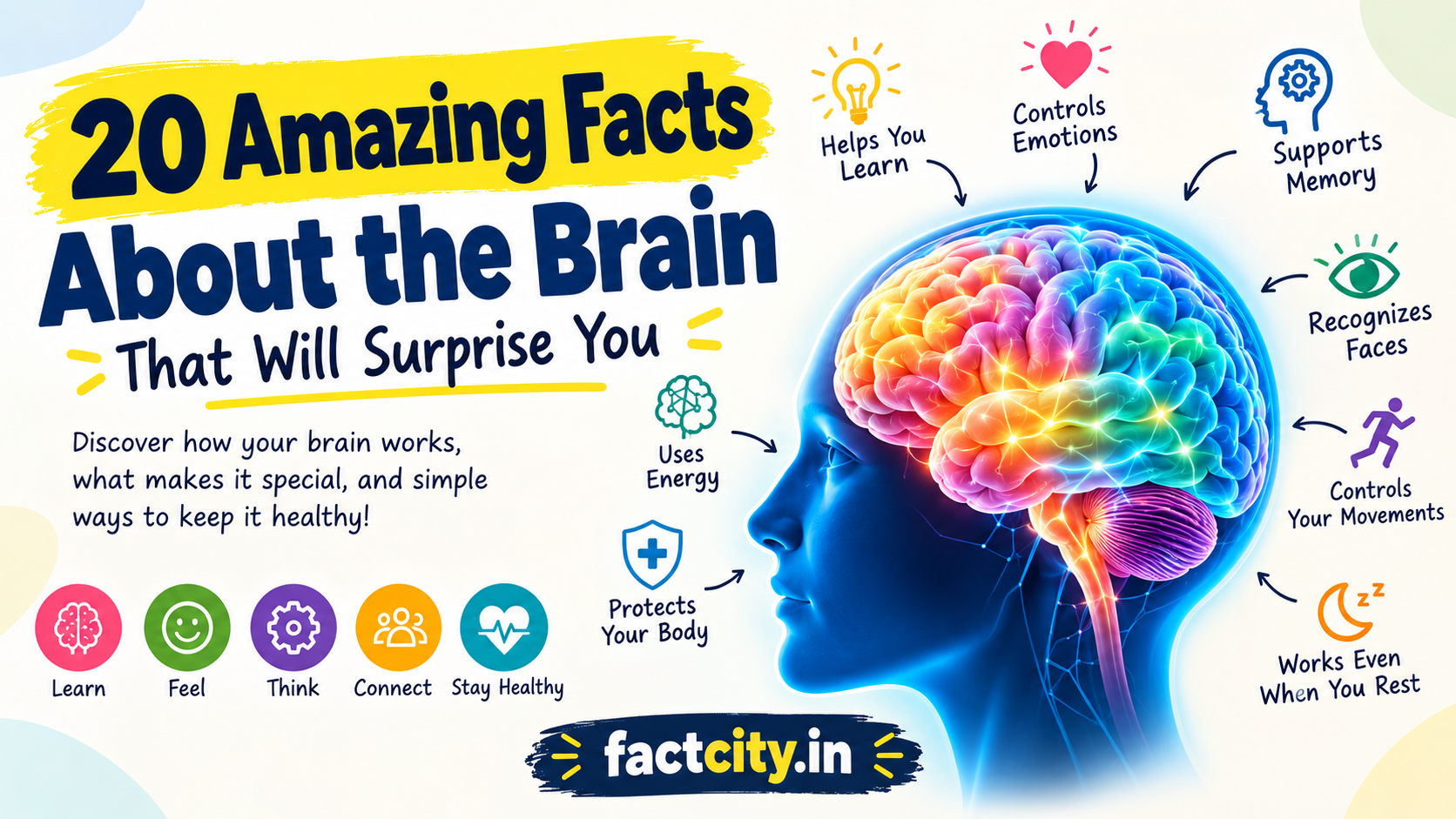
Amazing Facts About the Brain: Have you ever wondered how your brain helps you remember childhood memories, recognize your friends, or understand something new? The human brain is one of the most amazing parts of our body. It works every second, helping us think, feel emotions, make decisions, and control our movements.
What makes the brain even more interesting is that we still do not know everything about it. Scientists continue to discover new things about how our brains work and why we behave the way we do. Some facts about the brain may surprise you, while others might help you understand your everyday life a little better. So, let’s explore 20 amazing facts about the brain and discover what makes this incredible organ so special.
1. Your Brain Has Around 86 Billion Neurons
One of the most amazing facts about the human brain is the number of nerve cells it contains. Scientists estimate that an adult human brain has around 86 billion neurons. These neurons help your brain send and receive information. They work together when you talk, walk, learn something new, or remember an important moment. Think about it. Every time you recognize someone’s face or solve a problem, countless nerve cells are helping your brain make sense of the information.
2. Your Brain Uses a Lot of Energy
Even though your brain makes up only about 2% of your body weight, it uses roughly 20% of your body’s energy at rest. That is quite impressive for an organ that usually weighs around 1.3 to 1.4 kilograms in an adult. Your brain needs this energy to keep nerve cells working, process information, and control essential body functions. Even when you are relaxing on your sofa, your brain is still busy behind the scenes.
3. Your Brain Can Learn New Things Throughout Life
You might think that the brain stops changing when you become an adult, but that is not true. The brain can adapt and form new connections throughout life. Scientists call this ability neuroplasticity.
For example, when you learn to play a guitar, speak another language, or cook a new recipe, your brain gradually adapts to the experience. You may struggle at first, but with practice, the task often becomes easier. This is one reason why learning something new can be beneficial at almost any age.
4. Your Brain Helps You Remember Important Moments
Have you ever smelled a particular perfume or heard an old song and suddenly remembered someone from your past? That happens because your brain connects memories with different kinds of information, including sounds, smells, places, and emotions.
The hippocampus is an important brain region involved in forming new memories. Other brain areas help store and retrieve different types of information. Interestingly, memories are not always perfect. Sometimes, you may forget small details or remember an event differently after many years.
5. Your Brain Needs Sleep to Work Properly
Many people stay up late to study, work, or scroll through their phones. However, getting enough sleep is important for keeping the brain working well. During sleep, the brain carries out processes that support learning, memory, and emotional balance. Have you ever noticed that even a simple task feels difficult after a night of poor sleep? You might struggle to concentrate, forget things easily, or become irritated over small problems. Getting sufficient sleep can help you feel more focused and ready to handle the next day.
6. Your Brain Sends Signals Throughout Your Body
Your brain communicates with the rest of your body through an enormous network of nerve cells. When you decide to pick up a glass of water, your brain sends signals that help coordinate the necessary muscles. When you touch something hot, your nervous system helps you respond quickly. Some nerve signals can travel at speeds exceeding 100 meters per second. This communication system allows you to move, react to your surroundings, and perform everyday activities without thinking about every individual movement.
7. Your Brain Plays a Big Role in Your Emotions
Why do you sometimes feel happy for no obvious reason, while other days you feel nervous or upset? Your brain plays an important role in these emotional experiences. Different brain regions work together to process feelings, evaluate situations, and help you respond to what is happening around you.
For example, a familiar song might make you feel happy because it reminds you of a wonderful memory. A stressful situation might make you feel anxious because your brain recognizes a possible challenge. Emotions are complicated, and they are influenced by your experiences, environment, body, and memories.
8. Your Brain Does Not Completely Switch Off When You Rest
When you sit quietly and do nothing, you might assume that your brain is taking a complete break. In reality, your brain remains active even when you are resting. You might start thinking about an old conversation, imagine your future, or remember something that happened years ago. These experiences involve brain networks associated with internally focused thinking and remembering. This helps explain why interesting ideas sometimes appear when you are taking a shower, walking alone, or simply relaxing.
9. Your Brain Helps You Recognize Familiar Faces
Imagine meeting someone you have not seen for several years. Even if their hairstyle has changed, you may recognize them almost immediately. Your brain is very good at processing faces and connecting them with stored memories. It considers different visual details, such as facial features and expressions, to help identify people. Context and previous experiences can also make recognition easier. However, not everyone finds this task easy. Some people have a condition called prosopagnosia, which makes recognizing faces difficult.
10. Practice Can Make Certain Tasks Feel Easier
Remember the first time you tried riding a bicycle or typing on a keyboard? You probably had to concentrate on every movement. After enough practice, those same actions may become much more natural.
This happens partly because the brain learns from experience and adjusts the way it handles repeated tasks. The more effectively you practice, the easier it can become to perform a particular skill. Making mistakes, receiving feedback, and trying again are all important parts of learning.
11. Your Brain Helps You Experience Pain
Pain is your body’s way of alerting you that something may be wrong, but the experience is more complicated than many people realize. When you accidentally touch a hot pan, your nervous system responds quickly. Your spinal cord can help trigger a withdrawal reflex before you consciously experience the pain.
The brain then plays a major role in how that pain is experienced and understood. Interestingly, stress, attention, emotions, and previous experiences can influence how strongly pain feels. This does not mean the pain is imaginary; it shows how closely the brain and body work together.
12. Your Brain Continues Developing Into Young Adulthood
Growing up involves more than changes in height, appearance, and physical strength. The brain also continues developing during childhood and adolescence. Some brain regions involved in planning, controlling impulses, and making decisions undergo important changes into young adulthood.
This development happens gradually, and the timing varies from person to person. Experiences, education, sleep, and the surrounding environment can all influence brain development and learning.
13. Your Brain Uses Both Electrical and Chemical Signals
Your brain’s communication system is more fascinating than it might seem. Neurons use electrical signals to carry information within cells, and chemical messengers called neurotransmitters to communicate across many connections. These processes help your brain control movement, process emotions, pay attention, and form memories. Without this constant communication, your brain would not be able to coordinate the many activities that make everyday life possible.
14. Your Brain Can Create Vivid Dreams
Have you ever dreamed about flying, meeting someone from your past, or finding yourself in a place you have never visited? Dreams can sometimes feel surprisingly real, even though the events may be impossible in everyday life. Vivid dreams often occur during REM sleep, a stage of sleep associated with increased brain activity. However, dreaming can also happen during other stages. Scientists are still studying why we dream. Dreams may involve memories, emotions, and the brain’s activity during sleep, but there is no single explanation for every dream.
15. Your Brain Cannot Pay Attention to Everything at Once
Imagine sitting in a crowded restaurant. People are talking, music is playing, and dishes are moving around you. Even though your senses receive a lot of information, you can usually focus on just one conversation at a time. Your brain helps prioritize information so you can concentrate on what seems important. However, this process has limits. If you are deeply distracted by your phone, you might miss someone calling your name. This is a simple example of how attention influences what you notice and remember.
16. Your Brain Helps Keep You Alive Without You Thinking About It
You do not have to remind yourself to breathe every few seconds or consciously manage every heartbeat. Your brain helps regulate essential functions such as breathing, heart rate, and body temperature. The brainstem is particularly important for several automatic processes that keep your body functioning. Other parts of the brain work with the nervous and hormonal systems to help maintain balance inside the body. These processes continue throughout the day and night, even when you are sleeping.
17. Learning New Skills Keeps Your Brain Engaged
Trying something new can be an enjoyable way to challenge your mind. You might learn a language, practice drawing, solve puzzles, read about history, or develop a musical skill. These activities encourage your brain to process information and build knowledge. You do not need to become an expert to benefit from learning. Even small steps toward understanding a new subject can be rewarding. However, no single puzzle or brain-training game guarantees better intelligence. A mix of meaningful mental activities is a more practical way to keep learning throughout life.
18. Your Brain Has Its Own Protective Systems
Your brain is delicate, so the body has several ways to protect it. The skull provides a strong outer covering, while three protective membranes called the meninges surround the brain. Cerebrospinal fluid also helps cushion the brain and spinal cord. Another important feature is the blood-brain barrier, which controls the movement of many substances from the blood into brain tissue. These protective systems are essential, although they cannot prevent every type of injury or harmful substance from affecting the brain.
19. Exercise Can Be Good for Your Brain
Going for a walk or riding a bicycle does more than help your physical fitness. Regular physical activity can also support brain health. Exercise improves cardiovascular health and supports blood circulation. Research also links regular physical activity with benefits for certain aspects of cognitive function and mood. You do not necessarily need an intense workout to get started. Walking, dancing, swimming, or cycling can be useful options. The most important thing is to choose activities that suit your abilities and make it easier to stay active regularly.
20. Scientists Are Still Learning About the Brain
Despite decades of research, the human brain continues to surprise scientists. Researchers have learned a great deal about memory, emotions, sleep, and how neurons communicate. However, some questions remain difficult to answer. For example, scientists are still investigating how conscious experiences arise from brain activity and how different networks work together to produce complex thoughts. Every new discovery helps us understand ourselves a little better. The brain remains one of the most fascinating subjects in science.
Simple Ways to Take Care of Your Brain
Your everyday habits can make a difference to your overall brain health. Here are a few practical things you can do:
- Get enough sleep: Give your brain the rest it needs to support memory and concentration.
- Stay physically active: Walk, cycle, dance, or choose another activity you enjoy.
- Eat a balanced diet: Include fruits, vegetables, whole grains, and nutritious sources of protein and healthy fats.
- Keep learning: Read books, explore new subjects, and develop useful skills.
- Spend time with others: Meaningful conversations and social connections can support emotional well-being.
- Manage stress: Make time for relaxation, hobbies, and activities that help you unwind.
- Avoid harmful habits: Avoid smoking and recreational drugs, and limit alcohol consumption.
You do not need to change everything in one day. Small, consistent habits can help you build a healthier lifestyle over time. why-do-airplanes-leave-white-lines-in-the-sky
Conclusion
The human brain is much more than the organ that helps us think. It allows us to experience emotions, remember special moments, learn from mistakes, recognize familiar faces, and control countless activities inside our bodies. These amazing facts about the brain show just how complex and adaptable it really is. From the billions of neurons working together to the brain’s ability to learn new skills, there is always something interesting to discover.
Although scientists have made tremendous progress, many questions about the brain remain unanswered. That is what makes studying it so exciting. By getting enough sleep, staying active, learning new things, and maintaining healthy daily habits, you can support your overall well-being and give your brain the care it deserves.
Frequently Asked Questions
1. What are some amazing facts about the human brain?
The human brain contains approximately 86 billion neurons, uses around 20% of the body’s energy at rest, helps control emotions, and can adapt through learning and experience.
2. How many neurons does the human brain have?
An adult human brain contains approximately 86 billion neurons. These nerve cells communicate through complex networks that help the brain process information and control body functions.
3. Can the brain learn new things at any age?
Yes. The brain can adapt throughout life. Learning new skills and practicing regularly can change connections between neurons, although learning abilities and the extent of these changes vary among individuals.
4. Why does the brain need sleep?
Sleep supports memory, learning, attention, and emotional regulation. Getting enough sleep can help you concentrate and perform everyday tasks more effectively.
5. How can I keep my brain healthy?
You can support brain health by sleeping well, exercising regularly, eating a balanced diet, staying socially connected, managing stress, and continuing to learn new things.
6. Do scientists know everything about the brain?
No. Scientists understand many brain functions, but questions about consciousness, complex thinking, and how brain activity creates subjective experiences remain active areas of research.