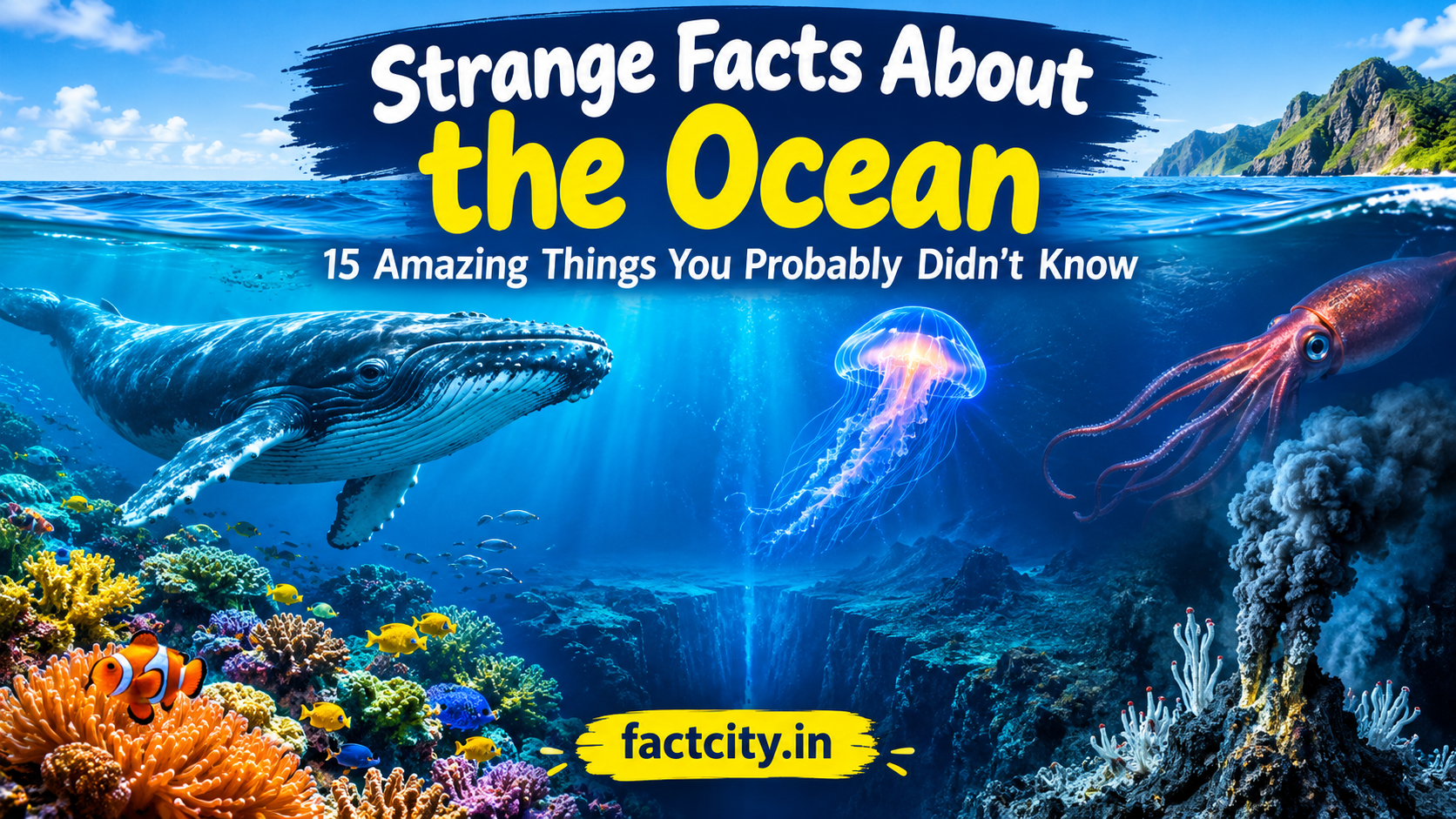
Strange Facts About the Ocean: Bioluminescence can serve different purposes. Some creatures use it to attract prey, while others produce flashes of light to confuse predators or communicate with other members of their species.
In some places, bioluminescent plankton can make waves and shorelines glow blue at night. This beautiful phenomenon occurs when the organisms are disturbed by movement in the water.
5. The Ocean Has Underwater Mountains
Many people imagine the ocean floor as a flat surface, but it actually contains a wide variety of landscapes. Underwater mountains, known as seamounts, rise from the ocean floor without reaching the surface. Some are formed by volcanic activity, while others develop through different geological processes. “Strange Facts About the Ocean“
The ocean floor also contains deep valleys, vast plains, ridges, and canyons. These underwater structures influence ocean currents and create habitats for many marine species. Seamounts can provide feeding and breeding areas for fish, corals, and other organisms, making them important parts of ocean ecosystems.
6. There Are Lakes and Rivers Beneath the Sea
It may sound impossible, but scientists have discovered underwater features that resemble lakes and rivers. These formations can occur when extremely salty water, called brine, collects in depressions on the seafloor. Because this water is denser than the surrounding seawater, it can form a distinct pool with a visible boundary.
Some underwater brine pools even have shore-like edges and surface-like ripples. They are sometimes called underwater lakes. Deep-sea brine pools can contain chemicals at concentrations that are harmful to many marine animals. However, certain specialized organisms can survive around their edges, creating unusual habitats beneath the ocean.
7. Some Marine Animals Can Survive Without Sunlight
Sunlight is essential for photosynthesis, but not every marine ecosystem depends directly on it. Around hydrothermal vents on the ocean floor, hot, mineral-rich water escapes through cracks in Earth’s crust. These environments can support communities of organisms despite the complete absence of sunlight.
Certain bacteria use chemical energy from substances such as hydrogen sulfide to produce organic matter. This process is called chemosynthesis. The bacteria provide the foundation of a food web that can include tube worms, clams, mussels, and other animals. These ecosystems show that life can thrive in conditions very different from those found on the surface.
8. The Ocean Contains Enormous Amounts of Salt
Ocean water tastes salty because it contains dissolved minerals and salts. Sodium and chloride are the main ions responsible for the familiar salty taste. On average, seawater has a salinity of about 35 parts per thousand, meaning approximately 35 grams of dissolved salts per kilogram of seawater.
However, salinity is not the same everywhere. Evaporation, rainfall, river water, and the formation or melting of sea ice can all affect how salty the water becomes. These differences influence water density, which helps drive important ocean circulation patterns around the planet.
9. Some Fish Change Their Sex During Their Lives
One unusual fact about marine life is that some fish can change sex during their lifetime. This biological process is known as sequential hermaphroditism. Depending on the species, an individual may change from male to female or from female to male.
For example, clownfish live in social groups in which a dominant breeding female and a breeding male typically occupy the main reproductive roles. If the female dies, the breeding male can change into a female. Certain wrasses show the opposite pattern, with individuals changing from female to male under particular social conditions. These adaptations help some species reproduce successfully in changing environments.
10. The Ocean Produces a Large Share of Earth’s Oxygen
The ocean plays a major role in the global oxygen cycle. Tiny photosynthetic organisms, including phytoplankton, use sunlight and carbon dioxide to produce organic matter and release oxygen. Scientists commonly estimate that marine photosynthesis accounts for roughly half of the oxygen produced globally, although the exact proportion varies with the methods and time periods used.
However, this does not mean that half of the oxygen we breathe today comes directly from the ocean each moment. Oxygen production and consumption occur continuously on land and in water. Healthy marine ecosystems are important for maintaining the balance of Earth’s natural systems.
11. The Ocean Has Powerful Underwater Currents
Ocean currents move enormous amounts of water across the planet. They are influenced by wind, differences in temperature and salinity, Earth’s rotation, and the shape of ocean basins. Some currents travel near the surface, while others move deep below it. These movements help transport heat from warmer regions toward cooler areas, influencing weather and climate. They also carry nutrients that support marine food webs.
Ocean currents can even transport floating objects, including natural debris and human-made waste, over long distances. Understanding these currents helps scientists study climate change, marine ecosystems, and the movement of pollutants.
12. Giant Squid Live in the Deep Ocean
The giant squid is one of the most fascinating animals in the sea. It can grow to an impressive size, with some estimates suggesting total lengths of around 10 to 13 meters when its long feeding tentacles are included.
These animals inhabit deep ocean waters and are rarely observed alive in their natural environment. Giant squids have large eyes that help them detect light in the darkness of the deep sea. They are also equipped with powerful arms and tentacles used to capture prey.
For many years, much of what scientists knew about giant squids came from dead specimens found in fishing nets or washed ashore. Modern cameras and research equipment have helped reveal more about their behavior.
13. The Ocean Can Create Waves of Enormous Size
Ocean waves can become extremely powerful during severe storms. Strong winds transfer energy to the water, producing waves that can travel across large distances. In addition to ordinary wind-driven waves, the ocean can produce tsunamis. These waves are usually caused by underwater earthquakes, volcanic eruptions, or landslides that suddenly displace large amounts of water.
Unlike typical storm waves, a tsunami can travel across an entire ocean basin. In deep water, it may have a relatively small height, but it can grow dramatically as it approaches shallow coastal areas. Tsunamis are dangerous natural events, which is why monitoring systems and early-warning networks are so important.
14. Coral Reefs Support an Incredible Variety of Life
Coral reefs cover a relatively small portion of the ocean floor, yet they support an exceptionally rich diversity of marine life. They provide shelter, feeding grounds, and breeding areas for many fish, crustaceans, mollusks, and other organisms.
Corals are animals that often live in partnership with microscopic algae. These algae provide much of the energy that helps reef-building corals grow in clear, sunlit waters. Unfortunately, rising ocean temperatures, pollution, and other environmental pressures threaten coral reefs in many parts of the world. Protecting these ecosystems is important for marine biodiversity and the communities that depend on healthy reefs.
15. The Ocean Helps Regulate Earth’s Climate
The ocean absorbs a substantial amount of the excess heat trapped by greenhouse gases and takes up carbon dioxide from the atmosphere. This process helps slow some aspects of global warming, but it also creates serious challenges for marine ecosystems. As the ocean absorbs carbon dioxide, seawater becomes more acidic. This process, known as ocean acidification, can make it more difficult for certain organisms to build shells and skeletons from calcium carbonate.
Warmer ocean temperatures can also contribute to coral bleaching, shifts in marine species distributions, and changes in ocean circulation. The ocean is therefore both a major part of Earth’s climate system and an environment vulnerable to human-driven changes.
Why Are Ocean Facts So Fascinating?
The ocean is fascinating because it combines familiar natural beauty with environments that are difficult for humans to reach. Its deepest regions contain unusual life forms, its currents connect distant parts of the world, and its ecosystems influence the climate and support countless organisms.
Every discovery adds another piece to our understanding of the planet. From glowing plankton to deep-sea hydrothermal vents, the ocean reminds us that Earth still holds many mysteries worth exploring.
Conclusion
These 15 strange facts about the ocean show that the underwater world is far more complex than it may appear from the shore. The ocean contains the deepest known places on Earth, extraordinary marine animals, unusual underwater landscapes, and ecosystems that can exist without sunlight. It also plays a vital role in producing oxygen, supporting biodiversity, and regulating the global climate. why-is-space-completely-silent
Although scientists have made remarkable progress in ocean exploration, many questions remain unanswered. By supporting marine research, reducing plastic pollution, and protecting vulnerable habitats, we can help preserve this remarkable environment for future generations.
Frequently Asked Questions (FAQs)
1. What is the strangest fact about the ocean?
One fascinating fact is that some deep-sea ecosystems survive without sunlight. Around hydrothermal vents, bacteria use chemical energy to support food webs that include unusual marine animals.
2. How much of the ocean has been explored?
There is no single percentage that describes all forms of ocean exploration. Scientists have mapped much of the seafloor at a broad scale, but detailed mapping and direct exploration of many deep-sea environments remain incomplete.
3. What is the deepest part of the ocean?
Challenger Deep in the Mariana Trench is the deepest known point in the ocean, reaching approximately 11 kilometers below sea level.
4. Can animals glow in the ocean?
Yes. Certain jellyfish, squid, fish, and plankton produce light through bioluminescence, which can help them attract prey, communicate, or avoid predators.
5. Why is the ocean important to humans?
The ocean helps regulate Earth’s climate, supports food supplies and livelihoods, contributes to the oxygen cycle, and provides habitats for a vast range of living organisms.