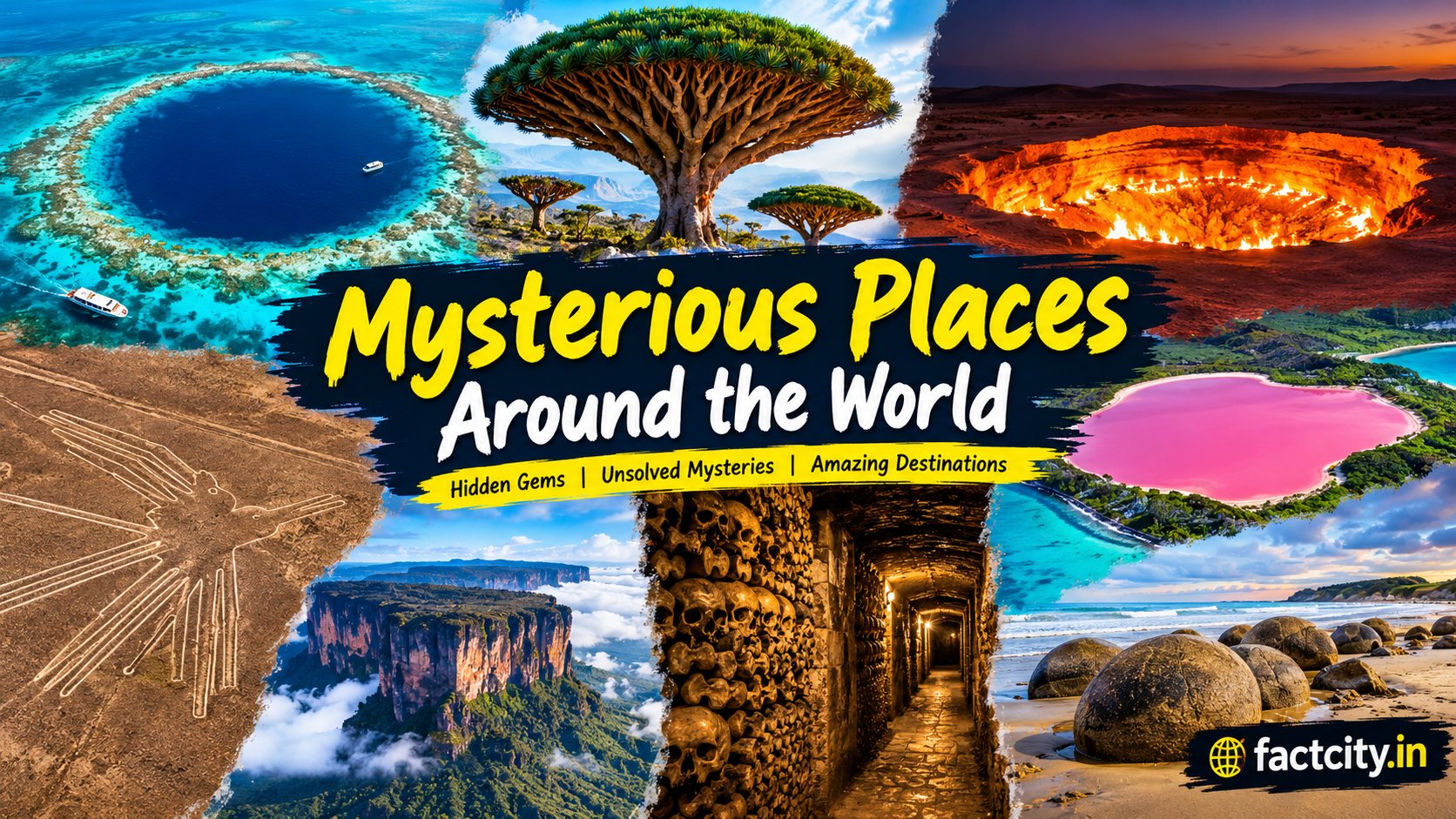
Mysterious Places Around the World. Our planet is full of incredible places that seem almost unbelievable. From islands covered in unusual trees to ancient cities hidden inside mountains, many destinations continue to surprise travelers and researchers. Some are famous for their strange natural formations, while others are connected to old legends, unexplained events, and fascinating historical discoveries.
The most interesting thing about these mysterious places around the world is that many of them have scientific explanations, yet they still leave people with countless questions. Their unusual landscapes, forgotten histories, and unique environments make them feel like something from a fantasy story. If you enjoy discovering unusual destinations and learning about the secrets of our planet, these mysterious places deserve a place on your travel bucket list.
1. The Bermuda Triangle, Atlantic Ocean
The Bermuda Triangle is one of the most famous mysterious locations in the world. It is a region of the Atlantic Ocean commonly described as lying between Florida, Bermuda, and Puerto Rico. Over the years, stories about missing ships and aircraft have made this area popular among mystery lovers. Some people believe that unusual magnetic forces, underwater phenomena, or even extraterrestrial activity could explain the disappearances reported in the region. These theories have appeared in books, documentaries, and television programs.
However, there is no reliable scientific evidence that the Bermuda Triangle has supernatural properties. Many incidents can be explained by severe weather, human error, navigation problems, and the large amount of maritime traffic passing through the area. Despite these explanations, the Bermuda Triangle remains a fascinating example of how real events and popular storytelling can combine to create a lasting mystery.
2. Socotra Island, Yemen
Socotra Island is one of the most unusual-looking places on Earth. Located in the Arabian Sea near the Horn of Africa, this island is famous for its strange plants, dramatic landscapes, and remarkable biodiversity. Its most recognizable plant is the dragon blood tree, which has an umbrella-shaped canopy and produces a dark red resin. When viewed from a distance, these trees can make the landscape look like something from another planet.
Socotra is home to many plant species that naturally occur nowhere else in the world. Its isolation over millions of years allowed unique forms of life to develop. Although the island’s appearance may seem mysterious, scientists explain its unusual biodiversity through evolution, geography, and long-term isolation. The real wonder of Socotra is that nature has created an environment so different from those found in most other parts of the world.
3. The Door to Hell, Turkmenistan
A burning crater in the Karakum Desert. The Darvaza gas crater, popularly known as the Door to Hell, is one of the strangest sights in Central Asia. Located in Turkmenistan’s Karakum Desert, this large crater has become famous for its persistent flames. The crater is associated with a gas-field collapse that occurred during Soviet-era exploration. Natural gas escaping from the ground was ignited, reportedly to reduce the spread of methane. The fire continued far longer than expected, turning the site into a remarkable attraction.
At night, the bright flames illuminate the surrounding desert, creating an eerie scene that looks almost unreal. The contrast between the dark landscape and the glowing crater makes it particularly memorable. The exact details of the crater’s origin and ignition are not fully documented in every account, which has contributed to its mysterious reputation. Nevertheless, its burning appearance is linked to natural gas rather than supernatural activity.
4. The Nazca Lines, Peru
The Nazca Lines are enormous designs created on the dry desert plains of southern Peru. They include straight lines, geometric shapes, and figures resembling animals such as monkeys, spiders, and hummingbirds. Many of these designs were created by the Nazca culture centuries ago. The lines were formed by removing the dark stones on the desert surface to reveal the lighter ground beneath them.
Some figures are so large that their shapes are easiest to recognize from the air. This has led to questions about why the ancient people created them and how they planned such enormous designs.
Researchers have proposed several explanations, including religious ceremonies, ritual landscapes, and connections with water or agricultural practices. Different designs may have served different purposes. Although the exact meaning of every figure remains uncertain, the Nazca Lines demonstrate the impressive planning and cultural knowledge of the people who created them.
5. The Island of the Dolls, Mexico
The Island of the Dolls, or Isla de las Muñecas, is a small island in the canals of Xochimilco near Mexico City. It is known for hundreds of old dolls hanging from trees, buildings, and other structures. Many dolls are weathered, damaged, and missing parts, giving the island an unsettling appearance. Its unusual decoration has inspired ghost stories and attracted visitors interested in folklore and the paranormal.
According to a popular local story, a man named Don Julián Santana Barrera began hanging dolls around the island after a tragic incident involving a young girl. He reportedly believed the dolls could protect the area or appease a spirit. The story has become an important part of the island’s reputation, although some details come from local accounts rather than independently verified historical records. Today, the Island of the Dolls is a reminder of how local traditions, personal beliefs, and unusual sights can transform an ordinary location into a world-famous mystery.
6. Mount Roraima, South America
Mount Roraima is a remarkable flat-topped mountain located in the Guiana Highlands, where Venezuela, Guyana, and Brazil meet. Its towering cliffs and cloud-covered summit create the impression of a giant stone island rising above the surrounding landscape. The mountain belongs to a group of ancient geological formations known as tepuis. These mountains have steep sides and broad, relatively flat tops shaped by millions of years of geological processes and erosion.
The summit contains unusual rock formations, small streams, and plant life adapted to its distinctive environment. Some species found on tepuis are highly specialized and may occur only in these isolated habitats. Because the summit is often surrounded by clouds and difficult terrain, Mount Roraima has inspired countless stories and adventure narratives. Its dramatic appearance helped influence descriptions of fictional lost worlds. The mystery of Mount Roraima lies less in supernatural events and more in its ancient geology, isolated ecosystem, and extraordinary natural beauty.
7. The Great Blue Hole, Belize
The Great Blue Hole is a giant circular marine sinkhole located near Lighthouse Reef off the coast of Belize. Its deep blue color stands out against the lighter turquoise waters surrounding it. The hole formed when the area was above sea level and caves developed in limestone. As sea levels rose, the cave system flooded, leaving behind a deep underwater formation. The Great Blue Hole is approximately 300 meters wide and more than 120 meters deep. Its nearly circular shape makes it especially striking when viewed from above.
Divers visit the site to explore its underwater environment, although diving there requires appropriate training and attention to safety. The deeper sections contain geological evidence of the region’s changing climate and sea levels. The Great Blue Hole looks mysterious because of its dark center and immense depth. Yet it also provides valuable information about Earth’s geological history.
8. The Catacombs of Paris, France
Beneath the busy streets of Paris lies a vast network of underground tunnels and former limestone quarries. A section of this underground system became the Paris Catacombs, an ossuary containing the remains of millions of people. The remains were transferred there mainly during the late eighteenth and early nineteenth centuries, when overcrowded cemeteries created serious public health concerns. Today, carefully arranged human bones line parts of the catacombs, creating a striking and unsettling atmosphere. Visitors can explore an authorized section of the underground site and learn about the history of the city.
However, the catacombs are much larger than the official visitor route. Entering closed tunnels without permission can be dangerous because of confusing passages, unstable areas, and the risk of getting lost. The combination of underground architecture, human history, and darkness makes the Paris Catacombs one of Europe’s most intriguing places.
9. Lake Hillier, Australia
Lake Hillier, located on Middle Island off the coast of Western Australia, is famous for its unusual pink color. Seen from above, the lake can appear like a bright pink patch surrounded by green vegetation and blue ocean water. The lake’s color is associated with microorganisms and other biological and chemical conditions in its highly saline environment. Similar pink lakes around the world can owe their colors to combinations of salt-loving algae, bacteria, and other microorganisms.
Lake Hillier has attracted attention because its color contrasts so strongly with the surrounding landscape. However, the exact contribution of different organisms and environmental factors can vary between pink lakes. Its appearance is a reminder that nature can produce colors that seem artificial but arise through natural processes. Access to Middle Island is limited, so travelers should check current local rules and available tour options before planning a visit.
10. The Moeraki Boulders, New Zealand
Along Koekohe Beach on New Zealand’s South Island, large, nearly spherical boulders rest on the sand. Known as the Moeraki Boulders, these unusual formations look like enormous stone balls scattered along the coastline. The boulders formed within ancient marine mudstone through a process called concretion. Minerals gradually accumulated around a central point, creating rounded masses over millions of years.
Erosion eventually exposed the boulders as the surrounding softer rock wore away. Some have cracked surfaces, while others remain remarkably round. Local Māori traditions offer their own cultural explanations for the boulders, connecting them with stories about the ancestral canoe Ārai-te-uru. These traditions give the landscape cultural significance beyond its geological features. The Moeraki Boulders are a wonderful example of how geology and cultural storytelling can make an ordinary stretch of coastline feel extraordinary. unbelievable-facts-about-space-that-will-blow
Why Are Mysterious Places Around the World So Fascinating?
Mysterious destinations attract people for several reasons. Some contain unanswered historical questions, while others feature landscapes that look completely different from anything visitors have seen before. Human beings naturally want to understand things that appear unusual. When we encounter an unexplained structure, an unfamiliar natural formation, or an old legend, curiosity encourages us to search for answers.
In many cases, scientific research gradually explains what once seemed impossible. Archaeology helps us understand ancient civilizations, geology explains unusual landforms, and biology reveals how unique ecosystems develop.
At the same time, not every historical question has been completely answered. Researchers may still debate the original purpose of an ancient monument or the precise reasons a particular cultural tradition developed. The most rewarding approach is to enjoy these mysteries while separating documented evidence from speculation. This allows us to appreciate both the wonder of a place and the knowledge that science continues to uncover.
Conclusion
The world is filled with mysterious places that reveal just how extraordinary our planet can be. From the unusual dragon blood trees of Socotra to the enormous Nazca Lines of Peru, each destination offers a different combination of natural beauty, history, culture, and unanswered questions.
Some locations have inspired ghost stories and legends, while others have challenged researchers to understand ancient civilizations or unusual geological formations. Many mysteries have scientific explanations, but their stories remain fascinating because they connect us with the unknown. Exploring these destinations can help us learn more about Earth’s past, appreciate different cultures, and understand the importance of protecting unique natural environments.