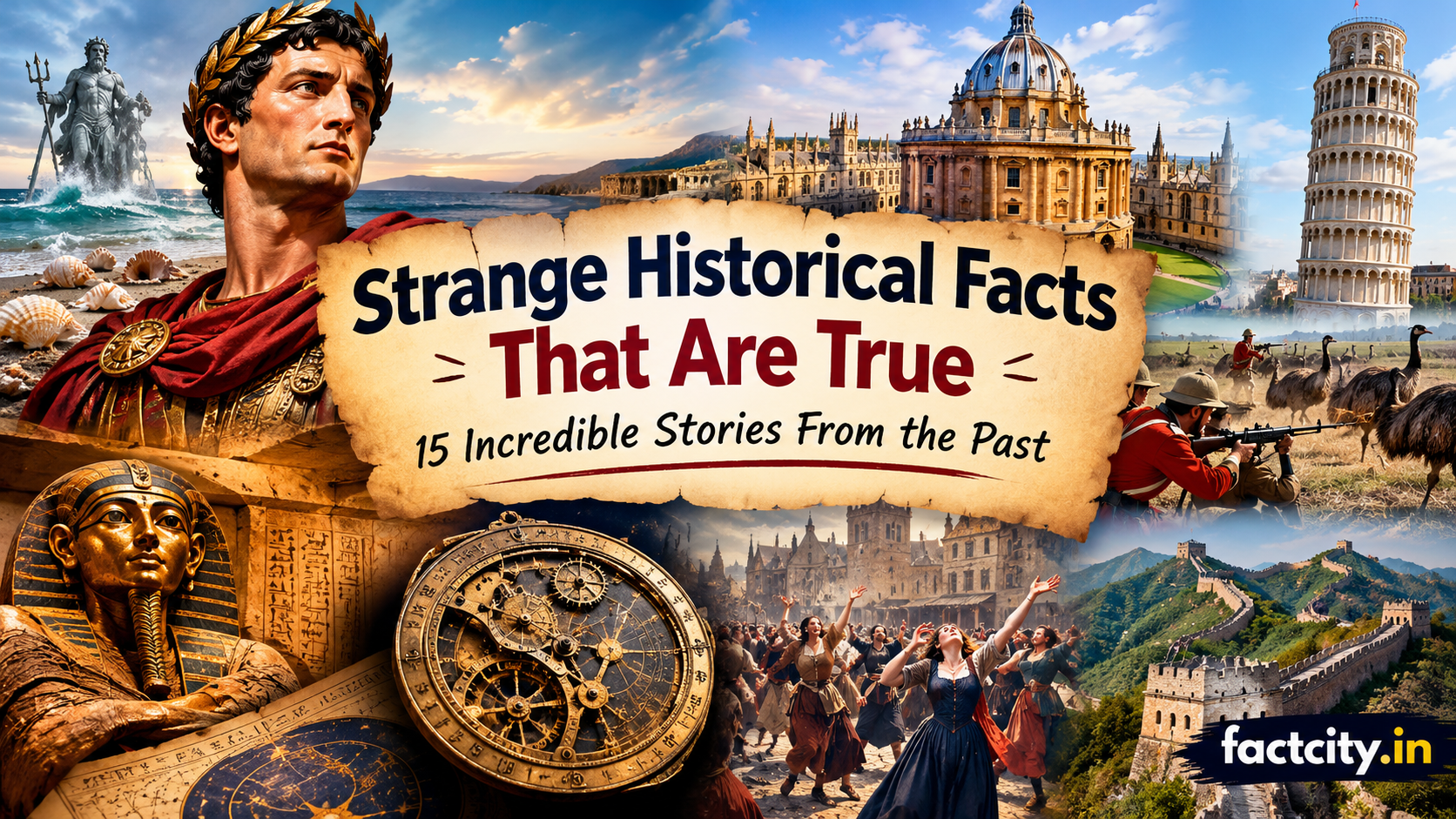
Strange Historical Facts That Are True: History is full of strange events, unusual traditions, and surprising discoveries that sound almost impossible to believe. We often learn about kings, wars, ancient civilizations, and famous historical figures in school, but there are many lesser-known stories that are even more fascinating. Some historical events were so unusual that they seem like scenes from a movie, yet they are supported by historical records and research.
From a war that lasted less than an hour to an emperor who reportedly declared war on the sea, the past is filled with unexpected moments. These strange historical facts that are true reveal how unpredictable human history can be. If you enjoy learning about unusual events, forgotten stories, and surprising facts about the world, these examples will give you a fresh perspective on the past.
1. The Shortest War in History Lasted Less Than an Hour
One of the strangest historical facts concerns the Anglo-Zanzibar War, which took place on August 27, 1896. The conflict was fought between the British Empire and the Sultanate of Zanzibar, an island territory off the coast of East Africa. The dispute began after the death of Zanzibar’s previous sultan. The British government supported one candidate for the throne, but Khalid bin Barghash took power without British approval. The British demanded that he step down, but he refused. As a result, British warships opened fire on the sultan’s palace.
The fighting ended in approximately 38 to 45 minutes, making it widely recognized as the shortest recorded war in history. Zanzibar’s forces suffered heavy casualties, while the British experienced very few. Although the conflict was brief, it demonstrated the enormous military advantage the British Empire held over Zanzibar at that time.
2. An Ancient Roman Emperor Reportedly Declared War on the Sea
Roman Emperor Caligula is remembered for stories about his unusual behavior and extravagant decisions. One famous account claims that he ordered his soldiers to collect seashells as the spoils of victory after a supposed campaign against the sea. According to the ancient Roman writer Suetonius, Caligula commanded his troops to gather shells on the shore as evidence of their victory over Neptune, the Roman god of the sea. The story has become one of the most bizarre episodes associated with the emperor. “Strange Historical Facts That Are True“
However, historians debate how literally this account should be understood. Ancient writers sometimes portrayed emperors in exaggerated or hostile ways, especially when describing unpopular rulers. Whether the incident happened exactly as described remains uncertain, but the story continues to fascinate people interested in strange historical facts.
3. Napoleon Was Once Attacked by a Group of Rabbits
Napoleon Bonaparte was one of the most powerful military leaders in European history, but one unusual story suggests that he once faced an embarrassing encounter with rabbits. According to a widely repeated account, Napoleon arranged a rabbit hunt during which hundreds of rabbits were released for him and his companions to chase. Instead of running away, the rabbits reportedly rushed toward Napoleon and the hunting party.
The explanation often given is that the rabbits had been raised by people and expected to receive food. When they saw the approaching group, they moved toward it rather than fleeing. Napoleon and his companions supposedly had to retreat from the unexpectedly enthusiastic animals. The exact details of the incident are difficult to verify, and versions of the story differ. Nevertheless, it remains a memorable example of how even famous military leaders can become part of unusual historical anecdotes.
4. The Great Fire of London Changed the City’s Future
In September 1666, a devastating fire swept through London, destroying thousands of homes and many important buildings. The fire reportedly began in a bakery on Pudding Lane and spread rapidly through the crowded streets, where many buildings were constructed from timber and other flammable materials. The Great Fire of London burned for several days and destroyed a large part of the city’s central area. Thousands of homes were lost, and important landmarks, including the original medieval St Paul’s Cathedral, were severely damaged or destroyed.
Surprisingly, the disaster also created an opportunity to rebuild parts of London. New construction practices, improved street layouts, and changes in building regulations gradually influenced the city’s development. Although the fire caused enormous suffering and financial loss, it became a major turning point in London’s architectural history.
5. Oxford University Is Older Than the Aztec Empire
Many people assume that ancient American civilizations existed long before European universities appeared. However, one surprising historical comparison challenges this assumption. Teaching at the University of Oxford can be traced back to at least 1096, making it one of the oldest universities in the English-speaking world. The Aztec Empire, on the other hand, developed much later, becoming a major power in central Mexico during the 15th century.
This means that organized teaching at Oxford existed centuries before the Aztec Empire rose to prominence. The comparison is fascinating because it shows that different societies developed complex institutions at very different times. It is important to remember that the Aztec civilization had its own rich traditions, knowledge systems, architecture, and education. Comparing dates does not make one civilization more advanced than another; it simply highlights the surprising timelines of world history.
6. Ancient Egyptians Used More Than One Method to Preserve Bodies
Ancient Egypt is famous for mummies, but not everyone in ancient Egyptian society received the same burial treatment. The process of preserving bodies depended on a person’s wealth, social position, religious beliefs, and the customs of the period. Wealthy Egyptians could afford elaborate mummification, which involved removing certain internal organs, treating the body with natron, and wrapping it in linen. The goal was to preserve the body for the afterlife, an important part of ancient Egyptian religious belief.
People with fewer resources often received simpler burial treatments. Archaeological discoveries have also shown that natural conditions, including the dry desert environment, could preserve bodies without elaborate human intervention. The surprising part is that mummification was not simply a mysterious ritual. It involved practical knowledge of drying, preservation, materials, and religious traditions developed over many centuries.
7. A Dancing Mania Swept Through Parts of Europe
During the summer of 1518, the city of Strasbourg experienced an unusual event known as the Dancing Plague. Historical accounts describe a woman beginning to dance in the street, followed by other people who continued dancing for extended periods. The incident reportedly involved dozens and possibly hundreds of people over time, although the exact number remains uncertain. Some accounts claim that participants danced until they collapsed from exhaustion.
Historians and medical researchers have proposed different explanations, including mass psychogenic illness, extreme stress, and possible cultural or religious influences. However, no single explanation has been conclusively established. The event is particularly strange because it shows how difficult it can be to understand unusual collective behavior using modern knowledge alone. It remains one of the most discussed mysteries in European history.
8. The World’s Oldest Known Peace Treaty Was Signed Thousands of Years Ago
Peace agreements may seem like a modern diplomatic practice, but ancient civilizations also negotiated arrangements to end conflicts and establish political relationships. One famous example is the Egyptian-Hittite peace treaty associated with Egyptian Pharaoh Ramesses II and the Hittite king Hattusili III. The agreement followed years of conflict between the two powers and is generally dated to around 1259 BCE.
The treaty established peaceful relations and included provisions concerning mutual assistance and the treatment of political rivals. Versions of the agreement were recorded in different forms, including inscriptions in Egypt and clay tablets associated with the Hittites. The treaty is often described as one of the oldest known surviving international peace agreements. Its existence shows that diplomacy, negotiation, and political cooperation played important roles in the ancient world, just as they do today.
9. Australia Once Declared War on Emus
In 1932, Australia experienced an unusual episode known as the Emu War. Farmers in Western Australia were struggling with large numbers of emus damaging crops, particularly in agricultural areas affected by difficult economic conditions. The Australian government authorized military personnel to use machine guns in an attempt to control the birds. However, the emus proved surprisingly difficult to manage. They moved in groups, scattered quickly, and were not easily stopped by the military operation.
The campaign attracted public attention and became known as the Emu War, even though it was not a conventional war between nations. The initial effort was unsuccessful enough to become a lasting source of humor and historical discussion. The episode highlights the difficulties of managing wildlife populations and demonstrates that military equipment is not necessarily an effective solution to every problem.
10. Ancient Greeks Used a Device That Predicted Astronomical Events
The Antikythera mechanism is one of the most remarkable archaeological discoveries ever made. It was recovered from an ancient shipwreck near the Greek island of Antikythera in 1901. The device contains a complex arrangement of bronze gears and is generally dated to around the second or first century BCE. Researchers believe it was designed to calculate and display astronomical cycles, including the positions of celestial bodies and the timing of eclipses.
Its complexity surprised historians because it demonstrated a level of mechanical engineering that was not fully appreciated in the ancient Greek world. The mechanism is sometimes described as an early analog computer. Although many details of its operation have been reconstructed, researchers continue to study the device to better understand its original functions. It provides powerful evidence that ancient engineers possessed sophisticated mathematical and mechanical knowledge.
11. The Leaning Tower of Pisa Was Leaning Almost From the Beginning
The Leaning Tower of Pisa in Italy is one of the world’s most recognizable landmarks. What makes it unusual is that its famous tilt was not an intentional architectural feature. Construction began in 1173, but the tower started leaning while it was still being built. The main reason was the soft ground beneath the structure, combined with a foundation that was not deep enough to provide adequate support.
Construction continued in stages over many years, and builders attempted to compensate for the tilt. Over the centuries, the tower’s angle became more pronounced, creating concerns about its stability. Modern engineering work has helped stabilize the structure and reduce the risk of collapse. Today, the tower attracts visitors from around the world, proving that an architectural problem can sometimes become a landmark’s most famous feature.
12. A War Between Britain and the Netherlands Continued for Centuries Without Fighting
One unusual historical story concerns the so-called Three Hundred and Thirty-Five Years’ War between the Netherlands and the Isles of Scilly, a group of islands off the southwestern coast of England. The conflict is traditionally said to have begun in 1651, during the English Civil War, when the Isles of Scilly were associated with Royalist forces opposed to Parliament. Dutch representatives reportedly declared war because Dutch ships had suffered losses during the conflict.
No actual fighting took place between the Netherlands and the islands as part of this supposed war. The story continued for centuries largely because no formal peace treaty had been signed. In 1986, a peace agreement was finally signed, bringing the unusual historical claim to an end. However, historians have questioned aspects of the traditional account, including whether a formal declaration of war was genuinely made. The story remains an entertaining example of how diplomatic misunderstandings can become historical legends.
13. Ancient Romans Had Public Toilets and Shared Washing Facilities
Modern plumbing is often associated with recent technological development, but the Romans created impressive public sanitation systems more than two thousand years ago. Roman cities featured aqueducts that transported water over long distances, public baths, drainage systems, and communal toilets. Some public toilets consisted of long stone benches with openings placed side by side, allowing several people to use the facilities at once.
These systems were not identical to modern sanitation infrastructure, and access varied between social groups and locations. Nevertheless, Roman engineering helped support the daily lives of large urban populations. The Romans also understood the importance of water management, although their sanitation systems did not eliminate all public health problems. Their infrastructure remains an important example of how ancient societies addressed practical challenges through engineering.
14. The First Modern Olympic Games Were Held in 1896
Today, the Olympic Games are one of the world’s largest international sporting events. However, the modern Olympics began on a much smaller scale than the global competition we know today. The first modern Summer Olympic Games opened in Athens, Greece, in April 1896. The event was organized through the efforts of Pierre de Coubertin and other supporters who wanted to revive the spirit of the ancient Greek Olympic Games.
Athletes from several countries competed in sports such as athletics, gymnastics, wrestling, swimming, and cycling. The event helped establish the foundation for the modern Olympic movement. Although the ancient Olympic Games had existed in Greece centuries earlier, the modern competition introduced a new international structure that gradually expanded over time. This historical connection between ancient traditions and modern sporting culture is one of the most interesting examples of history repeating itself in a new form.
15. The Great Wall of China Cannot Easily Be Seen From the Moon
One of the most widespread historical myths claims that the Great Wall of China is visible from the Moon with the naked eye. The idea has appeared in popular discussions for generations, but it is misleading. The Great Wall is an extraordinary construction project that developed over many centuries. Different sections were built, connected, repaired, and expanded by various Chinese states and dynasties. Some sections stretch across mountains, deserts, and other difficult landscapes.
However, the wall is relatively narrow compared with the enormous distance between Earth and the Moon. It is not realistically visible to the unaided human eye from the lunar surface. Under certain conditions, parts of human infrastructure may be difficult to distinguish even from much closer distances in space. The myth illustrates how impressive historical achievements can inspire stories that are not supported by scientific evidence.
Why Are Strange Historical Facts So Interesting?
Strange historical facts attract attention because they challenge our assumptions about the past. We often imagine history as a collection of predictable events involving kings, battles, empires, and political decisions. Yet unusual stories reveal a more complicated picture of human life. why-do-airplanes-leave-white-lines-in-the-sky
Some events, such as the Dancing Plague of 1518, remain difficult to explain fully. Others, including the Anglo-Zanzibar War and the Antikythera mechanism, are supported by historical records and archaeological evidence. Distinguishing between documented facts, debated accounts, and popular legends helps us understand history more accurately. Learning about unusual historical events can also make the past easier to remember. A surprising story about ancient engineering or an unexpected military failure may encourage readers to explore a period in greater depth.
Conclusion
These strange historical facts that are true show that the past is far more surprising than many people realize. From the remarkably short Anglo-Zanzibar War to the sophisticated Antikythera mechanism, history contains events and discoveries that challenge our expectations.
At the same time, not every unusual historical story is completely accurate. Some accounts were exaggerated by ancient writers, while others became popular myths through repetition. Looking at the available evidence allows us to separate well-documented events from stories that remain uncertain. If you enjoy discovering unusual facts about history, keep exploring different civilizations, archaeological discoveries, and forgotten events. The more you learn, the clearer it becomes that real history can be just as fascinating and unexpected as fiction.