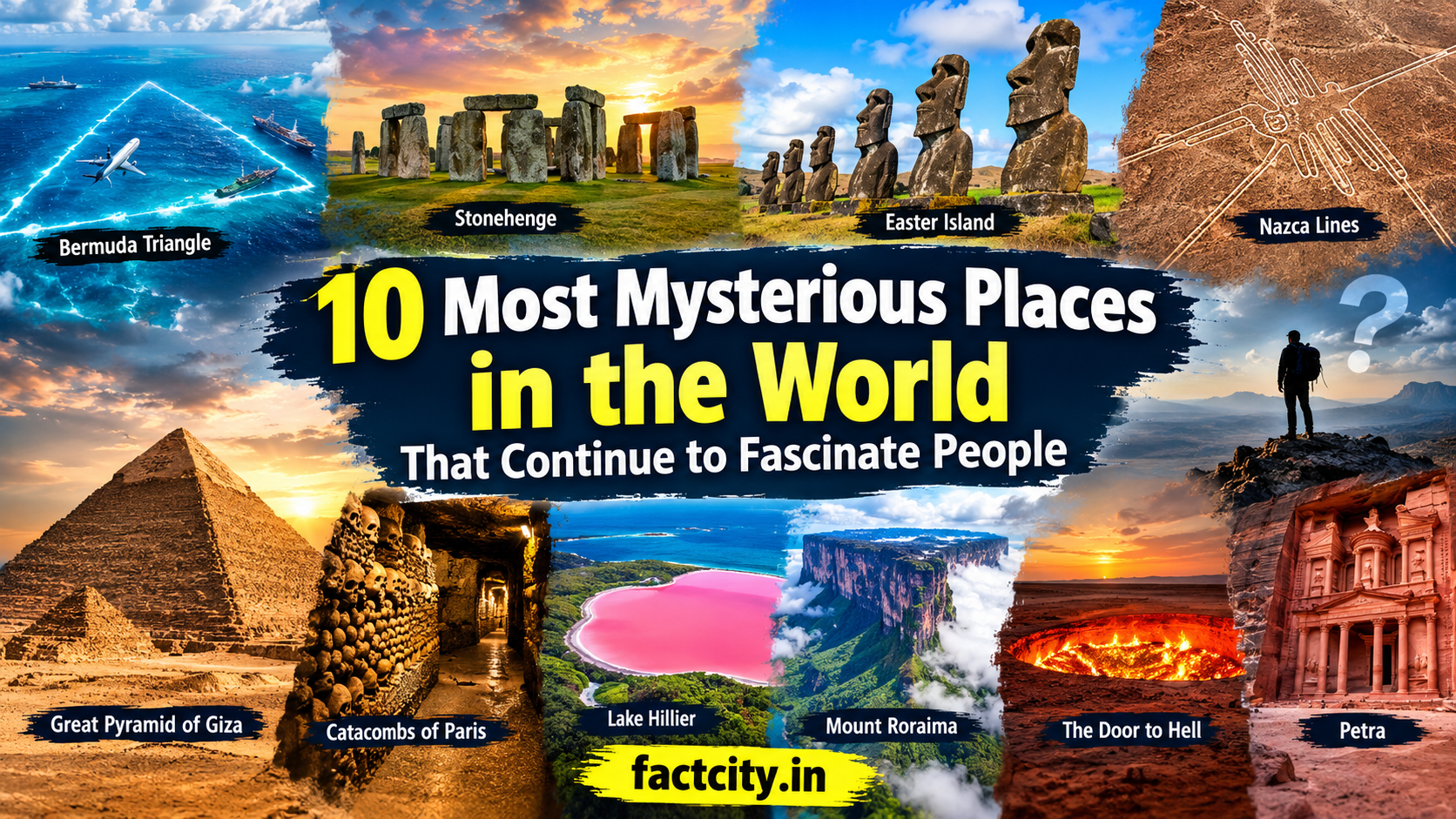
10 Most Mysterious Places in the World. The world is full of extraordinary places that attract travelers, historians, scientists, and curious minds. Some are famous for their unusual natural formations, while others are known for ancient ruins, unexplained stories, and legends passed down through generations. These destinations often raise fascinating questions about human history, nature, and the mysteries of our planet. Although modern science has helped explain many unusual discoveries, certain places still leave people wondering about their origins and hidden secrets.
The most mysterious places in the world are not always frightening or dangerous. Many are beautiful locations with remarkable landscapes and fascinating histories. From ancient stone monuments to remote islands and mysterious underground structures, each destination offers something unique to explore. In this article, we will discover ten mysterious places around the world, learn about their backgrounds, and understand why they continue to capture the imagination of people everywhere.
1. Bermuda Triangle, Atlantic Ocean
The Bermuda Triangle is one of the most famous mysterious locations in the world. It is a loosely defined area of the Atlantic Ocean commonly associated with Bermuda, Florida, and Puerto Rico. For decades, stories about missing ships and aircraft have made this region popular among mystery enthusiasts. 10 Most Mysterious Places in the World
Some accounts suggest that unusual forces, magnetic disturbances, or unexplained phenomena are responsible for disappearances in the area. However, there is no reliable scientific evidence that the Bermuda Triangle possesses supernatural properties. Weather changes, powerful storms, navigation errors, human mistakes, and heavy maritime traffic can help explain many incidents associated with the region.
Despite these explanations, the Bermuda Triangle remains a popular subject in books, documentaries, and online discussions. Its combination of real maritime risks and dramatic stories has made it one of the world’s most recognizable mysteries.
2. Stonehenge, England
Stonehenge is an ancient prehistoric monument located on Salisbury Plain in Wiltshire, England. It consists of enormous standing stones arranged in a circular pattern, and its construction began approximately 5,000 years ago. The monument was developed over several stages, making it an important archaeological site for understanding ancient societies.
One of the biggest questions surrounding Stonehenge is how prehistoric people transported and positioned such heavy stones without modern machinery. Researchers have proposed different methods involving wooden structures, sledges, ropes, and coordinated human effort. Archaeologists also believe the monument had ceremonial, religious, and possibly astronomical significance.
Although many aspects of Stonehenge have been investigated, researchers continue to study its construction, changing uses, and cultural importance. The combination of impressive engineering and ancient history makes it one of the most mysterious places in the world.
3. Easter Island, Chile
Easter Island, also known as Rapa Nui, is a remote island in the southeastern Pacific Ocean that belongs to Chile. It is internationally famous for its enormous stone statues called moai. These statues were created by the island’s Polynesian inhabitants and represent an extraordinary achievement in traditional craftsmanship.
The moai vary in size, and many were carved from volcanic rock. Some stand near ceremonial platforms along the coastline, while others remain close to the quarries where they were produced. Researchers have investigated how the islanders carved, transported, and erected these massive figures.
Archaeological studies and traditional knowledge suggest that the statues were moved using organized methods, potentially including upright rocking techniques. Their precise purposes and the meanings of individual statues remain subjects of research and cultural interpretation.
Easter Island is also important because of its history of environmental change, social organization, and contact with the outside world. Its remarkable statues continue to inspire questions about the creativity and resilience of ancient communities.
4. Nazca Lines, Peru
The Nazca Lines are enormous geoglyphs drawn across the desert plains of southern Peru. Created by ancient people, these designs include animals, plants, geometric patterns, and long straight lines. Some figures can be understood most clearly from elevated viewpoints because of their impressive scale.
Many of the geoglyphs were made by removing the darker surface stones to expose lighter-colored ground underneath. The dry climate has helped preserve these designs for centuries. Archaeologists generally associate many of the lines with the ancient Nazca culture, although some geoglyphs in the wider region belong to different periods.
Their exact purposes are still debated. Researchers have suggested that some may have been connected to religious ceremonies, water-related beliefs, social activities, or movement through the landscape. There is no credible evidence that extraterrestrials created them, despite popular theories that appear in entertainment and speculative accounts.
The Nazca Lines remain one of the most intriguing archaeological mysteries because their enormous designs reveal impressive planning and knowledge of the desert environment.
5. Great Pyramid of Giza, Egypt
The Great Pyramid of Giza is one of the most remarkable monuments of ancient Egypt. Built during the reign of Pharaoh Khufu more than 4,500 years ago, it was originally approximately 146.6 meters tall. It was the tallest human-made structure in the world for thousands of years.
The pyramid was constructed using enormous quantities of stone, demonstrating the engineering knowledge and organizational abilities of ancient Egyptian society. Historians believe it served as a royal tomb and formed part of a much larger funerary complex.
Researchers have discovered internal passages, chambers, and structural features that continue to attract archaeological interest. Modern scanning technologies have also identified previously unknown spaces inside the pyramid, raising new questions about its internal design.
Although the pyramid’s general purpose is well established, scientists continue to investigate the precise construction methods and the organization of the workforce involved. Its extraordinary size, mathematical precision, and age make it one of the most fascinating ancient structures on Earth.
6. The Catacombs of Paris, France
Beneath the streets of Paris lies an extensive network of underground tunnels known as the Catacombs of Paris. These tunnels developed from former limestone quarries and were later used to hold the remains of millions of people.
During the late eighteenth century, Paris faced serious problems involving overcrowded cemeteries and public health. Authorities began transferring human remains into the underground quarries, creating carefully arranged walls of bones and skulls in certain sections.
Today, the officially accessible portion of the catacombs offers visitors a remarkable look at a lesser-known side of the French capital. The underground passages have a quiet, unusual atmosphere that contrasts sharply with the busy streets above.
The catacombs are mysterious because of their scale, history, and complex network of tunnels. However, not all passages are open to the public, and unauthorized entry can be dangerous. Their history provides a fascinating reminder of how cities have dealt with changing populations, sanitation, and burial practices.
7. Lake Hillier, Australia
Lake Hillier is famous for its striking pink-colored water. Located on Middle Island in Western Australia, this unusual lake stands out against the surrounding green vegetation and the deep blue ocean nearby.
The lake’s color has attracted scientists and travelers for many years. Researchers associate its pink appearance with microorganisms, including certain salt-loving algae and bacteria, although the precise contribution of different organisms can vary. The lake’s high salt concentration also creates an environment that supports specialized life.
Unlike ordinary freshwater lakes, Lake Hillier has a distinctive chemical environment that helps explain its unusual appearance. Its bright color makes it look almost unreal in photographs, leading many people to wonder whether the water has been artificially colored.
Lake Hillier demonstrates that nature can produce remarkable sights without requiring supernatural explanations. It is a striking example of how microorganisms and environmental conditions can influence the appearance of an entire landscape.
8. Mount Roraima, South America
Mount Roraima is a spectacular flat-topped mountain located in the Guiana Highlands of South America, where Venezuela, Brazil, and Guyana meet. It is part of a geological formation known as a tepui, characterized by steep cliffs and a relatively flat summit.
The mountain’s unusual shape makes it look like a giant stone fortress rising above the surrounding landscape. Its summit often appears surrounded by clouds, adding to its mysterious appearance. The isolated environment supports distinctive plants and other forms of life, including species adapted to the area’s unusual conditions.
Mount Roraima has also inspired legends among Indigenous communities and influenced adventure literature. Reaching the summit requires careful planning, and the terrain can be challenging because of changing weather and steep approaches.
Scientists are interested in the mountain because its geological history and isolation provide opportunities to study distinctive ecosystems. Its remote location, dramatic cliffs, and unusual landscape make Mount Roraima one of the most extraordinary places in the world.
9. The Door to Hell, Turkmenistan
The Darvaza gas crater, popularly known as the Door to Hell, is located in the Karakum Desert of Turkmenistan. This enormous crater has become famous because flames and glowing gas have burned inside it for decades.
The crater is commonly linked to a Soviet-era drilling operation during the twentieth century. A widely repeated account says that the ground collapsed and released natural gas, which was then ignited to reduce the spread of methane. However, the exact circumstances and date of its formation are not fully established in every detail.
The burning crater creates a dramatic sight, particularly after sunset, when the flames illuminate the surrounding desert. Its appearance has helped make it a popular subject for travel photography and documentaries.
Despite its nickname, the crater is a geological and industrial phenomenon rather than a supernatural gateway. It also highlights the environmental challenges associated with fossil fuels and methane emissions. Its unusual appearance makes it one of the most striking mysterious destinations in Central Asia.
10. The Lost City of Petra, Jordan
Petra is an ancient archaeological city in southern Jordan, famous for its buildings carved directly into rose-colored sandstone cliffs. It was an important center of the Nabataean civilization and developed into a major trading hub connecting different regions of the ancient world.
One of Petra’s most recognizable structures is Al-Khazneh, often called the Treasury. Its elaborate facade was carved into the rock and demonstrates the remarkable artistic skills of its builders. The wider archaeological site includes tombs, temples, water channels, and other structures spread across a dramatic desert landscape.
Petra’s location helped protect parts of the city from the attention of outsiders for long periods after its importance declined. Although it was never completely unknown to local communities, its renewed international attention in the nineteenth century contributed to its reputation as a rediscovered lost city.
Researchers continue to study Petra’s architecture, water-management systems, and history. The city’s combination of natural scenery and human craftsmanship makes it one of the most fascinating historical places in the world.
Why Are Mysterious Places So Fascinating?
Mysterious destinations attract people because they combine curiosity, history, and the desire to understand the unknown. When visitors encounter an ancient monument, an unusual natural formation, or a place connected with unexplained stories, they naturally begin asking questions about its origins and purpose.
These locations also remind us that knowledge develops over time. Archaeological discoveries, scientific research, and modern technology can reveal information that was previously unavailable. In some cases, researchers have already explained the origins of a mystery, while other questions remain open because evidence is limited.
It is important to distinguish verified facts from legends and unsupported claims. A place may have a fascinating history without requiring supernatural explanations. Understanding the available evidence makes exploring these destinations even more rewarding. amazing-facts-about-the-brain-20-fascinating-things
Conclusion
The most mysterious places in the world reveal the incredible diversity of our planet and the achievements of earlier civilizations. From the ancient stones of Stonehenge and the massive pyramids of Egypt to the pink waters of Lake Hillier and the dramatic cliffs of Mount Roraima, each destination offers a different reason to explore.
Some mysteries have been partly explained through scientific research, while others continue to inspire new questions. These locations demonstrate how history, nature, and human imagination can come together to create extraordinary stories.
Whether you enjoy ancient civilizations, unusual landscapes, archaeological discoveries, or fascinating travel destinations, these ten places offer plenty to discover. Exploring them with an open mind and an interest in reliable evidence can help us appreciate both the wonders we understand and the questions that researchers are still trying to answer.