Is Challenger Deep the Deepest Point on Earth? Have you ever wondered how deep the ocean can go and what lies beneath its dark, mysterious waters? While mountains rise thousands of meters above sea level, the deepest parts of the ocean extend far below the surface into places that humans have barely explored. One of the most fascinating places on our planet is Challenger Deep, a remarkable underwater location known for being the deepest confirmed point in the Earth’s oceans. Located in the western Pacific Ocean, Challenger Deep has attracted scientists, explorers, and ocean enthusiasts for decades. Its extreme depth, enormous water pressure, and almost complete darkness make it one of the most challenging environments on Earth to study. But is Challenger Deep really the deepest point on Earth, how deep is it, and what makes this extraordinary location so special? Let’s explore the facts behind this incredible natural wonder.
Is Challenger Deep the Deepest Point on Earth?
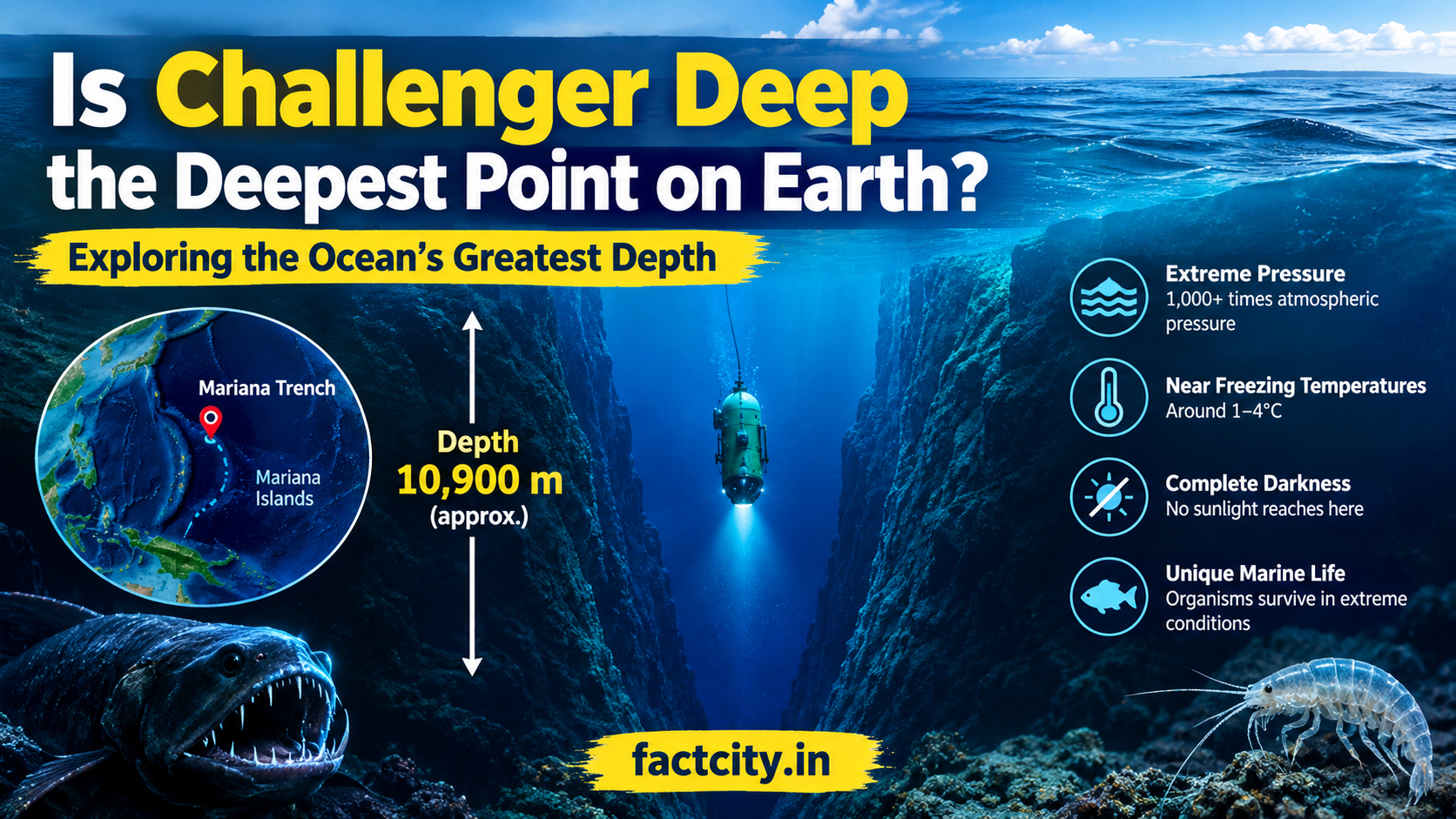
Yes, Challenger Deep is widely recognized as the deepest known point in the Earth’s oceans and is generally considered the deepest known point on the planet’s surface beneath sea level. It lies within the Mariana Trench, an enormous underwater trench in the western Pacific Ocean, east of the Mariana Islands. Although researchers have discovered many deep ocean locations, Challenger Deep remains the best-known location associated with the greatest measured ocean depth. Its deepest surveyed areas reach approximately 10,900 to 10,935 meters below sea level, although measurements vary depending on the survey method, equipment, and exact location. This means its depth is nearly 11 kilometers, making it difficult to imagine just how far below the ocean surface this place lies.
The exact depth of Challenger Deep is not a single universally agreed-upon number because measuring the deepest parts of the ocean is extremely difficult. Scientists use advanced sonar systems, pressure sensors, and specialized underwater vehicles to estimate the seafloor’s position. Differences in technology, ocean conditions, and measurement techniques can produce slightly different results. Despite these variations, scientific surveys consistently identify Challenger Deep as the deepest known part of the ocean.
Where Is Challenger Deep Located?
Challenger Deep is situated inside the Mariana Trench in the western Pacific Ocean, near the Mariana Islands. The trench stretches for approximately 2,500 kilometers and forms part of the boundary between the Pacific Plate and the smaller Mariana Plate. Challenger Deep lies toward the southern end of this vast underwater feature.
The Mariana Trench formed through a geological process called subduction. This happens when one tectonic plate moves beneath another and sinks into the Earth’s mantle. In this region, the Pacific Plate is moving beneath the Mariana Plate, gradually creating a deep depression in the ocean floor. Over millions of years, this powerful geological process has helped shape one of the most extreme environments on Earth.
Unlike a narrow hole with perfectly vertical walls, Challenger Deep consists of several deep basins and irregular sections along the seafloor. These areas have different measured depths, which helps explain why scientific reports sometimes provide slightly different figures for the deepest point.
How Deep Is Challenger Deep?
Challenger Deep reaches a depth of approximately 10.9 kilometers below sea level. To understand this measurement, imagine stacking several of the world’s tallest mountains on top of one another. Even Mount Everest, which rises about 8,849 meters above sea level, would not reach the ocean surface if placed at the bottom of Challenger Deep. Its summit would remain more than two kilometers underwater.
This comparison highlights the extraordinary scale of Earth’s oceans. From the surface, the Pacific Ocean may look calm and endless, but beneath it lies a landscape of mountains, valleys, ridges, and deep trenches. Challenger Deep is among the most extreme examples of this hidden underwater world.
The enormous depth also means that sunlight cannot reach the seafloor there. Temperatures remain close to freezing, and the environment is completely dark. Any exploration of Challenger Deep requires specially designed equipment capable of surviving conditions far beyond those experienced by ordinary submarines.
What Is the Water Pressure at Challenger Deep?
One of the most remarkable features of Challenger Deep is the enormous pressure created by the water above it. As depth increases, the weight of the water produces greater pressure, making deep ocean exploration extremely challenging. At the bottom of Challenger Deep, the pressure is approximately 1,000 to 1,100 times greater than the atmospheric pressure at sea level.
At this depth, the pressure reaches roughly 110 megapascals, or more than 15,000 pounds per square inch. Ordinary equipment would be crushed under these conditions, which is why scientists use specially engineered submersibles with strong pressure-resistant hulls. These vehicles must be carefully tested before entering such a dangerous environment.
Despite these extreme conditions, life can still exist at the bottom of the trench. Some microorganisms and small marine animals have adapted to survive under intense pressure, proving that even the harshest environments on Earth can support living organisms.
Can Humans Reach the Bottom of Challenger Deep?
Yes, humans have reached the bottom of Challenger Deep, but doing so requires specialized deep-sea vehicles. The first successful crewed descent took place in 1960, when Swiss oceanographer Jacques Piccard and US Navy Lieutenant Don Walsh traveled to the bottom aboard the bathyscaphe Trieste. Their historic journey demonstrated that human exploration could reach one of the most inaccessible places on the planet.
In 2012, filmmaker and explorer James Cameron completed another famous solo descent using a specially designed submersible. His expedition helped bring renewed public attention to deep ocean exploration and the scientific importance of studying the Mariana Trench.
Since then, additional crewed and uncrewed missions have investigated Challenger Deep. Modern submersibles use advanced navigation systems, cameras, scientific instruments, and pressure-resistant materials to explore the seafloor. These missions help researchers collect samples, document marine life, and understand the geological processes that shape the deepest parts of the ocean.
Although reaching Challenger Deep is possible, it remains an expensive and technically demanding undertaking. Every mission requires careful preparation because equipment failure at such a depth can create serious risks for both people and scientific instruments.
What Lives at the Bottom of Challenger Deep?
Despite the darkness, cold temperatures, and immense pressure, Challenger Deep is not completely lifeless. Scientists have discovered microorganisms and small animals capable of surviving in deep-sea environments. These organisms have developed adaptations that allow them to live under conditions that would be fatal to most familiar forms of life.
Researchers have studied microscopic organisms, including bacteria and other microbes, that can survive in the deep ocean. Some animals, such as amphipods, have also been observed in the deepest parts of the Mariana Trench. These small crustaceans are related to shrimp and play a role in deep-sea food webs.
Food is limited because sunlight does not reach the seafloor, meaning photosynthesis cannot occur there. Instead, many deep-sea organisms depend on organic material that sinks from shallower waters. This material is sometimes called marine snow because tiny particles slowly descend through the ocean.
Scientists continue to investigate how organisms obtain energy, reproduce, and withstand extreme pressure in these environments. Studying life in Challenger Deep may also help researchers understand the limits of life on Earth and identify environments where similar biological adaptations could be useful in astrobiology research.
Why Is Challenger Deep Important to Scientists?
Challenger Deep provides an extraordinary opportunity to study the Earth’s geology, ocean chemistry, and biological diversity. Its location within a subduction zone allows researchers to investigate how tectonic plates interact and how deep trenches develop over geological time.
The trench also helps scientists understand how carbon and other materials move through the ocean. Organic matter that reaches deep-sea sediments can become part of long-term carbon storage processes. Studying these processes helps researchers build a more complete picture of the global carbon cycle.
Another important area of research involves the effects of extreme pressure on living organisms. Deep-sea microbes may possess unusual biological adaptations that could improve scientific understanding of cellular processes and survival under stressful conditions. However, any practical applications require further investigation and careful testing.
Exploring Challenger Deep also helps scientists improve underwater technology. The equipment developed for these missions can support other forms of ocean research, including seafloor mapping, environmental monitoring, and the study of underwater geological hazards.
How Is Challenger Deep Different From Mount Everest?
Mount Everest and Challenger Deep represent two remarkable extremes of Earth’s surface. Mount Everest is the highest mountain above sea level, while Challenger Deep is the deepest known point in the ocean. However, they are measured using different reference points, so the comparison requires some explanation.
Mount Everest reaches approximately 8,849 meters above sea level, whereas Challenger Deep lies around 10,900 meters below sea level. If Mount Everest were placed at the bottom of Challenger Deep, its summit would remain more than two kilometers beneath the surface.
This comparison shows that the vertical distance from the ocean surface to Challenger Deep exceeds the height of the world’s tallest mountain. It also highlights how much of Earth’s landscape remains hidden beneath the oceans.
Although mountains receive considerable attention because they are visible and accessible, the deep ocean contains equally remarkable geological features. Challenger Deep reminds us that some of the planet’s most extraordinary environments exist far beyond our everyday view.
Why Is Challenger Deep Difficult to Explore?
Exploring Challenger Deep presents several major challenges. The first is the extreme water pressure, which can damage or destroy equipment that is not specifically designed for deep-sea conditions. Every part of a submersible, including its hull, windows, electrical systems, and communication equipment, must be engineered to withstand the pressure.
The second challenge is complete darkness. Sunlight cannot penetrate to the bottom, so explorers must rely on artificial lighting and cameras to observe their surroundings. Visibility can also be affected by suspended particles and disturbed sediment.
Communication is another difficulty. Ordinary radio signals do not travel effectively through seawater, so deep-sea vehicles often rely on acoustic communication systems. These systems have limitations in data transmission speed and reliability.
Finally, the remoteness of Challenger Deep makes expeditions costly and complicated. Research vessels must travel to the region, deploy specialized equipment, and recover it safely. Weather, ocean currents, equipment malfunctions, and limited research budgets can all affect the success of a mission.
Interesting Facts About Challenger Deep
Challenger Deep is full of fascinating facts that demonstrate how extraordinary the deep ocean can be. It is located within the Mariana Trench in the western Pacific Ocean and reaches approximately 10.9 kilometers below sea level. The trench itself formed through tectonic plate movement, particularly the process of subduction.
The bottom of Challenger Deep is completely dark because sunlight cannot reach such extreme depths. Water temperatures are close to freezing, while pressure is more than a thousand times greater than atmospheric pressure at sea level. Despite these conditions, certain microorganisms and small animals can survive there.
Another interesting fact is that Challenger Deep was named after HMS Challenger, a British research vessel associated with important nineteenth-century oceanographic expeditions. The vessel’s scientific work contributed to the early exploration and understanding of the world’s oceans.
Although humans have reached the bottom, much about Challenger Deep remains unknown. Each new expedition can provide information about seafloor geology, deep-sea ecosystems, and the physical conditions that exist in Earth’s deepest marine environments unbelievable-facts-about-space-that-will-blow/
Conclusion
So, is Challenger Deep the deepest point on Earth? Yes, it is widely recognized as the deepest known point in the Earth’s oceans and the deepest known location beneath sea level. Situated within the Mariana Trench in the western Pacific Ocean, it reaches approximately 10.9 kilometers below the ocean surface.
Its immense pressure, freezing temperatures, complete darkness, and unusual marine life make it one of the most fascinating places on our planet. Although humans have successfully reached its bottom, scientists still have much to learn about its geology, ecosystems, and physical environment.
Challenger Deep demonstrates how much of our planet remains unexplored. As technology advances and new expeditions take place, researchers may uncover more information about this extraordinary underwater world. For anyone interested in ocean mysteries, Earth’s extreme environments, or scientific discovery, Challenger Deep remains a remarkable reminder of the wonders hidden beneath the sea.