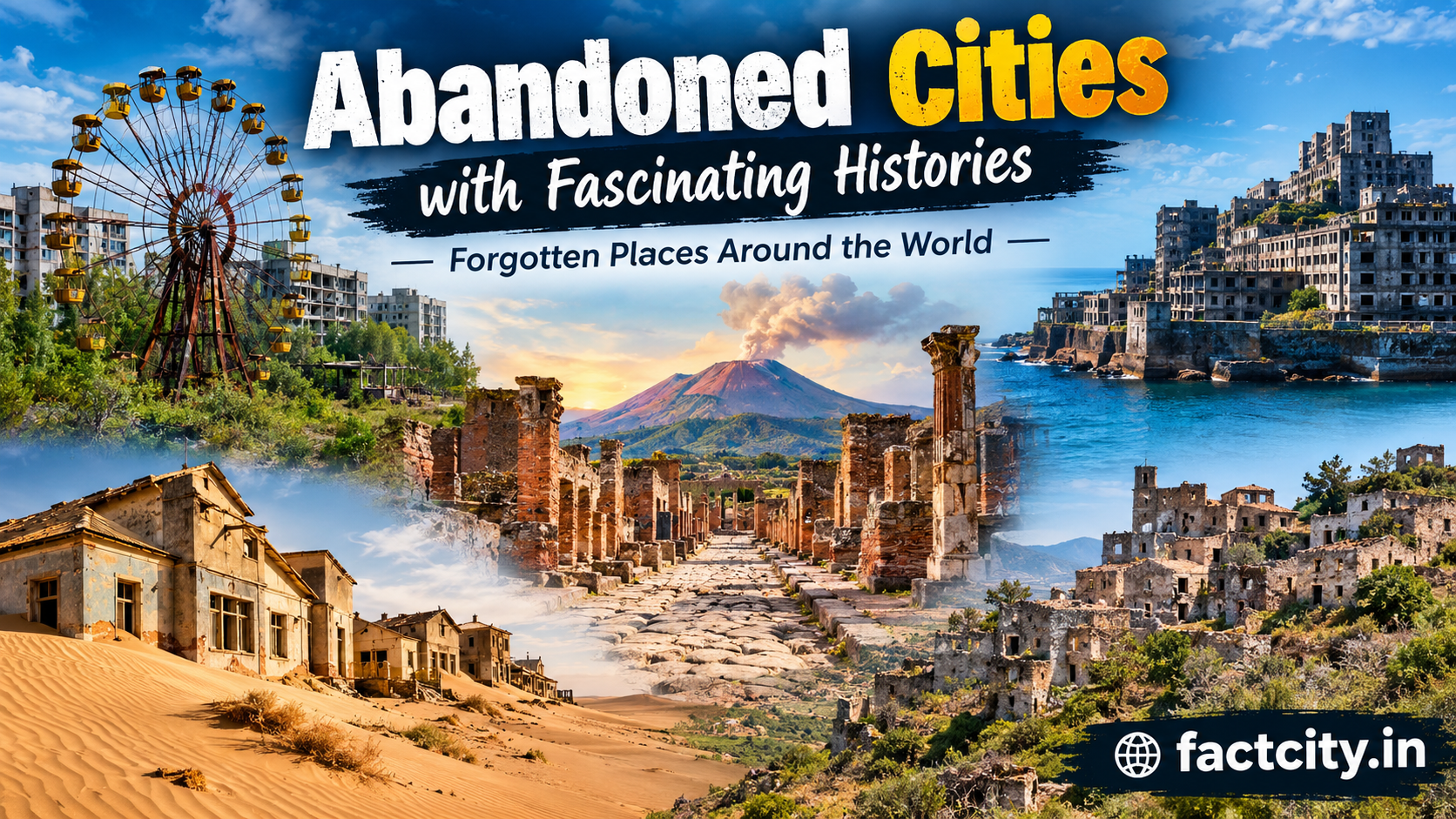
Abandoned Cities with Fascinating Histories. The world is full of amazing places that were once home to thousands of people but are now silent, empty, and slowly being reclaimed by nature. These abandoned cities have fascinating histories filled with mystery, war, natural disasters, economic struggles, and sudden changes in human life. Some were once powerful trading centers, while others were famous for their beautiful architecture, rich natural resources, or advanced civilizations. Today, their empty streets, ruined buildings, and forgotten homes tell stories of people who lived, worked, and dreamed there many years ago. Exploring abandoned cities with fascinating histories helps us understand how quickly a thriving community can disappear and how the past continues to shape our world.
1. Pripyat, Ukraine: The City Frozen in Time
Pripyat is one of the most famous abandoned cities in the world. Located in northern Ukraine, it was established in 1970 to provide housing for workers at the nearby Chornobyl Nuclear Power Plant. During its early years, Pripyat was a modern and growing city with schools, hospitals, shops, sports facilities, and apartment buildings. Thousands of families lived there, and many residents worked at the power plant. The city was designed to provide a comfortable life for its population, making it a symbol of progress during the Soviet era.
Everything changed on April 26, 1986, when a reactor at the Chornobyl Nuclear Power Plant exploded during a safety test. The accident released dangerous radioactive material into the surrounding environment. Residents were not evacuated immediately, but the evacuation began the following day. Around 49,000 people were moved from Pripyat, initially believing they might return after a short time. However, the radiation contamination made permanent resettlement unsafe. Today, abandoned apartment blocks, empty classrooms, and the famous amusement park stand as reminders of the disaster. Pripyat remains one of the most haunting examples of how a technological accident can transform a thriving city into an abandoned place. Abandoned Cities with Fascinating Histories
2. Pompeii, Italy: A Roman City Buried by a Volcano
Pompeii is an ancient Roman city with a history that attracts millions of people interested in archaeology and the ancient world. Before its destruction, Pompeii was a busy settlement near modern Naples, Italy. It had markets, houses, public baths, temples, restaurants, and entertainment spaces. The city offered a valuable picture of everyday Roman life, including how people cooked, traded goods, decorated their homes, and spent their free time.
In AD 79, Mount Vesuvius erupted and buried Pompeii beneath layers of volcanic ash and other materials. The eruption destroyed the city and killed many residents, preserving buildings and objects under the volcanic deposits. For centuries, Pompeii remained largely hidden until systematic archaeological discoveries began bringing it back into view. Excavations have revealed streets, wall paintings, household objects, and even casts of victims created from spaces left in hardened ash. Although Pompeii is no longer a living city, it is not completely forgotten. It has become one of the world’s most important archaeological sites, helping historians understand Roman society in remarkable detail.
3. Hashima Island, Japan: The Abandoned Concrete Island
Hashima Island, also known as Gunkanjima or Battleship Island, is located off the coast of Nagasaki, Japan. Its unusual appearance comes from the dense concrete buildings that cover much of its small surface. During the late nineteenth and twentieth centuries, the island became an important coal-mining center. Mitsubishi acquired the island in 1890 and developed it into a settlement for miners and their families. 20-inventions-that-changed-the-world
As coal production expanded, apartment blocks, schools, shops, and other facilities were built to support the growing population. At its peak in 1959, Hashima had an exceptionally high population density, with thousands of people living on a very small area of land. However, Japan gradually shifted from coal toward petroleum as a major energy source. The mine became less profitable and eventually closed in 1974. Residents left the island, and its buildings were abandoned to the sea air, wind, and rain. Today, Hashima is known for its dramatic skyline of deteriorating concrete structures. Its history also includes the forced labor of Korean and Chinese workers during wartime, making it important to remember both its industrial achievements and the suffering associated with its past.
4. Centralia, Pennsylvania, USA: The Town That Never Fully Recovered
Centralia is a small town in Pennsylvania that became famous because of an underground mine fire that has burned for decades. Founded during the nineteenth century, Centralia developed around the coal industry. Mining provided jobs, supported local businesses, and helped the community grow. For many years, the town was an ordinary place where families lived and workers earned their livelihoods.
In 1962, a fire began in an underground coal mine, and it eventually spread through coal seams beneath the town. The underground fire produced dangerous conditions, including carbon monoxide concerns, ground instability, and sinkholes. Efforts to control the fire proved unsuccessful, and the situation gradually became more serious. During the following decades, many residents were relocated through government-supported buyout programs. Most homes were demolished, and the population declined dramatically. A small number of residents remained for years despite the dangers. Centralia is now largely deserted, with limited signs of its former community. Its story demonstrates how an environmental problem can continue affecting a town long after the original event.
5. Kolmanskop, Namibia: A Desert Town Swallowed by Sand
Kolmanskop is an abandoned mining town in Namibia that looks as though it belongs in a historical film. Its story began in the early twentieth century when diamonds were discovered in the region. The discovery attracted miners, workers, and businesspeople who hoped to benefit from the valuable stones. As the diamond industry expanded, Kolmanskop developed into a surprisingly modern settlement in the middle of the Namib Desert.
The town once had comfortable houses, a hospital, a school, a ballroom, shops, and other facilities that supported its residents. Despite the harsh desert environment, people created a community with amenities that were unusual for such a remote location. However, diamond deposits became less profitable, and new discoveries elsewhere encouraged mining companies and workers to move away. By the 1950s, Kolmanskop had been abandoned. Since then, windblown sand has gradually filled its rooms and hallways. Today, its sand-covered buildings create striking scenes that attract photographers, historians, and tourists. Kolmanskop reminds us that even a wealthy settlement can disappear when the resource supporting its economy becomes less valuable.
6. Kayaköy, Turkey: The Silent Village of Stone Houses
Kayaköy is an abandoned settlement in southwestern Turkey, near the Mediterranean coast. Unlike some abandoned cities that disappeared because of natural disasters or industrial decline, Kayaköy’s history is closely connected to political change and population displacement. The settlement was once home to a Greek Orthodox community, and its hillside contained hundreds of stone houses, churches, and narrow pathways.
In the early twentieth century, political tensions and the collapse of the Ottoman Empire transformed the region. Following the Greco-Turkish War, the 1923 population exchange between Greece and Turkey led to the compulsory relocation of many Greek Orthodox Christians from Turkey and Muslims from Greece, subject to specific nationality and religious categories and with some exceptions. The Greek community of Kayaköy was displaced, and the village was not repopulated in the same way. Over time, its houses deteriorated, leaving behind empty stone buildings scattered across the hillsides. Today, Kayaköy is a historical site that reflects the human cost of political conflict and forced migration. Its silent streets offer a powerful reminder that communities can vanish not only because of economic or environmental problems but also because of decisions made by governments.
7. Varosha, Cyprus: The Resort City Left Behind
Varosha is a district of Famagusta in Cyprus that was once a popular holiday destination. During the 1960s and early 1970s, it became known for its hotels, beaches, restaurants, and modern tourist facilities. Visitors from different countries came to enjoy the Mediterranean coastline, and the area attracted investment from businesses and property owners. At the time, Varosha represented the growth of international tourism in the region.
In 1974, a military conflict and the division of Cyprus led to the evacuation of Varosha’s residents. The district was fenced off and remained largely inaccessible for decades. Hotels and apartment buildings were left behind, while roads and public spaces deteriorated. Because the area had been abandoned relatively suddenly, it became a powerful symbol of interrupted lives and unresolved political tensions. Parts of Varosha have reopened to visitors in recent years, but its history remains closely linked to displacement and the continuing division of Cyprus. The abandoned resort illustrates how quickly a place built around tourism can lose its identity when political instability changes everyday life.
8. Craco, Italy: A Medieval Town on the Edge of the Hills
Craco is a historic hilltop town in southern Italy, known for its stone buildings, narrow streets, and dramatic position above the surrounding countryside. Its origins go back many centuries, and it developed into a small community shaped by agriculture, local traditions, and medieval architecture. For generations, residents lived in its houses, worked the surrounding land, and maintained a close connection with the landscape.
However, Craco faced serious geological problems, including landslides and unstable ground. These conditions damaged buildings and made parts of the settlement increasingly unsafe. Earthquakes and difficult economic circumstances added to the challenges faced by the community. During the twentieth century, many residents were relocated, and the old town was gradually abandoned. Today, Craco stands as a striking example of a historic settlement affected by the natural environment. Its ruined buildings attract visitors interested in history, architecture, and photography. The town shows how environmental instability can gradually make even a centuries-old community impossible to maintain.
Why Do Cities Become Abandoned?
There is rarely just one reason why a city becomes abandoned. In some cases, natural disasters such as volcanic eruptions, earthquakes, and floods make an area too dangerous to inhabit. In other places, wars, political decisions, or forced migration cause residents to leave their homes. Economic changes can also play a major role, especially when a town depends on a single industry such as coal mining or diamond extraction. When that industry declines, jobs disappear, businesses close, and people move elsewhere to find better opportunities.
Environmental problems can make the situation even worse. Pollution, contaminated land, underground fires, and unstable ground may create long-term risks that are difficult or expensive to manage. Sometimes, several of these factors occur together. Understanding why abandoned cities exist helps us recognize the importance of sustainable development, disaster preparedness, economic diversity, and protecting communities from avoidable risks.
Conclusion
Abandoned cities with fascinating histories are much more than collections of empty buildings. They are places where the past remains visible in streets, homes, factories, and public spaces that once supported busy communities. From the nuclear disaster at Pripyat and the volcanic destruction of Pompeii to the mining decline of Hashima Island and the desert ruins of Kolmanskop, every location tells a different story about human ambition, unexpected change, and survival.
These forgotten places also remind us that no city is immune to change. Technology, nature, politics, and economic conditions can transform a thriving settlement within a surprisingly short period. Some abandoned cities are dangerous and inaccessible, while others have become protected heritage sites or tourist destinations. Learning about their histories gives us a deeper appreciation of the people who lived there and the events that shaped their lives. The next time you see photographs of an abandoned city, remember that behind every empty building is a story that deserves to be understood and preserved.