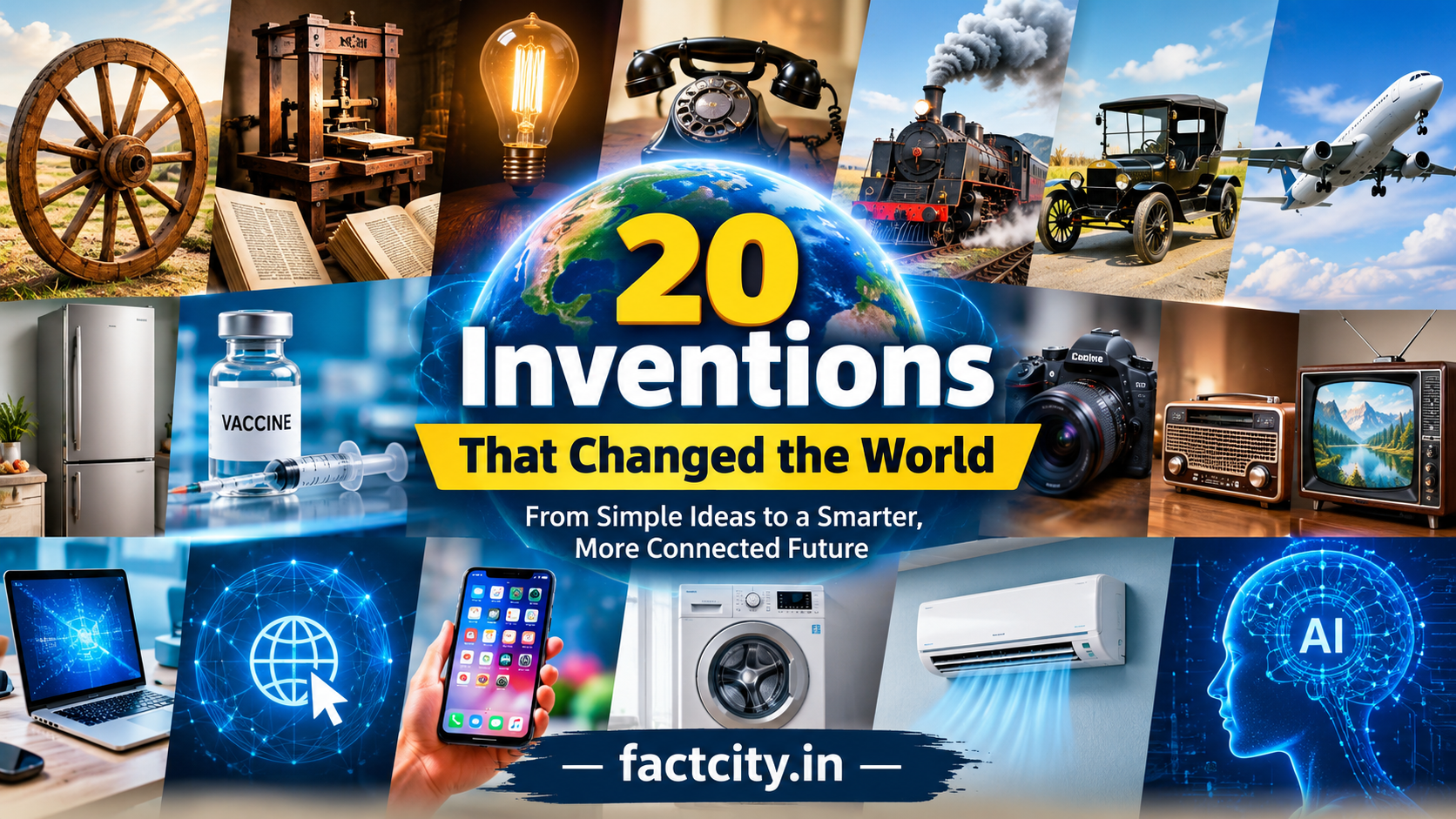
20 Inventions That Changed the World. Throughout history, human beings have created remarkable inventions that have changed the way we live, work, communicate, and understand the world. From the invention of the wheel to the development of the internet, every major breakthrough has opened new opportunities and helped societies move forward. Many things we use every day, such as smartphones, electricity, computers, and modern transportation, are the results of centuries of creativity, research, and hard work.
The 20 inventions that changed the world are not just interesting historical achievements. They also explain how human civilization developed and why modern life looks so different from life thousands of years ago. Some inventions made travel faster, while others improved healthcare, increased access to education, and connected people across continents. Here are 20 important inventions that transformed human history and continue to influence our lives today.
1. The Wheel
The wheel is one of the most important inventions in human history. Early wheeled objects appeared in ancient Mesopotamia around 3500 BCE, although the exact origins of the wheel and its earliest uses developed over time. The wheel made it easier to transport heavy goods, move materials, and develop more efficient methods of travel. It later became essential for carts, wagons, machinery, bicycles, and automobiles. Today, wheels remain a fundamental part of transportation and industrial equipment. Without this simple but powerful invention, many aspects of modern engineering and transportation would be much more difficult. 20 Inventions That Changed the World
2. The Printing Press
The printing press transformed the way information was shared around the world. In fifteenth-century Europe, Johannes Gutenberg developed a practical movable-type printing system that made producing books much faster than copying them by hand. This reduced the cost of many printed materials and helped knowledge reach a wider audience. Books, scientific discoveries, educational resources, and political ideas could spread more easily between communities. The printing press supported the growth of literacy and contributed to major cultural and scientific changes. Modern newspapers, publishing, and printed educational materials all developed within the wider history of printing technology.
3. Electricity and Electric Power Systems
Electricity is a natural phenomenon, but the development of practical electrical generators, distribution networks, and household appliances changed the modern world. During the nineteenth century, scientists and engineers developed technologies that made electric lighting and power increasingly useful. Electric power transformed factories, hospitals, homes, offices, and public transportation. It allowed people to work and study after dark, operate machinery efficiently, and use devices that depend on reliable energy. Today, electricity supports almost every part of modern society, including communication networks, medical equipment, refrigeration, and digital technology.
4. The Telephone
The telephone changed human communication by allowing people to speak to one another over long distances. Traditionally, sending messages could take hours, days, or even weeks, depending on the distance and method of delivery. Telephone technology made direct conversations possible without requiring people to meet in person. Businesses could coordinate their activities more quickly, families could stay connected, and emergency services could respond more efficiently. Although smartphones and internet-based calls have transformed communication, the telephone remains one of the most influential inventions in the history of human connection.
5. The Light Bulb
Artificial lighting changed how people used their homes, workplaces, and public spaces. Earlier lighting methods included candles, oil lamps, and gas lamps, but these often required regular maintenance and could present fire risks. During the nineteenth century, inventors and engineers improved electric lighting, with Thomas Edison and his team helping develop a commercially practical incandescent lighting system. The light bulb made indoor illumination more convenient and helped extend productive hours beyond daylight. Modern LED lighting is much more energy-efficient than traditional incandescent bulbs, but it builds on the same broader achievement of making artificial light widely available.
6. The Steam Engine
The steam engine played a major role in the Industrial Revolution. Improvements made during the eighteenth century, particularly by James Watt and other engineers, helped make steam power more efficient and practical. Factories could use machinery powered by steam instead of relying entirely on human labor, animals, wind, or water. Steam engines also powered locomotives and ships, allowing goods and people to travel over greater distances. This invention supported industrial growth, changed working patterns, and helped reshape cities. Although modern engines and electric motors have replaced many steam-powered systems, the steam engine remains an important milestone in industrial history.
7. The Automobile
The automobile transformed personal transportation and influenced the development of modern cities. Early motor vehicles emerged through the work of several inventors, while Karl Benz’s 1885–1886 motor car became a landmark in automobile history. As manufacturing methods improved, cars became more accessible to ordinary people. They made commuting, road travel, and the transportation of goods more flexible. The automobile also encouraged the growth of highways, fuel stations, repair businesses, and suburban communities. However, widespread car use has also created challenges, including traffic congestion, air pollution, and greenhouse gas emissions. Electric vehicles are now helping reshape the future of transportation.
8. The Airplane
The airplane made it possible to travel through the air over long distances and transformed global transportation. On December 17, 1903, Orville and Wilbur Wright achieved a landmark powered, controlled flight at Kitty Hawk, North Carolina. Over the following decades, aircraft became faster, safer, and capable of carrying more passengers and cargo. Air travel connected countries, supported international business, and made tourism more accessible. Aircraft are also essential for emergency assistance, medical transportation, and delivering supplies to remote locations. Modern aviation has made the world more connected, although its environmental impact remains an important challenge.
9. The Refrigerator
Refrigeration changed food storage and improved everyday life. Before modern refrigeration became widely available, people relied on methods such as drying, salting, smoking, and storing food in cool places to preserve it. Refrigerators made it possible to keep perishable foods at controlled temperatures for longer periods. This helped reduce food spoilage, improved household convenience, and supported the safe storage of many medicines. Commercial refrigeration also became essential for supermarkets, restaurants, food transportation, and healthcare facilities. Today, refrigerators are common household appliances that play an important role in food preservation and public health.
10. The Vaccination
Vaccination is one of the most significant developments in medical history. In 1796, Edward Jenner demonstrated that exposure to material from cowpox lesions could protect against smallpox, helping establish the foundations of modern vaccination. Over time, scientists developed vaccines against numerous dangerous infectious diseases. Vaccination has helped prevent illness, reduce deaths, and protect communities from outbreaks. The global campaign against smallpox ultimately led to its eradication, officially declared by the World Health Organization in 1980. Modern vaccines continue to play a crucial role in public health, although their development and use require careful scientific testing and monitoring.
11. Antibiotics
Antibiotics transformed the treatment of bacterial infections. Before effective antibiotics became available, illnesses and injuries that are often treatable today could lead to severe complications or death. Alexander Fleming discovered penicillin in 1928, and later research and manufacturing advances made it widely available for medical use. Antibiotics became essential for treating many bacterial infections and made procedures such as surgery safer. However, antibiotics do not work against viruses, and their misuse can contribute to antimicrobial resistance. Responsible use is necessary to preserve their effectiveness for future generations.
12. The Camera
The camera changed how people record memories, document events, and understand the world. Early photography developed during the nineteenth century, allowing images to be captured rather than created entirely by hand. Cameras later became important tools in journalism, science, education, art, and historical documentation. Digital photography made taking, storing, and sharing pictures easier, while smartphone cameras brought photography into everyday life. People can now document important moments and communicate visually within seconds. Photography has also changed how news travels and how people preserve personal and cultural memories.
13. The Radio
Radio revolutionized communication by allowing information and entertainment to reach large audiences without requiring printed materials or direct personal contact. During the early twentieth century, radio broadcasting became an important way to share news, music, educational programs, and emergency announcements. Families could listen to events and programs together, while governments and public organizations could communicate with communities over wide areas. Radio also became important in aviation, maritime communication, and disaster response. Even with the growth of television, podcasts, and online streaming, radio remains a valuable communication medium.
14. Television
Television changed entertainment, journalism, and access to information by combining moving images with sound. During the twentieth century, television became a common household technology in many countries. People could watch news reports, educational programs, sporting events, films, and cultural performances from their homes. Television helped major events reach international audiences and influenced public discussion and popular culture. Modern smart televisions also provide access to internet-based services and on-demand entertainment. Although viewing habits have shifted toward digital platforms, television remains a major part of global media.
15. The Computer
The computer is one of the most influential inventions of the modern age. Early electronic computers were large machines designed for specialized calculations and data processing. Over time, advances in electronics and microprocessors made computers smaller, faster, and more affordable. Today, computers are used in education, medicine, engineering, scientific research, business, entertainment, and government services. They can process large amounts of information, automate repetitive tasks, and help researchers solve complex problems. Personal computers also made digital tools available to millions of individuals, creating new ways to work, learn, and communicate.
16. The Internet
The internet has transformed the way people access information and communicate across the world. Its development grew from research networks, including ARPANET, which began operating in 1969. Later advances in networking and the creation of the World Wide Web made online information much easier for ordinary users to access. Today, the internet supports online education, digital banking, remote work, entertainment, shopping, and global collaboration. People can communicate instantly and access enormous collections of information from almost anywhere with a connection. However, the internet also brings challenges involving privacy, misinformation, cybersecurity, and unequal access to technology.
17. The Smartphone
The smartphone combines communication, computing, photography, navigation, and entertainment in one portable device. Modern smartphones evolved from earlier mobile phones and personal digital assistants, becoming increasingly powerful through improvements in processors, mobile networks, and software. People use them to make calls, send messages, attend online classes, manage finances, find directions, and access information. Smartphones have also helped small businesses reach customers and enabled people to work from different locations. Despite their benefits, excessive use can affect sleep, concentration, and face-to-face interaction, making balanced use important.
18. The Washing Machine
The washing machine transformed household work by reducing the time and physical effort required to clean clothes. Before mechanical washing machines became common, laundry often involved carrying water, scrubbing fabric by hand, rinsing garments, and drying everything manually. The development of powered washing machines made the process faster and more convenient. Modern machines can offer different wash cycles, control water temperature, and use energy-saving features. This invention helped reduce the burden of repetitive domestic work and made laundry easier for households, hotels, hospitals, and commercial facilities.
19. The Air Conditioner
Air conditioning changed the way people live and work in hot and humid environments. Modern air-conditioning technology developed through advances in refrigeration, with Willis Carrier designing an important early modern system in 1902. Air conditioning helps control indoor temperature and, in many systems, humidity as well. It can improve comfort in homes, offices, hospitals, schools, and industrial facilities. Temperature control is also essential for certain manufacturing processes and electronic equipment. However, air conditioning requires energy, and some refrigerants can contribute to climate change if released. More efficient systems are increasingly important as global temperatures rise.
20. Artificial Intelligence
Artificial intelligence, commonly known as AI, is a major technological development that is changing how people interact with machines. AI systems can perform tasks such as recognizing patterns, processing language, analyzing data, and generating content. Researchers have studied artificial intelligence for decades, while recent advances in computing power and machine learning have made many applications more widely available. Today, AI supports medical research, language translation, customer service, education, and scientific discovery. It can help people complete certain tasks faster, but it also raises questions about privacy, employment, bias, and the reliability of automated decisions. Responsible development will be essential as AI continues to evolve. ancient-inventions-ahead-of-their-time
Conclusion
These 20 inventions that changed the world show how human creativity has shaped civilization across thousands of years. The wheel made transportation easier, the printing press helped spread knowledge, electricity powered modern life, and medical innovations improved health and survival. More recent developments, including computers, the internet, smartphones, and artificial intelligence, have transformed how people communicate, learn, and work.
Every invention has built on earlier discoveries, demonstrating that progress is often the result of many people contributing ideas over time. Some inventions have made daily life more comfortable, while others have completely changed industries and societies. As science and technology continue to advance, future inventions may bring solutions to major challenges involving healthcare, energy, transportation, and the environment. Understanding the inventions that changed the world helps us appreciate the achievements of the past and imagine the possibilities of the future.