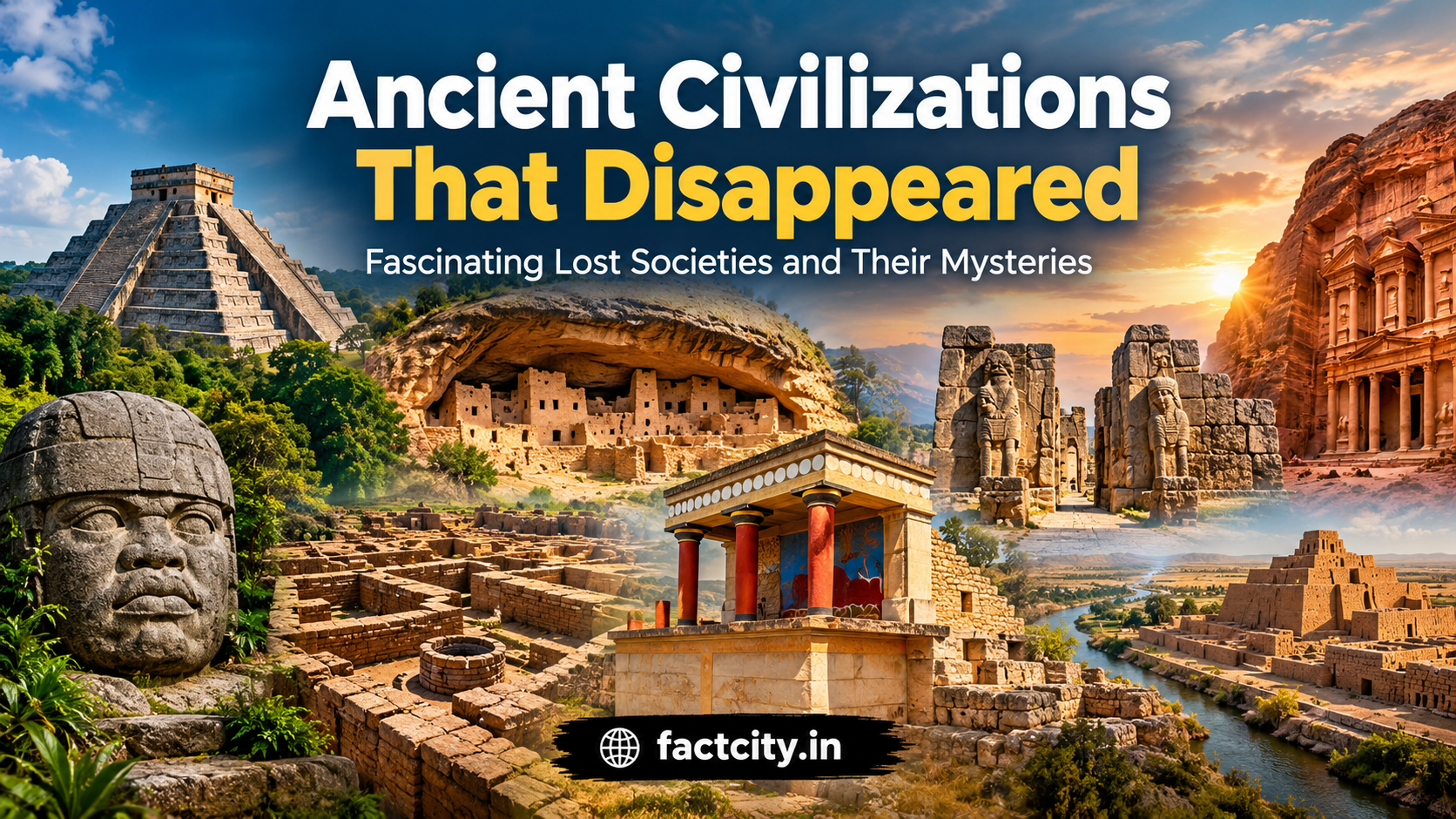
Ancient Civilizations That Disappeared. Throughout human history, many remarkable civilizations have risen, developed powerful cities, created impressive monuments, and made discoveries that changed the world. However, some of these societies eventually declined, leaving behind abandoned settlements, mysterious ruins, and unanswered questions. The ancient civilizations that disappeared continue to fascinate historians, archaeologists, and curious readers because their stories reveal how people lived thousands of years ago and what may have caused their societies to change or collapse.
Although some ancient civilizations lost their political power and major cities, their people did not always disappear completely. Many communities migrated to new regions, adapted to changing conditions, or became part of other societies. Their traditions, knowledge, and cultural achievements often survived long after their original kingdoms ended. By studying these lost civilizations, we can better understand the challenges faced by ancient people and discover important lessons about the rise and fall of human societies.
1. The Maya Civilization
The Maya civilization was one of the most advanced ancient societies in Mesoamerica, developing across parts of present-day Mexico, Guatemala, Belize, Honduras, and El Salvador. The Maya were famous for their impressive pyramids, detailed calendars, mathematical knowledge, and sophisticated writing system. They built magnificent cities such as Tikal, Palenque, and Copán, where rulers, religious leaders, merchants, and skilled workers contributed to the growth of their society. Ancient Civilizations That Disappeared
During the Classic Period, from approximately AD 250 to 900, many Maya cities experienced remarkable development. They constructed large temples, established trading networks, and made important advances in astronomy and mathematics. However, several major cities in the southern Maya lowlands gradually declined between the eighth and tenth centuries. Researchers believe that prolonged droughts, warfare, political instability, population pressure, and environmental changes may have contributed to this decline.
The Maya civilization did not disappear entirely. Millions of Maya people continue to live across Central America and southern Mexico, preserving their languages, traditions, and cultural identity. What declined was the power of many ancient city-states, not the Maya people themselves. Their history demonstrates how environmental challenges and political conflicts can transform even highly developed societies.
2. The Indus Valley Civilization
The Indus Valley Civilization was one of the earliest urban civilizations in the world, flourishing around 2600–1900 BC across parts of present-day Pakistan and northwestern India. Its most famous cities, Harappa and Mohenjo-daro, were known for their organized streets, carefully constructed brick buildings, drainage systems, and advanced water-management facilities. These features demonstrate that the people of the Indus Valley possessed impressive knowledge of urban planning and community organization.
The civilization also maintained trading relationships with distant regions and produced distinctive pottery, ornaments, seals, and other valuable objects. Many houses were connected to drainage systems, while wells and bathing areas provided access to water. Despite these achievements, large urban settlements gradually declined after approximately 1900 BC, and populations increasingly moved toward smaller communities in different regions.
Scientists and historians have suggested several possible explanations for this transformation, including changing river systems, variations in monsoon rainfall, agricultural difficulties, and shifts in trade. However, there is no universally accepted explanation for the decline. The Indus script also remains undeciphered, making it difficult to understand many aspects of the civilization directly from its written records. Although its great cities lost their former importance, its people and cultural practices may have contributed to the development of later communities across South Asia.
3. The Ancestral Puebloans
The Ancestral Puebloans lived in the southwestern region of what is now the United States. They developed farming communities, constructed stone and adobe homes, and built remarkable settlements in areas such as Mesa Verde in Colorado. Some of their most recognizable structures were built inside natural cliff alcoves, creating impressive residential complexes that used the surrounding landscape efficiently.
These communities developed agricultural methods suited to a region where rainfall could be unpredictable. They cultivated crops such as maize, beans, and squash while also relying on hunting and gathering. Their settlements contained storage areas, ceremonial rooms, and interconnected buildings that supported community life. Their architectural achievements demonstrate how ancient people adapted their lifestyles to challenging environmental conditions.
During the late thirteenth century, many settlements in the Mesa Verde region were abandoned. Prolonged drought, agricultural difficulties, pressure on local resources, and social changes may have contributed to the movement of people toward other areas. However, the exact causes varied between communities and remain a subject of archaeological research. The Ancestral Puebloans did not vanish completely, as their descendants include modern Pueblo peoples who continue to preserve cultural traditions and maintain connections to their ancestral lands.
4. The Minoan Civilization
The Minoan civilization flourished on the island of Crete in the eastern Mediterranean during the Bronze Age. It became particularly influential during the second millennium BC and was known for its impressive palaces, colorful frescoes, pottery, maritime trade, and artistic achievements. The Minoans maintained commercial connections with other Mediterranean societies, allowing goods, ideas, and cultural influences to travel across the region.
One of their most famous archaeological sites is the Palace of Knossos, which contains evidence of sophisticated architecture, storage facilities, workshops, and organized economic activity. Minoan artwork often features natural landscapes, marine life, and ceremonial scenes, providing valuable insights into their cultural interests and beliefs. Their achievements suggest that Crete was an important center of trade and craftsmanship in the ancient Mediterranean world.
The Minoan civilization experienced significant changes during the second millennium BC. A major volcanic eruption on the nearby island of Thera, now known as Santorini, caused widespread disruption, although its precise influence on the Minoan decline remains debated. Earthquakes, economic difficulties, and the growing influence of Mycenaean Greeks may also have played important roles. Rather than disappearing overnight, Minoan political power gradually weakened, and its cultural traditions became part of the changing societies of the eastern Mediterranean.
5. The Hittite Empire
The Hittite Empire was a powerful Bronze Age state centered in Anatolia, much of which lies within modern-day Türkiye. It became influential during the second millennium BC and controlled territories across parts of the eastern Mediterranean and the Near East. The Hittites developed organized administrative systems, maintained diplomatic relationships, and built fortified cities to protect their political and economic interests.
Their capital, Hattusa, was an impressive city surrounded by defensive walls and monumental gates. Archaeologists have discovered written records describing diplomatic negotiations, religious practices, laws, and military conflicts. The Hittites also competed with ancient Egypt for regional influence, and their famous conflict at the Battle of Kadesh was followed by a peace agreement between the two powers.
Around 1200 BC, the Hittite imperial system collapsed during a wider period of disruption known as the Late Bronze Age collapse. Historians have proposed several possible causes, including political instability, warfare, food shortages, trade disruptions, and population movements. The precise reasons remain uncertain, and different regions may have experienced different challenges. Although the empire lost its power, smaller Hittite successor states continued to exist in parts of Anatolia and northern Syria, preserving elements of its cultural and political traditions.
6. The Nabataean Civilization
The Nabataeans were an ancient Arab people who established a prosperous kingdom in the region surrounding present-day Jordan and parts of the Arabian Peninsula. Their civilization became particularly influential between approximately the fourth century BC and the first century AD. The Nabataeans gained wealth by participating in important trade networks that transported incense, spices, and other valuable goods between Arabia, the Mediterranean, and neighboring regions.
Their most famous city was Petra, a remarkable settlement known for its buildings carved directly into sandstone cliffs. Petra became an important commercial and administrative center, attracting merchants and travelers from different parts of the ancient world. The Nabataeans also developed impressive water-collection and storage systems that helped communities survive in an environment where rainfall was limited.
In AD 106, the Roman Empire annexed the Nabataean Kingdom and incorporated its territory into the Roman provincial system. Over time, changing trade routes, economic developments, and natural disasters contributed to Petra’s declining importance. The Nabataean kingdom disappeared as an independent political power, but its people and cultural influences became part of the changing societies of the region. Petra remains a powerful reminder of their achievements in architecture, engineering, and commerce.
7. The Olmec Civilization
The Olmec civilization developed along the Gulf Coast of present-day Mexico, particularly in areas now known as Veracruz and Tabasco. It flourished roughly between 1500 and 400 BC and is often considered one of the earliest major civilizations of Mesoamerica. The Olmecs created impressive ceremonial centers, produced distinctive artwork, and developed cultural traditions that influenced later societies in the region.
They are especially famous for their enormous carved stone heads, which demonstrate remarkable artistic skill and the ability to transport and shape heavy stone. Important Olmec centers included San Lorenzo and La Venta, where archaeologists have discovered monumental structures, sculptures, and evidence of organized communities. These findings suggest that the Olmecs had complex political and religious systems supported by skilled workers and agricultural production.
By around 400 BC, several major Olmec centers had declined or lost their former importance. Environmental changes, shifting political power, and changing regional settlement patterns may have contributed, although the exact causes remain uncertain. The Olmec civilization did not necessarily disappear as a population. Instead, its major centers declined while cultural influences continued to develop across Mesoamerica, contributing to the wider history of ancient American societies.
8. The Akkadian Empire
The Akkadian Empire emerged in Mesopotamia during the twenty-fourth century BC and became one of the earliest known empires to unite numerous cities under a centralized ruler. Its founder, Sargon of Akkad, established a powerful state that controlled extensive territories across parts of modern-day Iraq and neighboring regions. The empire brought together different communities and created administrative connections across a large area.
Akkadian rulers organized military campaigns, managed trade, and strengthened the authority of the central government. The Akkadian language became important in administration and communication, and its influence continued long after the empire lost its political power. Archaeological discoveries and written records provide evidence of the empire’s organization and its role in the development of early states.
Toward the end of the third millennium BC, the Akkadian Empire weakened and eventually lost its centralized authority. Possible explanations include internal rebellion, political instability, conflicts with neighboring groups, and environmental pressures. Some researchers have investigated whether prolonged drought contributed to its decline, although the exact role of climate remains debated. The fall of the Akkadian Empire did not end civilization in Mesopotamia, as other cities and kingdoms continued to develop and influence the region.
Why Did Ancient Civilizations Disappear?
Ancient civilizations declined for different reasons, and many experienced several problems at the same time. Environmental changes were particularly important for societies that depended on agriculture. Droughts, floods, changing rivers, and declining soil quality could reduce food production and make established settlements difficult to maintain. When food supplies became unreliable, communities sometimes moved to other regions in search of better living conditions.
Political conflicts and economic problems also played important roles. Wars could weaken governments, destroy settlements, and interrupt trade. Internal disagreements between rulers and communities could reduce political stability, while changing trade routes could leave once-prosperous cities struggling to survive. In some cases, the collapse of a government caused major cities to lose their importance even though people continued living in the surrounding region. historical-events-that-changed-modern-society
It is important to remember that historians do not always have complete answers. Archaeological evidence can be limited, ancient records may be difficult to interpret, and some writing systems remain undeciphered. As researchers discover new evidence, explanations for the decline of individual civilizations may change. The disappearance of an empire or city should therefore not automatically be interpreted as the complete extinction of its population.
Conclusion
The ancient civilizations that disappeared left behind fascinating stories of achievement, transformation, and mystery. The Maya, Indus Valley, Ancestral Puebloans, Minoans, Hittites, Nabataeans, Olmecs, and Akkadians each developed distinctive societies and made important contributions to human history. Their major cities or political systems eventually declined for different reasons, including environmental pressures, warfare, economic changes, and migration.
However, many of these civilizations left lasting cultural influences, and some of their descendants continue to preserve ancient traditions today. Their ruins, monuments, artwork, and archaeological discoveries help us understand how people lived in the distant past. By studying these lost societies, we can learn that civilizations are not permanent and that adapting to changing circumstances has always been an important part of human survival.