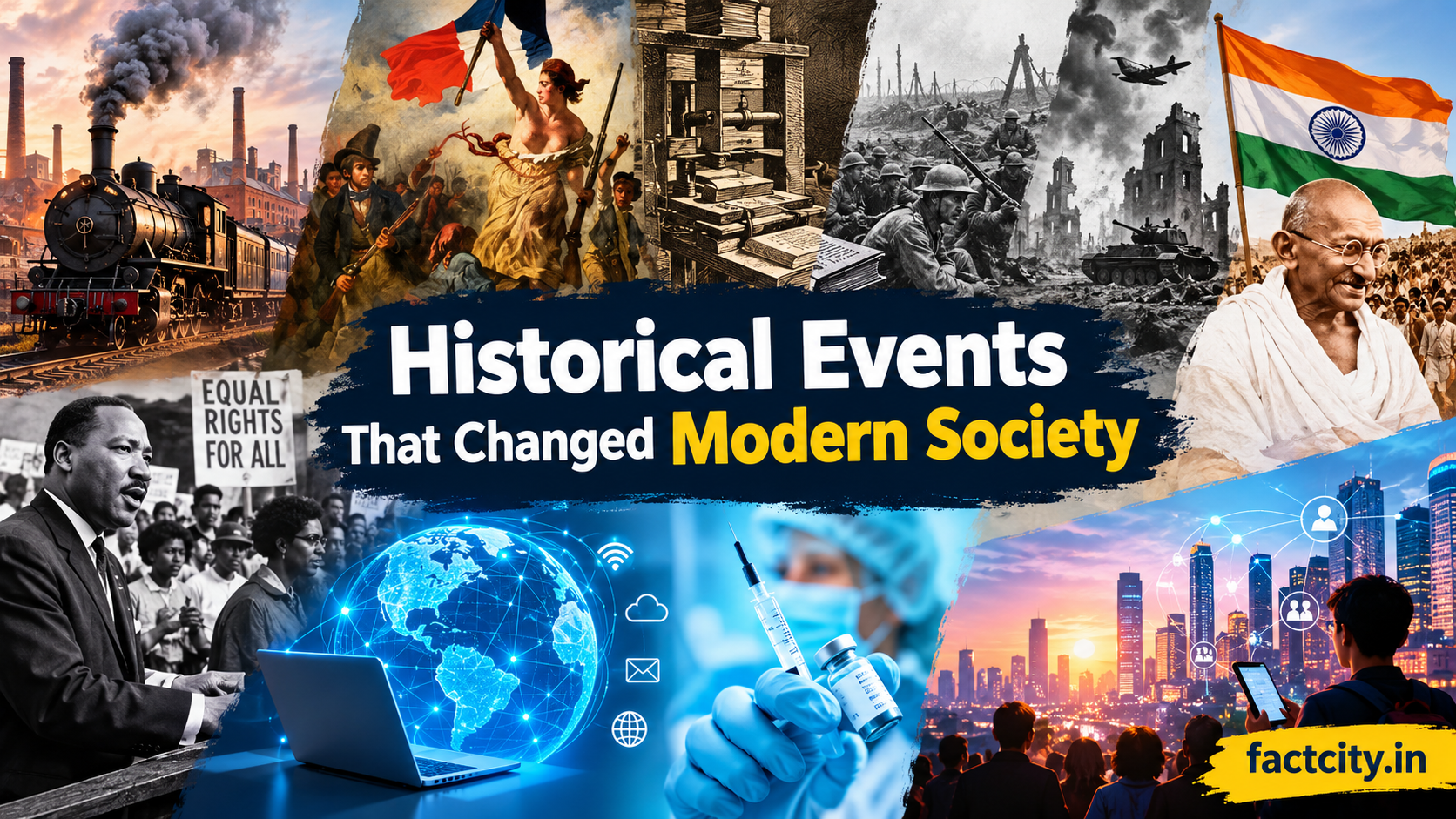
Historical Events That Changed Modern Society. The modern world has been shaped by many important historical events that changed the way people live, work, communicate, and understand their rights. From major revolutions and scientific discoveries to world wars and technological breakthroughs, these events have influenced the development of modern society in countless ways. Many things we consider normal today, including public education, modern transportation, democratic governments, human rights, and digital communication, have roots in events that took place decades or even centuries ago. Understanding the historical events that changed modern society helps us see how the past continues to influence our daily lives and how societies develop over time.
1. The Industrial Revolution
The Industrial Revolution was one of the most important turning points in human history. It began in Great Britain during the 18th century and gradually spread to other parts of Europe, North America, and the rest of the world. Before this period, most goods were produced by hand, and many people worked in agriculture or small workshops. The introduction of machines, steam power, and factory production changed the way products were manufactured and distributed. Industries could produce goods faster and in larger quantities, making many products more accessible to ordinary people. Historical Events That Changed Modern Society
The Industrial Revolution also transformed cities, employment, transportation, and economic systems. People moved from rural areas to industrial towns in search of work, leading to rapid urban growth. Although factory workers often faced long working hours and difficult conditions, the changes eventually encouraged labor reforms, improved production methods, and the development of modern industries. Today, manufacturing systems, large-scale transportation networks, and many features of the global economy reflect the lasting influence of this historical transformation.
2. The American Revolution
The American Revolution, which took place between 1775 and 1783, changed political thinking around the world. The thirteen British colonies in North America fought for independence from British rule and eventually established the United States. The revolution was influenced by ideas about individual liberty, representation, and the right of people to participate in government. These principles challenged the traditional belief that political authority should remain concentrated in the hands of a monarch.
The American Revolution influenced later independence movements and constitutional developments in other countries. The United States Constitution and the Bill of Rights helped establish important political principles, including representative government and protections for certain individual freedoms. However, these rights were not applied equally to everyone, particularly enslaved people, Indigenous communities, and women. The struggle to expand freedom and equality continued long after independence. Its historical importance lies not only in the creation of a new nation but also in the political debates it encouraged around the world.
3. The French Revolution
The French Revolution began in 1789 during a period of economic hardship, social inequality, and political dissatisfaction. French society was divided into different social groups, and many ordinary people believed the existing system gave excessive privileges to the wealthy and powerful. The revolution challenged the authority of the monarchy and promoted ideas such as liberty, equality, and popular sovereignty. It eventually led to the end of the French monarchy and brought major political changes to France.
The French Revolution influenced modern society by spreading ideas about citizenship, legal equality, and the relationship between governments and the people they govern. Its effects reached far beyond France, inspiring political movements across Europe and other parts of the world. Although the revolution also involved violence, political instability, and periods of repression, its principles helped shape modern debates about democracy, constitutional government, and civil rights. Many political systems today continue to reflect questions that became central during this period.
4. The Abolition of Slavery
The abolition of slavery was a major historical development that transformed societies across the world. For centuries, millions of people were enslaved through systems of forced labor, human trafficking, and colonial exploitation. Enslaved people were denied basic freedoms and often subjected to extreme violence. Resistance by enslaved communities, the work of abolitionist movements, and changing political and moral arguments gradually increased pressure on governments to end slavery.
The abolition of slavery occurred at different times in different countries. Britain abolished slavery throughout most of its empire in the 1830s, while the United States formally abolished slavery through the Thirteenth Amendment in 1865. However, ending legal slavery did not immediately eliminate racial discrimination, economic inequality, or other forms of exploitation. The long struggle against slavery helped shape modern human rights movements and continues to influence discussions about equality, justice, and the lasting effects of historical discrimination.
5. The Invention of the Printing Press
The development of movable-type printing in Europe by Johannes Gutenberg during the 15th century significantly changed the spread of knowledge. Before printing became widespread, books were expensive and time-consuming to produce because they had to be copied by hand. Printing technology made it possible to create multiple copies of written material more efficiently, helping books, religious texts, scientific ideas, and educational resources reach a much larger audience.
The printing press supported the spread of literacy, encouraged intellectual debate, and contributed to major movements such as the Renaissance and the Protestant Reformation. It also helped scientists share discoveries and allowed political ideas to circulate more widely. Modern newspapers, books, magazines, and many forms of mass communication developed from later advances in printing and publishing. Although digital media has transformed how information travels today, the printing revolution established an important foundation for the modern information society.
6. The First World War
The First World War lasted from 1914 to 1918 and involved many countries across Europe and other regions. The conflict was influenced by competing alliances, nationalism, imperial rivalries, and political tensions. New military technologies, including machine guns, heavy artillery, tanks, and chemical weapons, contributed to enormous destruction. Millions of soldiers and civilians died, and many communities experienced widespread hardship.
The war changed international politics and weakened several major empires, including the German, Austro-Hungarian, Ottoman, and Russian empires. New states emerged, and political boundaries were redrawn across parts of Europe and the Middle East. The conflict also contributed to the Russian Revolution and the creation of the League of Nations, an early attempt to promote international cooperation and prevent future wars. Although the League ultimately failed to prevent another global conflict, the lessons of the First World War influenced later efforts to establish international institutions and maintain peace.
7. The Second World War
The Second World War, fought from 1939 to 1945, was one of the most destructive events in modern history. It involved countries across Europe, Asia, Africa, and the Pacific. The conflict caused enormous loss of life, destroyed cities, displaced millions of people, and exposed the horrors of the Holocaust, during which Nazi Germany and its collaborators systematically murdered six million Jews, alongside the persecution and killing of millions of other victims.
The war changed the global balance of power and contributed to the emergence of the United States and the Soviet Union as superpowers. It also encouraged the establishment of the United Nations in 1945, which aimed to promote international cooperation, security, and peaceful relations between countries. The Universal Declaration of Human Rights followed in 1948, setting out a shared international standard for fundamental rights and freedoms. The war also accelerated decolonization in many regions and influenced the development of modern international law, diplomacy, and global security policies.
8. India’s Independence in 1947
India’s independence from British rule on August 15, 1947, was a landmark event in the history of freedom movements. The struggle for independence involved decades of political organizing, public protests, revolutionary activities, and campaigns led by many individuals and groups. Mahatma Gandhi became internationally known for his use of nonviolent resistance, while numerous other leaders, activists, workers, and ordinary citizens also played important roles in the movement.
Independence ended British colonial rule, but it was accompanied by the partition of British India into India and Pakistan. Partition caused mass migration, widespread violence, and immense human suffering. Despite these challenges, independent India adopted its Constitution in 1950 and established itself as a sovereign democratic republic. India’s independence inspired anti-colonial movements across Asia and Africa and contributed to the wider decline of European colonial empires. Its legacy remains important in discussions about self-determination, democracy, national identity, and social equality.
9. The Civil Rights Movement
The Civil Rights Movement in the United States gained significant momentum during the 1950s and 1960s. It challenged racial segregation, discrimination, and the denial of equal rights to African Americans. Activists organized marches, boycotts, sit-ins, legal challenges, and public campaigns to demand equal treatment under the law. Leaders such as Martin Luther King Jr. became widely recognized for their role in promoting nonviolent protest, while many local organizers and community members helped drive the movement forward.
The movement contributed to major legal changes, including the Civil Rights Act of 1964 and the Voting Rights Act of 1965. These laws prohibited important forms of discrimination and strengthened protections for voting rights. Although racial inequality did not disappear, the movement changed public attitudes, influenced political institutions, and inspired human rights campaigns in other countries. Its impact can still be seen in modern discussions about equal opportunity, discrimination, representation, and justice.
10. The Rise of the Internet
The development of the internet transformed modern society by changing how people communicate, learn, work, and conduct business. Its foundations emerged from computer networking research in the late 20th century, while the creation of the World Wide Web by Tim Berners-Lee in 1989 helped make online information easier to access and navigate. As internet access expanded, communication became faster and more affordable, connecting individuals and organizations across national borders.
Today, the internet supports online education, digital banking, remote work, e-commerce, scientific research, and international collaboration. Social media has also changed how people share information and participate in public discussions. However, the digital revolution has introduced challenges, including online misinformation, privacy concerns, cybercrime, and unequal access to technology. Despite these problems, the internet remains one of the most influential developments in modern history because it has reshaped the flow of information and created new opportunities for individuals and businesses. countries-with-unusual-traditions
11. The Development of Modern Medicine
Medical discoveries have dramatically changed human life by improving the prevention, diagnosis, and treatment of diseases. The development of vaccination, the discovery of antibiotics, advances in surgical techniques, and improvements in public sanitation have helped reduce deaths from many infectious diseases. Edward Jenner’s early smallpox vaccination work in 1796 became an important milestone in the history of immunization, while the discovery of penicillin by Alexander Fleming in 1928 opened the way for modern antibiotic treatment.
These advances have contributed to longer life expectancy and better health outcomes in many parts of the world. Modern medicine has also made childbirth safer, improved emergency care, and helped people manage conditions that were once frequently fatal. Nevertheless, access to healthcare remains unequal, and problems such as antibiotic resistance and emerging infectious diseases continue to require attention. The history of medicine demonstrates how scientific research and public health measures can improve the quality of life for entire populations.
Conclusion
The historical events that changed modern society continue to influence the world we live in today. The Industrial Revolution transformed economies, political revolutions introduced new ideas about government, the abolition of slavery advanced the struggle for human freedom, and the world wars reshaped international relations. India’s independence and the Civil Rights Movement demonstrated the continuing importance of equality and self-determination, while advances in medicine and the internet changed how people live and connect with one another.
Studying these events helps us understand that modern society did not develop overnight. It emerged through discoveries, struggles, sacrifices, and decisions made by generations of people. Although many historical changes brought progress, they also created challenges that societies are still working to address. By learning from the past, we can better understand present-day issues, appreciate the rights and opportunities available today, and make more informed decisions about the future.