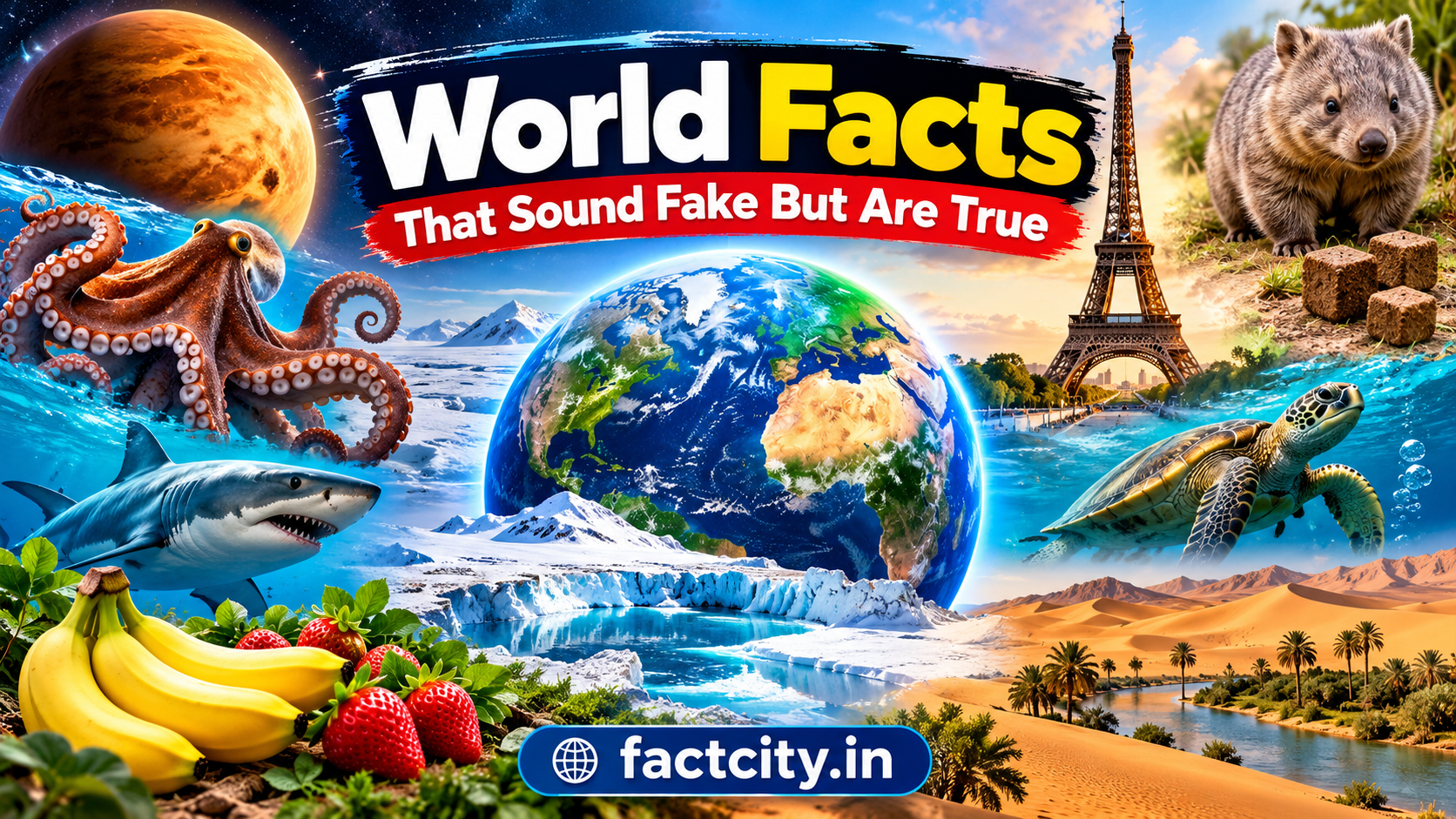
World Facts That Sound Fake The world is full of surprising discoveries, unusual natural events, and incredible scientific facts that seem almost impossible to believe. From animals with extraordinary abilities to mysterious places on Earth, many things around us are far more fascinating than they appear. Some real facts sound so strange that people often assume they are fictional stories or internet myths. However, science, history, and nature provide explanations for many of these unbelievable discoveries. If you enjoy learning something new, these world facts that sound fake but are true will help you explore the amazing things that make our planet unique. Whether you are curious about space, animals, the human body, or the natural world, these fascinating facts will give you plenty of reasons to look at everyday life differently.
1. A Day on Venus Is Longer Than Its Year
One of the most surprising facts about our solar system is that a day on Venus lasts longer than a year on the planet. Venus takes approximately 243 Earth days to complete one rotation on its axis, while it takes about 225 Earth days to travel around the Sun. This means Venus completes its journey around the Sun before it finishes one full rotation. The planet also rotates in the opposite direction to most planets in our solar system. These unusual characteristics make Venus one of the most fascinating worlds for astronomers to study. World Facts That Sound Fake
2. Octopuses Have Three Hearts
Octopuses are among the most unusual creatures living in the oceans, and their bodies have several remarkable features. One of the most interesting facts is that an octopus has three hearts. Two hearts pump blood toward the gills, where oxygen is absorbed, while the third pumps oxygen-rich blood to the rest of the body. Their blood is also blue because it contains a copper-based protein called hemocyanin, which helps transport oxygen. These adaptations allow octopuses to survive in marine environments and make them different from most animals people encounter on land.
3. Bananas Are Berries, but Strawberries Are Not
Many people assume that strawberries are berries and bananas are not. However, botanical classifications tell a different story. Bananas qualify as berries because they develop from a single flower’s ovary and contain seeds within their fruit structure. Strawberries, on the other hand, are classified as aggregate accessory fruits because their edible flesh develops largely from the flower’s receptacle, with the tiny structures on their surfaces being individual fruits. This difference shows that scientific classifications do not always match the names we use in everyday conversations. It is a perfect example of a real-world fact that sounds completely backward at first.
4. Sharks Existed Before Trees
It may seem impossible to imagine oceans filled with sharks before forests covered much of the land, but the fossil record supports this surprising fact. Ancient shark relatives appeared more than 400 million years ago, while the earliest trees emerged later, roughly 385 million years ago. Sharks and their ancestors have survived numerous environmental changes over an extraordinary period. Their long evolutionary history makes them some of the oldest groups of vertebrates still represented in today’s oceans. Modern sharks are not identical to their ancient relatives, but their history demonstrates just how long marine life has existed on Earth.
5. There Are Lakes Hidden Beneath Antarctica’s Ice
Antarctica is famous for its enormous ice sheets and freezing temperatures, but liquid water exists beneath the ice in several places. Scientists have discovered hundreds of subglacial lakes, including Lake Vostok, which lies beneath several kilometres of ice. Pressure from the ice above and heat from Earth’s interior help maintain liquid water in these hidden environments. Researchers study these lakes to understand how water moves beneath glaciers and whether microorganisms can survive in isolated conditions. These discoveries also help scientists investigate environments that may resemble some icy worlds elsewhere in the solar system.
6. Wombats Produce Cube-Shaped Poop
Wombats, animals native to Australia, have one of the strangest biological features in the animal kingdom: they produce cube-shaped droppings. Unlike most mammals, wombats have digestive systems that shape their waste into relatively distinct cubes. Researchers have found that differences in the elasticity of sections of the wombat’s intestines contribute to this unusual shape. The cubes may help prevent the droppings from rolling away when wombats use them to mark their territory. Although the explanation sounds amusing, it is a genuine example of how evolution can produce unusual solutions to everyday biological needs.
7. Water Can Boil and Freeze at the Same Time
Under a specific combination of temperature and pressure, water can exist as solid ice, liquid water, and water vapour simultaneously. This condition is known as the triple point. At the triple point, all three phases can coexist in equilibrium. For pure water, this occurs at approximately 0.01°C and a pressure of 611.7 pascals. These conditions are very different from those normally experienced at sea level, which is why the phenomenon seems impossible in everyday life. Scientists use the triple point to study the physical properties of substances and understand how changes in temperature and pressure affect matter.
8. The Eiffel Tower Can Grow Taller in Hot Weather
The Eiffel Tower in Paris is one of the world’s most recognisable landmarks, but its height is not perfectly constant throughout the year. When temperatures rise, the iron structure expands slightly because of thermal expansion. During colder weather, the metal contracts, making the tower somewhat shorter. Depending on the conditions, the height can change by several centimetres. This does not mean the tower is unstable or damaged; it is a normal physical response to temperature changes. Similar expansion and contraction occur in bridges, railway tracks, buildings, and other structures made from materials that respond to heat.
9. Some Turtles Can Absorb Oxygen Through Their Rear End
Certain freshwater turtles have a remarkable adaptation that helps them remain underwater for long periods. Some species can absorb oxygen through specialised tissues in their cloaca, an opening involved in waste removal and reproduction. This process is commonly called cloacal respiration. It allows these turtles to obtain additional oxygen from water under suitable conditions, particularly during periods when they remain inactive underwater. However, the ability varies between species, and it does not mean that all turtles can breathe underwater indefinitely. This unusual adaptation demonstrates how different animals develop specialised ways to survive in challenging environments.
10. The Sahara Desert Was Once Much Greener
Today, the Sahara is known as one of the largest hot deserts on Earth, with vast areas of sand, rocks, and dry landscapes. However, thousands of years ago, parts of the region experienced a much wetter climate. During a period known as the African Humid Period, lakes, rivers, grasslands, and vegetation existed across areas that are now extremely dry. Archaeological discoveries, ancient lake deposits, and rock paintings provide evidence that people and wildlife once lived in these greener environments. Changes in Earth’s orbit influenced seasonal sunlight and rainfall patterns, helping transform the region over time. This history reminds us that even the world’s most familiar landscapes can change dramatically.
11. A Group of Flamingos Is Called a Flamboyance
Flamingos are famous for their pink feathers, long legs, and graceful appearance. Another interesting detail is that a group of flamingos is commonly called a flamboyance. The word perfectly matches the birds’ striking appearance and social behaviour. Flamingos often gather in large groups, sometimes numbering thousands of individuals, especially around suitable feeding and breeding sites. Their pink colour comes mainly from carotenoid pigments found in the algae and small organisms they eat. The intensity of their colour can vary according to diet and species, making these birds some of the most visually distinctive animals in the world.
12. Earth’s Continents Are Still Moving
The continents may look permanent on a world map, but they are constantly moving. Earth’s outer shell is divided into large tectonic plates that shift slowly over the hotter, more dynamic material beneath them. These movements can cause earthquakes, volcanic eruptions, and the formation of mountains and ocean basins. Although the plates generally move only a few centimetres each year, their movement can transform the planet over millions of years. Scientists believe that the continents were once joined together in the supercontinent Pangaea before gradually separating into the landmasses we recognise today.
13. Some Fungi Can Control Insect Behaviour
Nature contains relationships that seem more like science fiction than reality. Certain parasitic fungi infect insects and can influence their behaviour in ways that help the fungi reproduce. Some species in the Ophiocordyceps group infect ants and can cause infected ants to move to locations that benefit the fungus before the insect dies. The fungus then grows and releases spores that may infect other hosts. These interactions are highly specialised, and different fungi affect different insect species. They do not mean that fungi can control human minds, but they reveal how complex and unusual relationships between organisms can become through evolution.
14. The Moon Is Slowly Moving Away From Earth
The Moon may appear to remain at a fixed distance from Earth, but it is gradually moving away. Measurements using laser reflectors placed on the lunar surface have shown that the Moon’s average distance from Earth increases by approximately 3.8 centimetres per year. This movement is mainly related to tidal interactions between Earth and the Moon. Earth’s rotation transfers energy through the tidal system, gradually changing the Moon’s orbit. The change is extremely small over a human lifetime, but it becomes significant when considered across millions of years. This is another reminder that even familiar objects in space are constantly changing.
15. Your Brain Uses a Significant Amount of Your Body’s Energy
Although the brain makes up only a small percentage of an adult’s body weight, it consumes a substantial share of the body’s energy. In a resting adult, the brain typically uses around 20% of the body’s energy expenditure. It requires this energy to maintain electrical signals, support communication between nerve cells, and keep essential processes functioning. Even while you sleep, your brain remains active, regulating basic bodily functions and processing information. This is one reason the human brain is such an extraordinary organ: it continuously performs complicated tasks while helping coordinate almost everything your body does. historical-events-that-changed-modern-society
Why Are These World Facts So Hard to Believe?
Many facts seem unbelievable because our everyday experiences provide only a limited view of the world. We rarely think about the changing height of metal structures, the movement of continents, or the unusual biology of animals living in distant environments. Scientific discoveries often challenge familiar assumptions, showing that reality can be stranger than the stories we imagine. The most interesting facts are not simply surprising; they also encourage us to ask questions, examine evidence, and learn how the natural world works.
Conclusion
These world facts that sound fake but are true demonstrate how extraordinary our planet and universe can be. From Venus having a day longer than its year to wombats producing cube-shaped droppings, real discoveries can be just as fascinating as fictional stories. The movement of continents, the hidden lakes beneath Antarctic ice, and the changing history of the Sahara also reveal how much there is to learn about Earth. Exploring these facts helps us develop curiosity and appreciate the science behind the things that initially seem impossible. Whenever you come across a surprising claim, take a moment to investigate it. You may discover that the truth is even more interesting than you expected.