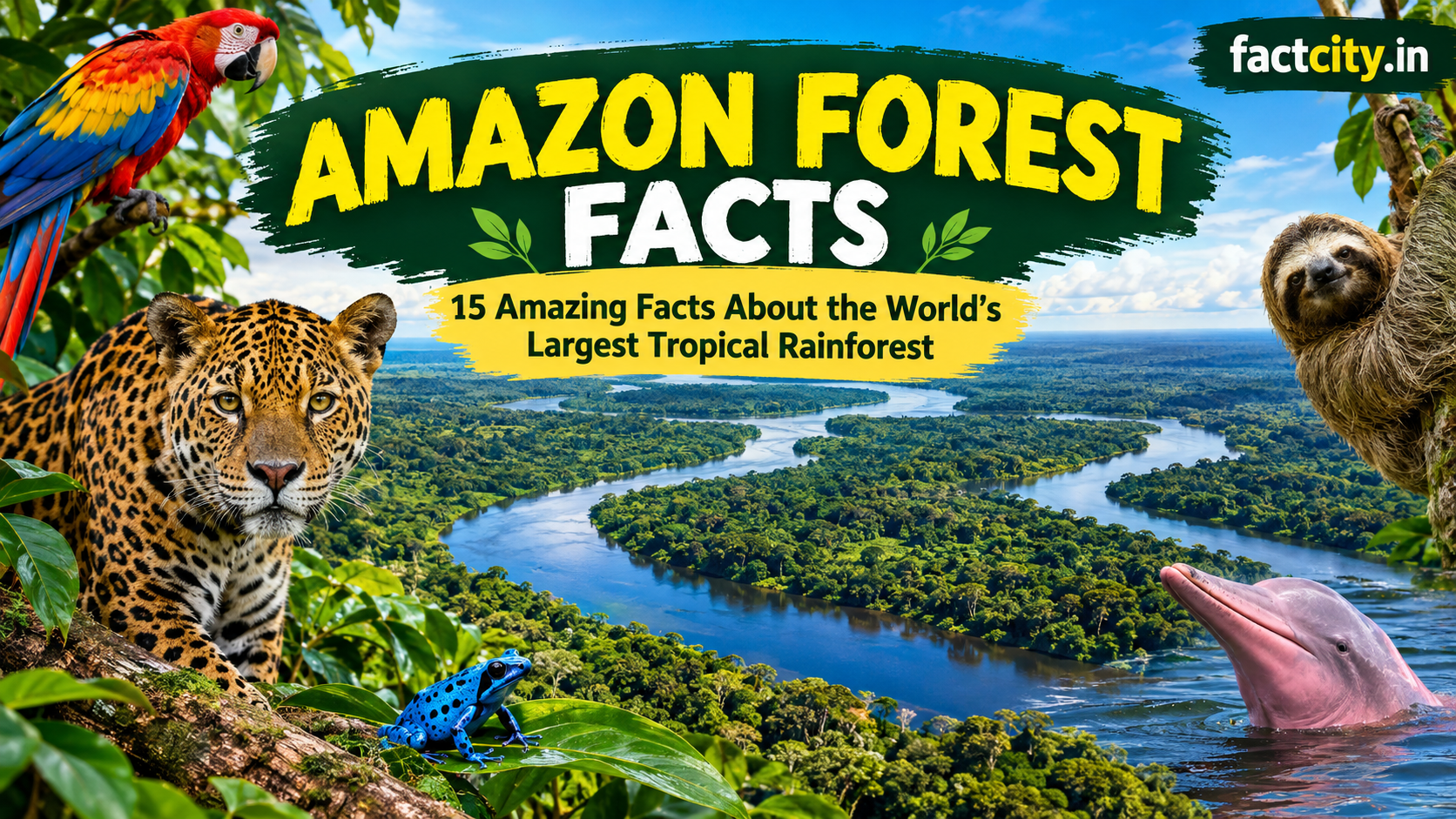
Amazon Forest Facts: The Amazon rainforest is a truly fascinating natural wonder on Earth. This rainforest is known for its amazing biodiversity, huge trees, winding rivers, and unique wildlife. This rainforest plays an important role in maintaining the balance of our planet. It runs through many South American countries and is home to millions of plants, animals, and people. There are countless Amazon rainforest facts that are intriguing and help us to understand why this natural treasure is so important to the world.
The Amazon rainforest is full of surprises, from colorful birds and strange insects to mighty rivers and ancient Indigenous cultures. It is also an important ecosystem for wildlife, storing carbon, and influencing rainfall patterns in the region. In this article, we will present 15 amazing facts about the Amazon forest, the wildlife, the environment, and the challenges faced by it today.
The Amazon is the world’s largest tropical rainforest.
One of the most interesting Amazon forest facts is that the Amazon is the world’s largest tropical forest. It covers about 5.5 million square kilometers, though estimates vary depending on how the rainforest is defined. Most of it is in Brazil, but other parts extend into countries like Peru, Colombia, Bolivia, Ecuador, Venezuela, Guyana, Suriname, and French Guiana.
The Amazon is one of the most important natural ecosystems on Earth due to its enormous size. Its forests are home to millions of trees that offer shelter, food, and breeding grounds for countless species. Rainforests also play an important role in regulating local and regional climate by absorbing sunlight, releasing moisture, and maintaining the natural water cycle.
The Amazon’s incredible biodiversity
The Amazon rainforest is known for its incredible diversity of life. Scientists have recorded thousands of species of trees, hundreds of species of mammals and vast numbers of birds, reptiles, amphibians, fish and insects.
Many species live in different forest layers. Some animals stick close to the forest floor; others live most of their lives in the branches of tall trees. Different kinds of habitats within the same environment allow different species to live.
Scientists keep finding new species in the Amazon and giving them names. But there are still some plants and animals that are poorly known because large areas are hard to study. This is why the rainforest is an important area for scientific research and biodiversity conservation.
Amazon River: One of the Greatest Rivers of the World
One of the most amazing features of South America is the Amazon River. It has more water than any other river in the world, and supports a huge variety of freshwater life. Millions depend on the river and its tributaries for food, water, transport, and livelihoods. Fishing is a mainstay for many communities, and boats are essential to reach villages with little or no road access.
The Amazon River system also has seasonal floodplains and wetlands. In high water, river levels rise, and adjacent forests are inundated, providing ephemeral aquatic habitats. These changing conditions offer feeding and breeding opportunities for many fish and other animals.
How The Amazon Makes Its Own Water Cycle
One Amazon forest fact is that trees help to move water through the environment. Their roots absorb water from the soil, and their leaves release water vapor into the atmosphere via a process called transpiration. Millions of trees give off huge amounts of moisture that helps create clouds and rain. Some of this moisture falls back on the forest, and winds in the atmosphere carry it to other parts of South America. some-facts-about-humans-amazing-facts-about-the-human
This natural process is sometimes referred to as a moisture-recycling system. Cutting down large areas of forest can lead to less moisture being released into the atmosphere and may affect rainfall patterns. So it’s important to protect the rainforest not just for the wildlife, but also for the stability of the regional climate.
Unique And Interesting Animals That Live In The Amazon
The Amazon rainforest is home to many animals that are rarely seen anywhere else in the world. They include jaguars, sloths, capybaras, giant river otters, pink river dolphins, toucans, and several species of monkey.
The jaguar is one of the most powerful predators in the rainforest. It is a good swimmer and is often found hunting near rivers and wetlands. Sloths, however, traverse the trees slowly and spend most of their time resting or feeding on leaves.
The Amazon is also home to the colorful macaws, the poison dart frogs, and the countless insect species. Each animal plays a role in the ecosystem, eating prey populations, spreading seeds, pollinating plants, or recycling nutrients.
There Are Many Unique Layers of the Rainforest
The Amazon rainforest is more than just some trees. It has some vertical layers. Each layer has different living conditions for plants and animals. The emergent layer is the layer of the tallest trees. These trees rise above much of the forest. Below it is the canopy, a thick green roof of branches and leaves. The region is home to many birds, monkeys, insects, and tree-dwelling mammals.
The understory is the area below the canopy where there is less sunlight and many smaller animals find shelter. The forest floor is dark and often damp, with decaying leaves, fungi, roots, and young plants. These layers allow thousands of species to live together in the same forest, but in different habitats.
Amazon Plants: Various Applications
For generations, indigenous communities have used a variety of plants from the Amazon rainforest. Some produce food, fibers, building materials, oils, and traditional medicines. Trees of cultural or economic value such as Brazil nut trees, cacao trees, and rubber trees. The rainforest is home to many plants that scientists study for their chemical properties and potential use in medicine.
But it’s important to remember that the presence of a plant in the rainforest doesn’t mean it’s a proven medical treatment. Any medicinal substance must undergo scientific testing to prove its safety and effectiveness. Preserving plant diversity could help preserve valuable knowledge and future research opportunities.
Indigenous Communities Have Resided in the Amazon for Thousands of Years
The Amazon rainforest is no empty wilderness. It is home to many Indigenous peoples whose cultures, languages, knowledge, and traditions are deeply connected to the forest. Many communities depend on rivers, forests and traditional farming methods to meet their food and other needs. Their knowledge might include seasonal changes, knowing useful plants, tracking wildlife, and managing local resources.
Indigenous communities are not all the same, and neither are Indigenous traditions. Some have regular contact with nearby towns, others have sporadic contact with the outside world. Protecting the Amazon and its cultural heritage depends on respecting Indigenous land rights and backing community-led conservation.
Amazon Rainforest Helps Store Carbon
Trees take up carbon dioxide from the atmosphere as they grow through photosynthesis. They build leaves, roots, trunks, and branches out of carbon, and they emit oxygen as a by-product. There is just too much vegetation in the Amazon for its forests to store significant amounts of carbon. Roots, dead plant material and soils also store carbon.
When trees are cut down or burned, some of the stored carbon can escape back into the atmosphere. Deforestation thus contributes to climate change and can at the same time damage habitats. Healthy forests are not a silver bullet for climate change, but protecting them is an important part of reducing emissions and maintaining natural carbon stores.
Amazon Has a Warm and Humid Climate
The majority of the Amazon has a tropical climate, with warm temperatures, high humidity, and large amounts of rain. Conditions differ across the region, but much of the country gets rain for much of the year. Such a warm, wet environment enables plants to grow rapidly and supports various animals. But rain does not fall everywhere the same. There are places that have wet and dry seasons, and the level of a river can vary a lot in a year.
Thus, the seasonal changes affect the time of availability of certain fruits, the time when fish enter flooded forests, and the place where animals find food and shelter. The rainforest climate is thus intimately connected to the daily lives of its plants, animals and human communities.
The Amazon Faces Deforestation Threat
One of the most frightening facts about the Amazon forest is that parts of it have been cleared for farming, cattle ranching, roads, mining and other human activity. Deforestation destroys the habitat and can break up large areas of forests into small isolated patches. This makes it harder for some animals to find food, reproduce, and move safely between habitats.
Forest loss can also affect Indigenous communities and lead to more soil erosion. Cleared land in some locations is susceptible to fire, particularly during dry periods. Although conservation has helped reduce deforestation in some places and times, it remains a huge problem. Long-term survival of the Amazon hinges on protection of existing forests and better land management.
Amazon =/= Amazon Basin
Many people use the words Amazon rainforest and Amazon basin as if they are the same, but they are different. The tropical forest ecosystem is known as the Amazon rainforest. The Amazon basin is the much larger drainage basin that sends water into the Amazon River and its tributaries. It includes forests, wetlands, rivers, and other landscapes.
Understanding this difference helps to explain why the scope of the Amazon extends well beyond the areas of dense rainforest. The river system links different environments and supports communities over a huge area of South America.
Thousands of species of fish live in the Amazon.
The river system of the Amazon sustains exceptional freshwater biodiversity. It is home to piranhas, electric eels, arapaimas, catfish, and many other fish species. As their waters change, some fish have developed strange ways to survive. Take the electric eel, for example. It can produce powerful electrical shocks that help it catch prey and defend itself.
Fish play an important role in local food systems and economies. Healthy rivers are vital for wildlife and human health, as many communities rely on fishing for protein and income. Pollution, habitat changes, and the construction of dams may affect fish populations and interfere with migration and reproduction.
Amazon Rainforest Is Important for World Weather Patterns
The Amazon influences climate and weather through its vegetation, its moisture recycling and its interactions with the atmosphere. Trees release water that helps create the conditions for rainfall across parts of South America. The rainforest can also affect the flow of moisture to agricultural regions beyond its borders. This makes forest protection important for farming, water availability, and ecosystem health.
But the Amazon doesn’t single-handedly control the world’s climate, and it is not true that it produces most of the oxygen that humans breathe. Much of the oxygen produced by forests is used up in respiration and decomposition. Its greatest importance is from the many environmental functions it performs together, including carbon storage, biodiversity support and water-cycle regulation.
Caring for the Amazon is the Job of Everyone
The future of the Amazon rainforest lies in the decisions made by governments, businesses, local communities and individuals. Conservation programs, responsible farming, Indigenous land protection and stronger action against illegal forest clearing can all help conserve this ecosystem.
What can we do? People can choose sustainably sourced products, reduce waste, learn about deforestation and support reputable conservation organizations. Companies can boost supply chain transparency and avoid products linked to illegal forest destruction.
At the same time, conservation must respect the rights and needs of people who depend on the forest for their livelihoods. Considering environmental goals together with community well-being, protection in the long run is more effective.
Summary
These Amazon forest facts show why the Amazon rainforest is one of the most valuable natural ecosystems on Earth. It is the largest tropical rainforest in the world and is home to astonishing biodiversity, immense river systems, and it influences water and carbon cycles. It is also home to many Indigenous communities, who have deep knowledge of the forest.
But the Amazon, for all its importance, is under severe threat from deforestation, habitat destruction, climate change, and other human pressures. Protecting this great rainforest will require sound decisions, responsible policies, and cooperation between communities and countries.
Learning about the Amazon is the first step in understanding the natural world. By appreciating its ecological and cultural value, we can better understand why conserving the rainforest is important for wildlife, people, and future generations.
Frequently Asked Questions About Amazon Rainforest Facts
The Amazon Rainforest is in South America.
The Amazon rainforest is in South America. Most of this region is in Brazil, with some areas in several neighboring countries and French Guiana.
Why is the Amazon rainforest so famous?
The region is characterized by its large size, its biodiversity, its large system of rivers, its tropical climate, and its importance for regional water cycles and for the storage of carbon.
How many animals live in the Amazon rainforest?
Many species are undocumented, so the exact number is unknown. The Amazon is home to thousands of animal species, including mammals, birds, reptiles, amphibians, fish, and insects.
The Amazon is important for several reasons:
The Amazon is an ecosystem for wildlife, a carbon reservoir, a moisture recycler, a provider of life to Indigenous communities, and a regional climate regulator.
What is the greatest danger facing the Amazon rainforest?
A major threat to the Amazon is deforestation. Agriculture, cattle ranching, mining, infrastructure development, and fires can destroy or damage forest habitats.
Can the Amazon rainforest be saved?
Yes, the Amazon can be saved through forest conservation, responsible land use, Indigenous land rights, restoration projects, and efforts to reduce illegal deforestation. Commitment to long-term and sustainable partnerships is key.