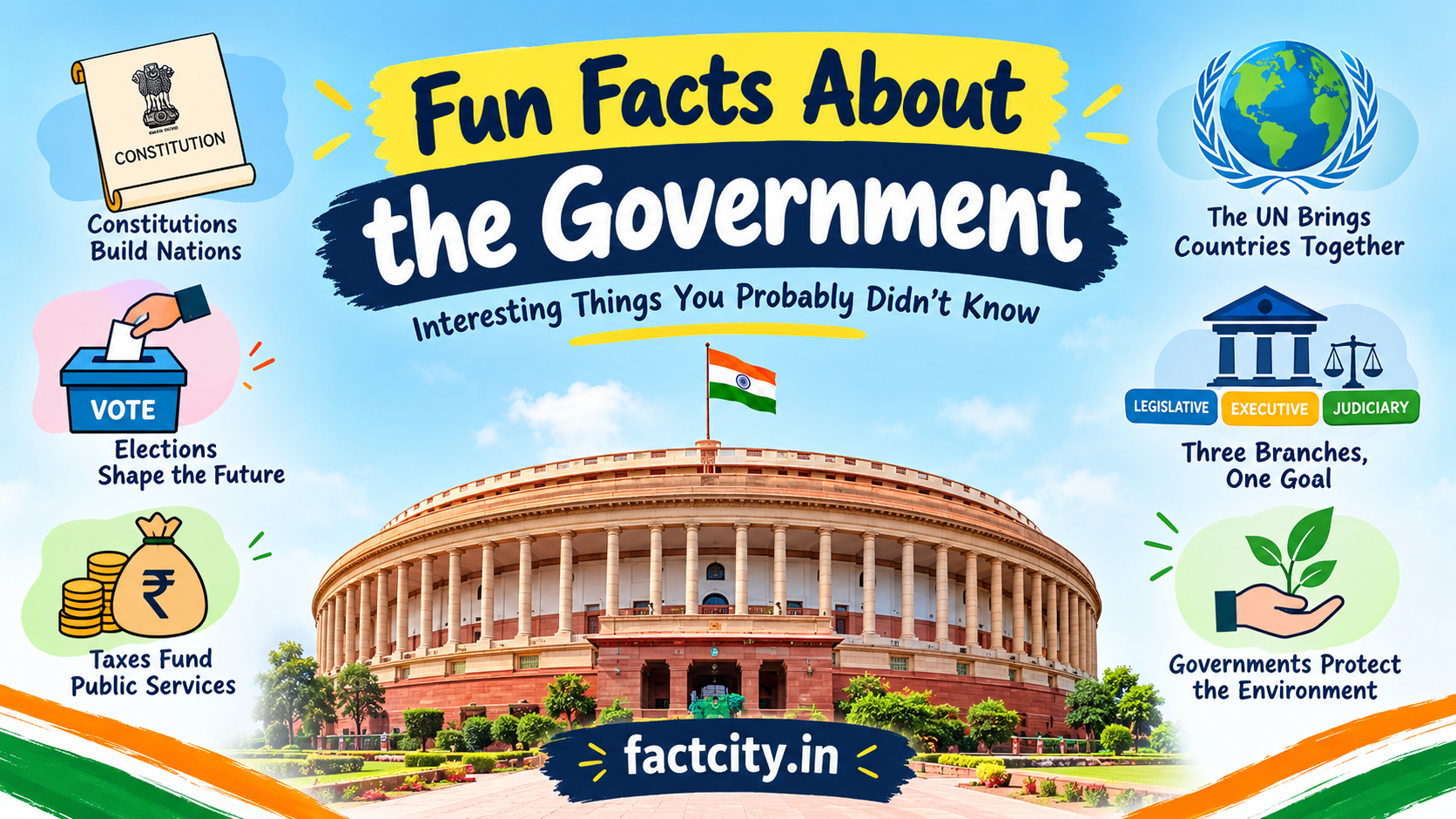
Fun Facts About the Government: Ever wonder how a government works? Who makes the laws we live by? How are important decisions made that affect an entire country? Government is a part of our everyday lives, even when we don’t think about it. Government decisions affect many things around us, from the roads we travel on to the schools where children study, to public hospitals, safety rules, and national security. But government is not just politicians making speeches and people voting in elections. Most people hardly think about many interesting facts about government. Each country has its own systems, its customs, and its way of dealing with public matters. In this article, we will take a look at 15 fun facts about the government that will help you understand how governments work and why they are important in our daily lives.
Every Country Has Its Own Way Of Running A Govt.
One interesting thing about governments is that not all countries have the same type of government. Some of these countries have democratic governments. Here , citizens who are eligible to vote elect their representatives . Other countries have monarchies where a king or queen is the head of state. Some countries combine a monarchy with an elected parliament, while others have a presidential system. For example, India is a democratic republic and the United Kingdom is a constitutional monarchy. These systems have arisen out of other historical events, political movements and traditions. No matter the structure of governments, they generally have responsibilities that include managing public affairs, maintaining order and making decisions that affect the people in their countries. “Fun Facts About the Government“
India’s Constitution is one of the longest written constitutions in the world
India’s written national constitution is one of the longest in the world and occupies a central place in the country’s democracy. The Constitution was adopted on 26th November, 1949 and came into force on 26th January, 1950. This is the reason why India celebrates Republic Day every year on January 26. The Constitution describes how government works, what powers the various institutions have, and outlines key rights and responsibilities. It provides the framework for law-making and the resolution of constitutional questions. What is particularly interesting is that it was designed for a country with a huge cultural, linguistic, and regional diversity. It is still the basis of the political and legal system of India.
The White House Is Not Just a Home for Presidents
One of the first buildings that comes to mind when people think about the government of the United States is the White House. The White House is the official residence and workplace of the American president, located in Washington, D.C. The building has served as a presidential residence since 1800 and has been the site of many important events in US history. It has offices, meeting rooms, and spaces for official ceremonies and meetings with international leaders. The White House is not just a famous building you see in movies and news reports all the time. It is also a major symbol of the American presidency and the political system of the country. Many visitors go to Washington, D.C. to visit it and learn about its history.
Citizens Have More Power Than They Sometimes Think
In a democracy, citizens have many ways to influence the direction of their country. Voting is one of the most important forms of participation as it allows eligible people to elect their representatives. But participation is not limited to an election. Citizens can also reach out to their elected officials, attend public meetings, sign petitions, engage in community discussions, and participate in peaceful protests. These activities are an opportunity for people to express their concerns and to call upon leaders to act on important issues. For example, residents might raise concerns about bad roads, clean water, public transit or local schools. Responsible citizens who stay informed and involved can help call attention to problems and push public officials to respond to community needs.
Planning an Election Takes a Lot of Organization
“You see elections on TV, and people may think it is an easy task, but it is not. A lot of work is involved in organizing an election. Election officials must compile voter lists, set up polling places, obtain voting materials, train election workers, and educate the public on how to vote. They might also run electronic voting machines, count votes, certify results, and investigate complaints, depending on the country. Conducting a national election in a large and diverse country like India needs a lot of coordination between states, cities, towns, and villages. Voting must be open to all and conducted according to the rules established by law for election officials. Such behind-the-scenes work is essential because elections need proper planning, reliable procedures, and public confidence to function properly.
Most Governments have Three Separate Branches
An interesting fact about government is that in many democratic countries there are three main branches of public power: the legislature, the executive, and the judiciary. The branches have different duties. The legislature makes laws; the executive administers government and implements laws; and the judiciary interprets laws and settles legal disputes. In India, Parliament is the highest law-making body at the national level. The Union executive performs the executive functions . The Supreme Court is the highest court in the country. Separation of responsibilities is designed to create a system of checks and balances. This may help to prevent any one institution from having unlimited power. The specifics vary from country to country, but the basic idea is to make governments more accountable.
Government influences your life in lots of ways
You may not think about the government when you switch on a tap, drive to school, visit a public hospital, or use a local road. But public institutions are often behind these daily activities. Governments can fund and/or run public schools, health care, sanitation, roads, public transportation, and emergency services. Waste collection, drainage, street maintenance, and community facilities are often the responsibility of local authorities. State or national governments often oversee public programs and larger infrastructure projects. The specific responsibilities vary according to country law. These examples illustrate that government is not confined within the walls of parliament buildings or political meetings. Its decisions can directly shape what is comfortable, safe, and possible for everyday people.
Why local government matters for every community
National leaders may get the most attention in the news, but local government is just as important in many aspects of everyday life. City councils and local bodies at the municipal and village level help address issues that directly impact residents. In some countries, local governments are responsible for maintaining public spaces, waste management, improving drainage, supporting local infrastructure, and providing some community services. In India , administration at the local level is carried out by urban local bodies and panchayati raj institutions . For example, if there’s overflowing rubbish bins or damaged local roads in a neighborhood, residents may need to contact the relevant municipal or local authority. Local government brings administration nearer to the people and enables attention to be given to matters peculiar to the community.
Taxes Enable Governments to Pay for Public Services
Taxes are a major source of revenue for governments to fund public services and national obligations. Money raised through taxes can be spent on roads, schools, hospitals, government administration, defense and many different development programs. Countries use different types of taxes, such as income taxes, property taxes, sales taxes, and corporate taxes. Governments may also generate revenue from fees, public enterprises and other sources. While paying taxes may not be a favorite thing to do, the revenue generated from taxes can pay for facilities and services that are for the good of entire communities. It also matters how efficiently this money is collected, managed, and spent. Open budgeting and sound financial management enable citizens to observe how public resources are being utilized and to appreciate the significance of government spending choices.
How Governments Can Help Protect the Environment
Environmental protection is also another important duty of governments around the world. Governments can make laws to limit pollution, protect forests, conserve wildlife, improve waste management and encourage cleaner sources of energy. They can also create national parks, protect endangered species, and set standards for industries that affect air and water quality. Some governments incentivize renewable energy projects such as solar and wind power. These efforts are important because environmental problems can impact millions of people and cannot always be solved by individual action alone. For instance, industrial pollution control generally requires clear legislation, monitoring and collaboration between public authorities and businesses. Thus government policies may influence the quality of the environment in which people live today and the natural resources available to future generations.
The United Nations helps countries cooperate
The United Nations, often called the UN, was founded in 1945 after the Second World War. It fosters cooperation, supports human rights, promotes international peace and security and helps countries tackle global challenges. The UN is not a world government that controls every country directly. Instead, it provides a platform for member nations to debate global matters and seek shared objectives. It provides humanitarian assistance, development programs, and peacekeeping operations authorized under its rules. The organization also encourages collaboration in fields like poverty, education, public health, and environmental protection. A good example of how governments can work together is the United Nations. Many of the problems of today cross borders and need cooperation between countries .
Presidents and Prime Ministers Don’t Always Have the Same Powers
It is easy to assume that all presidents do the same things but the role of a national leader depends on the political system of that country. In some countries, the president is the head of state and head of government. In some other countries, the president is mainly a ceremonial or constitutional figure, and the prime minister runs the government. In parliamentary systems the prime minister generally requires the backing of the elected legislature to stay in office. For example, India has a president as the constitutional head of state, and a prime minister who is the head of government. Spotting the difference can make it easier to follow international news. It also explains why the same title can mean very different levels of authority in different countries.
Governments Can Change Laws When New Problems Come Up
Laws are not always forever. Society is changing, and governments and legislatures may pass new laws or change old laws through established legal procedures. New technology, changing economic conditions, public safety concerns, and emerging social issues can all require changes in the law. Take online banking, social media, and digital communication, for example. Many countries have developed new or updated laws governing cybercrime, data protection, and online privacy. Courts also interpret laws and decide if the actions of the government comply with the requirements of the Constitution. Such processes enable legal systems to adapt to new situations while still being tied to known rules. Laws need to be updated because societies face challenges today that earlier generations couldn’t have imagined. fun-facts-about-atoms-amazing-things-you-should-know
Certain Types of Government Information Citizens May Request
Transparency is a key component of an accountable government. In many countries, citizens have a right to access certain public records or to make information requests to government departments. These rules help people understand how public institutions work and how decisions are made. In India, the legal framework for seeking information from public authorities is laid down in the Right to Information Act, 2005, subject to the exemptions and procedure provided therein. This information can assist students, journalists, researchers, and common citizens to know more about public services and administrative decisions. Access to government information can also help people to ask informed questions about how public money is spent. When public institutions provide information in accordance with the law, citizens have more opportunities to understand government activities and hold authorities accountable.
“Young People Can Learn About Government Before They Vote”
It’s not just for adults to know about government. Also, children and teenagers can learn a basic understanding of laws, citizenship, democracy, and public responsibilities. Schools frequently teach civics to explain how government institutions function and why citizens’ rights are important. Young people can also learn by following reliable news sources, discussing local issues, and participating in school councils or community projects. Students can relate government to real life by learning about how a municipal council functions or why it is important to maintain public spaces. Young people who learn these subjects at an early age can be better prepared to be informed citizens when they are old enough to vote. It can also help them to appreciate different points of view, ask meaningful questions, and participate positively in their communities.
Why should you learn about the government?
By learning about government, we can begin to understand the decisions that are made to shape our communities, our rights, and our opportunities. It explains how leaders are chosen, how laws are made, where public money comes from, and why public institutions have different responsibilities. It can also help people better understand political news and distinguish between verified information and false claims. Citizens who understand how their government functions have the ability to ask questions, discuss public issues, and make informed voting decisions. Government can seem like a complicated subject at first, but simple explanations and real-life examples can make it easier to understand. Even a few basic facts can make people more aware of the world around them.
Summary
These fun facts about the government prove there’s more to government than elections, politicians, and official buildings. It includes the bodies that make laws, manage public resources, provide basic services, protect rights, and interact with other countries. Governments affect many areas of modern life, from the Constitution of India and the role of local authorities to the work of the United Nations in the international arena. Knowing these facts can help us understand how public institutions operate and the significance of responsible leadership. It also reminds us that citizens have an important role to play by being informed, comprehending their rights, and participating in their communities. The more we learn about the government, the easier it is to understand the decisions that will shape our society and our future.