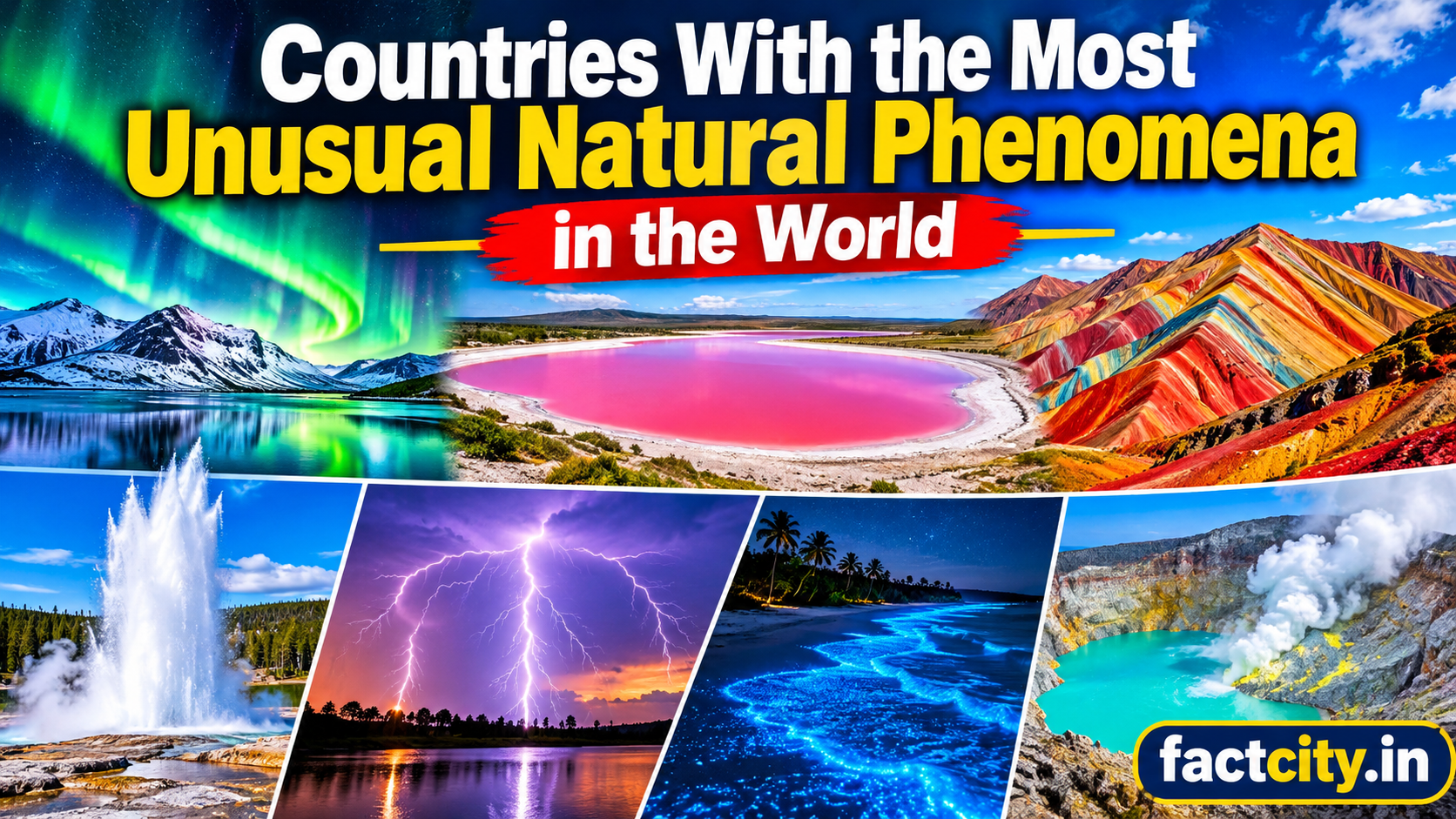
Countries With the Most Unusual Natural Phenomena. Nature is full of surprises, and some of the most fascinating events on Earth seem almost impossible to believe. From glowing beaches and colorful lakes to mysterious waterfalls and skies filled with dancing lights, our planet offers countless examples of extraordinary natural phenomena. These events are created by a combination of weather, geology, sunlight, microorganisms, and other natural processes. Some happen regularly, while others appear only during particular seasons or under rare conditions. Many countries around the world are famous for these unusual natural wonders, attracting travelers, photographers, scientists, and curious nature lovers. Let’s explore some of the countries with the most unusual natural phenomena and discover the science behind their incredible sights.
1. Iceland – The Land of Fire and Ice
Iceland is one of the most remarkable countries for unusual natural phenomena because it sits on the boundary between two tectonic plates and contains numerous active volcanoes and glaciers. This unique geological position creates a landscape where fire and ice exist side by side. One of Iceland’s most spectacular sights is the Northern Lights, also known as the Aurora Borealis. These colorful lights appear when charged particles from the Sun interact with gases in Earth’s atmosphere, producing green, purple, and sometimes red patterns across the night sky.
Iceland is also known for its powerful geysers, including Strokkur, which regularly shoots hot water into the air. Visitors can witness volcanic landscapes, steaming geothermal areas, black sand beaches, and enormous waterfalls. During winter, some glaciers contain beautiful blue ice caves formed by flowing meltwater. These natural features make Iceland a destination where the forces of nature are visible in extraordinary ways.
2. Australia – The Mysterious Pink Lakes
Australia is home to several unusual natural phenomena, including naturally pink lakes that look almost unreal. One famous example is Lake Hillier, located on Middle Island in Western Australia. Its striking pink color has attracted attention from scientists and visitors for many years. The color is associated with salt-loving microorganisms, including certain algae and bacteria, although the exact contribution of different organisms can vary.
Another remarkable phenomenon occurs in parts of Australia where large numbers of fireflies and glow-worms create beautiful displays of light. The country also experiences spectacular sunsets, unusual cloud formations, and powerful thunderstorms. In some regions, enormous dust storms can turn the sky orange or red, creating a dramatic scene that looks like something from another planet. Australia’s diverse climate and geography make it one of the most fascinating places to observe nature’s unusual behavior.
3. Norway – The Magical Northern Lights
Norway is among the best countries in the world for experiencing the Northern Lights. Located close to the Arctic Circle, northern Norway offers favorable conditions for viewing this spectacular natural phenomenon, especially during the darker months of the year. The lights appear when solar particles interact with Earth’s magnetic field and atmospheric gases, creating colorful waves that move across the sky.
The Lofoten Islands and Tromsø are particularly popular locations for aurora viewing. Norway also experiences the Midnight Sun during summer, when the Sun remains above the horizon for extended periods. In some northern areas, daylight continues throughout the night for weeks. This unusual seasonal pattern occurs because Earth’s axis is tilted as the planet travels around the Sun. Together, the Northern Lights and Midnight Sun make Norway a country where the sky itself becomes a natural attraction.
4. Bolivia – The World’s Largest Natural Mirror
Bolivia is famous for Salar de Uyuni, the world’s largest salt flat, which covers an enormous area in the country’s southwestern region. During the rainy season, a thin layer of water sometimes forms over the salt surface, transforming the landscape into a giant natural mirror. The sky, clouds, and distant mountains appear reflected on the ground, creating the illusion that visitors are walking among the clouds.
This unusual effect occurs because the flat surface of the salt crust becomes covered by shallow water that reflects light. The result is one of the most extraordinary landscapes on Earth. During dry months, the salt flat looks completely different, with bright white patterns stretching toward the horizon. This dramatic seasonal transformation makes Bolivia one of the most remarkable countries for unusual natural phenomena.
5. China – The Rainbow Mountains
China’s Zhangye Danxia National Geological Park is famous for its colorful mountains, which display layers of red, orange, yellow, and other shades. These striking patterns were formed over millions of years as different mineral-rich sandstone layers accumulated and were shaped by geological forces.
The colorful appearance is especially impressive under sunlight, when the mountain ridges look like waves of paint across the landscape. The phenomenon is not caused by artificial coloring but by natural mineral deposits and the long process of erosion. China’s Rainbow Mountains demonstrate how geological changes over immense periods can create landscapes that appear almost unreal.
6. Japan – The Blue Glow of the Sea
Japan is known for several unusual natural phenomena, including glowing marine waters. In certain coastal areas, tiny organisms called bioluminescent plankton can produce blue light when disturbed by waves or movement. This creates a magical glow along the shoreline, particularly during favorable seasonal conditions.
One famous example is the firefly squid, which appears in large numbers along parts of Japan’s coast during its breeding season. These small creatures produce blue light through a natural chemical reaction inside their bodies. Japan also experiences dramatic volcanic activity, hot springs, and snow-covered landscapes shaped by powerful winter weather. The combination of marine life, volcanic geology, and changing seasons makes Japan a fascinating country for nature enthusiasts.
7. Venezuela – The Never-Ending Lightning Storm
Venezuela is home to one of the world’s most remarkable atmospheric phenomena: the Catatumbo lightning. This event occurs near the mouth of the Catatumbo River, where it meets Lake Maracaibo. The region experiences frequent thunderstorms, sometimes producing lightning flashes on many nights throughout the year.
The phenomenon is influenced by local geography, warm moisture from the lake, surrounding mountains, and atmospheric conditions that encourage storm formation. Lightning can illuminate the sky repeatedly, creating an extraordinary natural light show. Although the intensity and frequency vary with the seasons, the region remains one of the most famous places on Earth for frequent lightning activity.
8. New Zealand – Glowing Caves and Powerful Geothermal Activity
New Zealand is famous for its unusual natural landscapes, including glowworm caves and geothermal areas. In the Waitomo region, tiny glowworms produce blue-green light that illuminates dark cave ceilings like a star-filled sky. These organisms use bioluminescence to attract insects, creating a beautiful display in underground environments.
The country also has geysers, bubbling mud pools, steaming ground, and colorful geothermal lakes. These features are especially common in the Taupō Volcanic Zone, where underground heat from volcanic activity warms water and produces gases. New Zealand’s combination of glowing caves, volcanic landscapes, and dramatic scenery makes it one of the most exciting destinations for discovering unusual natural phenomena.
9. Indonesia – Blue Flames and Volcanic Lakes
Indonesia is located within the Pacific Ring of Fire and contains numerous active volcanoes. One of its most unusual natural sights is the blue fire found at Kawah Ijen volcano on the island of Java. The blue flames are produced when sulfur-rich gases escape from volcanic vents and ignite upon contact with oxygen. The glowing effect is most visible at night.
Kawah Ijen also contains a highly acidic crater lake with a striking turquoise appearance. The lake’s color is influenced by its chemical composition and mineral content. Indonesia’s volcanic landscapes demonstrate the powerful geological forces that continue to shape our planet.
10. United States – The Mysterious Sailing Stones
Death Valley National Park in California is home to a fascinating natural phenomenon known as the sailing stones. These rocks leave long tracks across the dry surface of Racetrack Playa, even though no person or animal appears to have moved them. incredible-facts-about-countries-around-the-world
Scientists discovered that the movement can occur when a thin layer of water freezes into floating ice panels during cold conditions. As the ice melts and winds push the panels, they can slowly move rocks across the muddy surface. This rare combination of ice, water, and wind creates tracks that once seemed mysterious. Death Valley also experiences extreme temperatures, colorful desert landscapes, and unusual geological formations.
Conclusion
The countries with the most unusual natural phenomena show just how creative and powerful nature can be. From Iceland’s volcanic landscapes and Norway’s Northern Lights to Bolivia’s reflective salt flats and Venezuela’s lightning storms, every region offers something extraordinary. These phenomena are not simply beautiful sights; they also help scientists understand Earth’s atmosphere, geology, climate, and living organisms.
Exploring these natural wonders reminds us that our planet is constantly changing and that many of its most incredible features are created through ordinary natural processes working together in unusual ways. Whether it is a glowing ocean, a colorful mountain range, or a sky filled with lightning, these remarkable events reveal the fascinating beauty of the natural world.