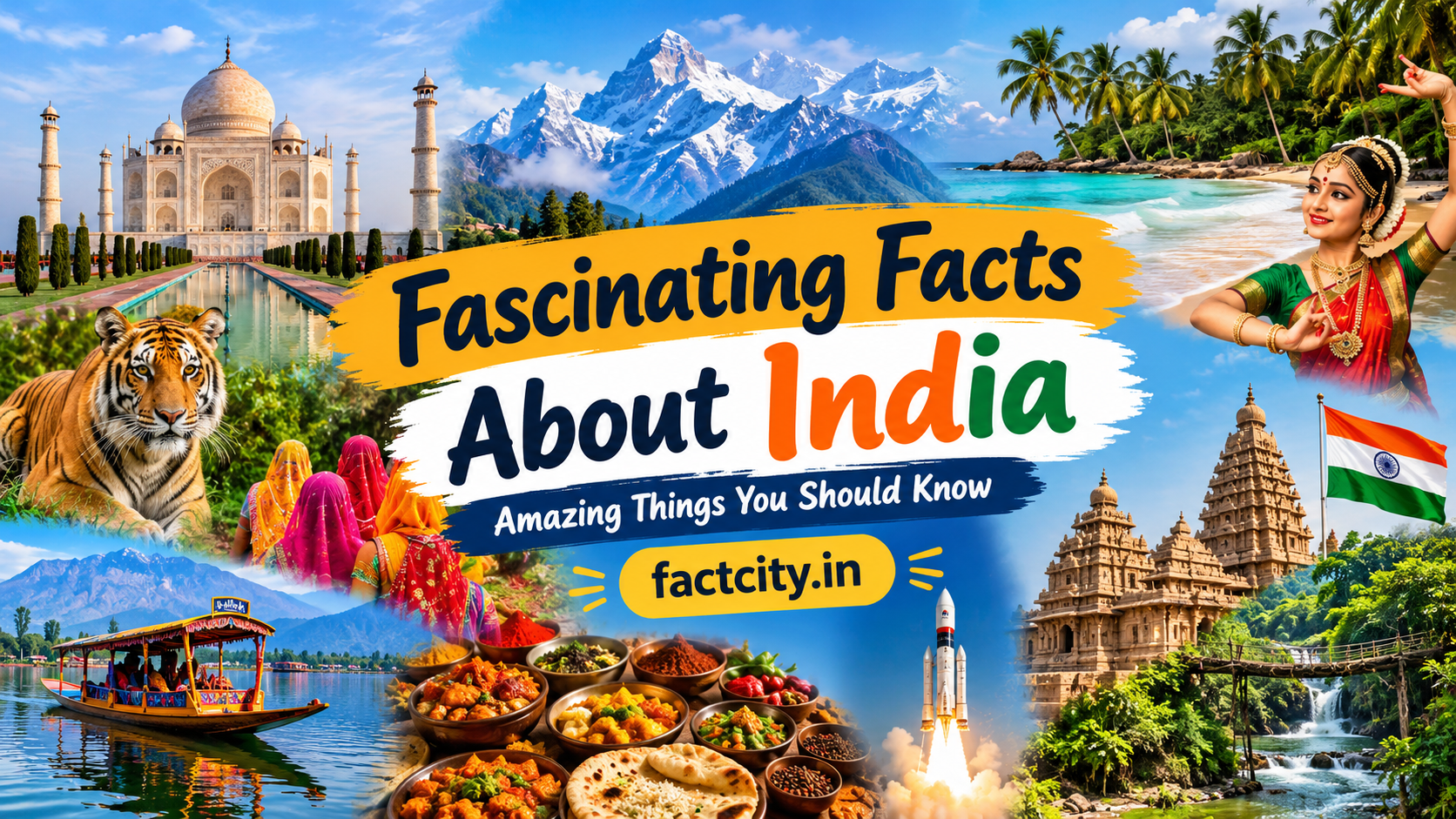
India is one of the most diverse and interesting countries in the world. India has endless stories that can surprise even those who know the country well, from ancient civilisations and amazing monuments to unusual traditions, incredible geography and unique cultural practices.
India is not just a single culture or tradition. It has thousands of years of history and hundreds of languages and dialects. Every region has its own food, festivals, architecture, dress, customs and history. Some facts are well known; others so strange they may seem unbelievable at first.
If you love learning about history, culture, geography, science and weird traditions, these interesting facts about India will give you a new perspective on this extraordinary country.
India has one of the oldest civilisations in the world
India has a very long history. The Indus Valley Civilisation is considered one of the oldest urban civilisations of the world, which developed thousands of years ago. “Fascinating Facts About India“
Important archaeological sites such as Harappa and Mohenjo-daro show evidence of planned cities, drainage systems, buildings, craft production and organised communities.
What makes these ancient settlements even more interesting is the fact that they were constructed thousands of years before many of today’s cities developed the same urban characteristics.
India Has Incredible Linguistic Diversity
The most interesting fact about India is the huge linguistic diversity.
India has 22 languages in the Eighth Schedule of the Constitution, but hundreds of other languages and dialects are spoken by different communities and regions.
While Hindi and English are the most common languages for communication and administration, languages such as Bengali, Tamil, Telugu, Marathi, Gujarati, Kannada, Malayalam, Punjabi, Assamese and Odia have millions of speakers.
In much of India, a person might speak one language at home, another at school or work, and understand several other languages through the course of everyday life.
India Has a Village Where Houses Are Traditionally Left Unlocked
In the Indian state of Maharashtra, the village of Shani Shingnapur is renowned for a long-standing tradition of houses and shops without conventional locked doors.
The tradition is linked to the local beliefs of Lord Shani, and the village has become a popular destination for visitors interested in its unusual cultural practices.
Note that these traditions are more indicative of local customs and beliefs than of everyday life across India.
India has one of the World’s Most Impressive Railway Networks
Indian Railways is one of the largest railroad systems in the world and is a vital link between cities, towns, villages and remote locations.
Millions of passengers travel by train every day for work, education, business, tourism and family travel.
The railway network is also interesting for the fact that it passes through a huge variety of landscapes. Trains can travel through mountains, deserts, forests, plains, coastal areas and busy cities.
For many travellers, an Indian train ride is more than just transportation; it’s an experience that offers a glimpse of the country’s remarkable diversity.
Northern India is Covered by the Himalayas
The spectacular Himalayan mountain system dominates the northern part of India.
The Himalayas house some of the highest mountains in the world and affect India’s climate, rivers, agriculture and ecosystems.
The Indian Himalayan region covers Jammu and Kashmir, Ladakh, Himachal Pradesh, Uttarakhand, Sikkim and parts of the north-eastern states.
The landscape goes from snow-covered peaks and glaciers to green valleys and high-altitude deserts.
India Has One of the Driest Inhabited Places in the World
Mawsynram in Meghalaya is internationally recognised for its very high rainfall.
The geography of the region is an important factor in its amazing precipitation. This helps the moisture-laden air coming from the Bay of Bengal to mix with the hills and result in heavy rains.
Meghalaya is one of India’s most visually distinctive states, with a landscape of waterfalls, dense vegetation, caves, rivers, and green valleys.
The Sundarbans are in India
The Sundarbans in the delta of the Ganges-Brahmaputra-Meghna rivers are known for their mangrove forests.
The Indian part of the Sundarbans lies mainly in West Bengal, but the larger ecosystem extends into Bangladesh.
The area is home to numerous species and is especially known for the Bengal tiger. Its labyrinth of tidal waterways, mudflats, islands, and mangrove vegetation creates an ecosystem unlike most other forests in the world.
India Has Living Tradition of Root Bridges
Meghalaya is famous for its extraordinary living root bridges.
The locals have, for a long time, been manipulating the aerial roots of rubber fig trees to create strong natural bridges across streams and small rivers.
Unlike typical bridges, these structures can continue to grow and get stronger over time if they are well maintained.
The living root bridges are a testimony to the ability of traditional knowledge and understanding of nature to be fused to solve practical problems.
Yoga Had Its Roots in India
Yoga has a long history in India and has evolved over thousands of years out of philosophical, spiritual and physical traditions.
Today, millions of people in the world practise yoga for various reasons like physical exercise, breathing practices, meditation, relaxation and personal well-being.
International Yoga Day is celebrated on June 21 every year to celebrate the global popularity of this ancient Indian tradition.
India Has a Wide Range of Food Traditions
Indian food is not a single cuisine. It is a mix of local food traditions that have been influenced by geography, history, religion, agriculture, and local ingredients.
South Indian food is famous for dosa, idli, sambar and different types of rice dishes. Punjab is known for things like makki di roti and sarson da saag, while Gujarat has a unique vegetarian cuisine.
Each region – east, northeast, west, north and coast – has its own way of cooking.
Spices such as turmeric, cardamom, cumin, coriander, cloves and black pepper are generally associated with Indian cooking, though the combinations and methods of preparation vary greatly from region to region.
India has a festival for almost every community and season
India is known for colourful festivals.
Different parts of the country celebrate Diwali, Holi, Eid, Christmas, Durga Puja, Navratri, Onam, Pongal, Baisakhi, Ganesh Chaturthi, and many regional festivals.
Such celebrations may include music, dancing, decorations, religious services, family gatherings, traditional foods, and community activities.
What makes India’s festivals particularly interesting is the regional diversity. The same season can look totally different from one state to another.
Taj Mahal Was Built as a Love Monument
The Taj Mahal in Agra is one of India’s most iconic landmarks and a UNESCO World Heritage Site.
Commissioned by the Mughal emperor Shah Jahan in memory of his wife, Mumtaz Mahal.
Built in the 17th Century, the monument was famous for its white marble architecture, detailed decoration, symmetrical design, and gardens.
People from all over the world visit the Taj Mahal, and it is one of the most popular examples of Mughal architecture.
India has the Himalayas and tropical beaches
India’s geography is very diverse.
For the visitor, in the north are some of the highest mountain landscapes in the world. Tropical beaches, coastal plains, lagoons and islands are found in the south, and along the western and eastern coasts.
India has deserts, forests, grasslands, wetlands, plateaus and river valleys and even high-altitude landscapes.
This geographical diversity explains India’s amazing diversity of climates, plants, animals and agricultural traditions.
The Long History of Mathematics in India
India has historically contributed a lot to the field of mathematics.
The ideas of ancient Indian mathematicians were written down and contributed to modern mathematical thinking. Important contributions from the mathematical history of India include the decimal place-value system and the development of the concept of zero.
There was plenty to be said about zero and the operations that can be performed on it by the 7th-century mathematician Brahmagupta.
Eventually these developments became part of the mathematical foundations used throughout the world today.
India Is Home to a Lot of Unique Animal Species
India’s huge and varied ecosystems support an amazing variety of wildlife.
The country is home to Bengal tigers, Asian elephants, Indian rhinoceroses, Asiatic lions, snow leopards, gharials, Indian peafowl and many other species.
To conserve these animals and their habitats, some national parks and wildlife sanctuaries have been established.
For example, the last remaining wild population of the Asiatic lion occurs in and around the Gir landscape of Gujarat, and hence conservation efforts there assume special significance.
The Indian Peafowl Is India’s National Bird
The Indian Peafowl, commonly known as the peacock, is the national bird of India.
Due to its bright plumage and unusual mating dance, it has been an important element in Indian art, culture, literature, and symbolism.
It is found in many parts of the country and familiar to many Indians even outside protected wildlife areas.
There Is a Floating Post Office in India
The postal system in India has some interesting aspects, including a notable floating post office in Srinagar, linked with Dal Lake.
The floating post office is a memorable attraction as it combines traditional Indian postal services with the unique landscape of Kashmir.
This is just one of the many quirky ways in which public services have adapted to the country’s varied geography.
India is one of the world’s largest tea-producing countries
Tea is deeply rooted in the economy and culture of India.
Tea-growing areas such as Assam, Darjeeling, and the Nilgiris are famous around the world. In India’s tea-growing regions, the climate and elevation vary from one area to another, creating different flavour and character notes.
For many Indians, tea is not just a drink. This is part of everyday social life, with many conversations starting over a simple cup of chai.
India has a space program with major achievements
India’s space program has grown over the years.
The Indian Space Research Organization (ISRO) has undertaken satellite launches, earth observation missions, communication projects, and planetary exploration.
India’s Chandrayaan missions have added to scientific research on the Moon. The Mars Orbiter Mission showcased India’s capability of interplanetary exploration.
These achievements have made the Indian space program an important part of the modern scientific narrative of the country.
India is a land of incredible contrasts
The most fascinating fact about India is that its diversity defies easy summation.
Ancient temples can exist side by side with modern skyscrapers. The technology companies are located near the traditional markets. Mountain communities are at elevations of thousands of meters above sea level. Coastal cities have tropical climates.
Across the country, you have different religions, languages, cuisines, architectural styles, and cultural traditions living side by side.
One of the main reasons why India continues to fascinate travellers, researchers, historians and curious readers all over the world is the blend of ancient heritage and modern development.
Conclusion: What Makes India So Interesting
India is a land of stories that link the ancient world with the modern age. Its civilisations, languages, festivals, landscapes, wildlife, cuisine, scientific achievements, and local customs offer almost an infinite number of things to explore.
From the Himalayas and the Sundarbans to the ancient archaeological sites and the modern space missions, each region adds a new chapter to the story of India.
These amazing facts about India are just the tip of the iceberg. The more you learn about the country’s history and culture, the more surprises you are sure to find.
Perhaps India’s greatest fascination is not with a particular monument, tradition, or historical happening. It is the wealth of experiences and cultures that exist within one country.