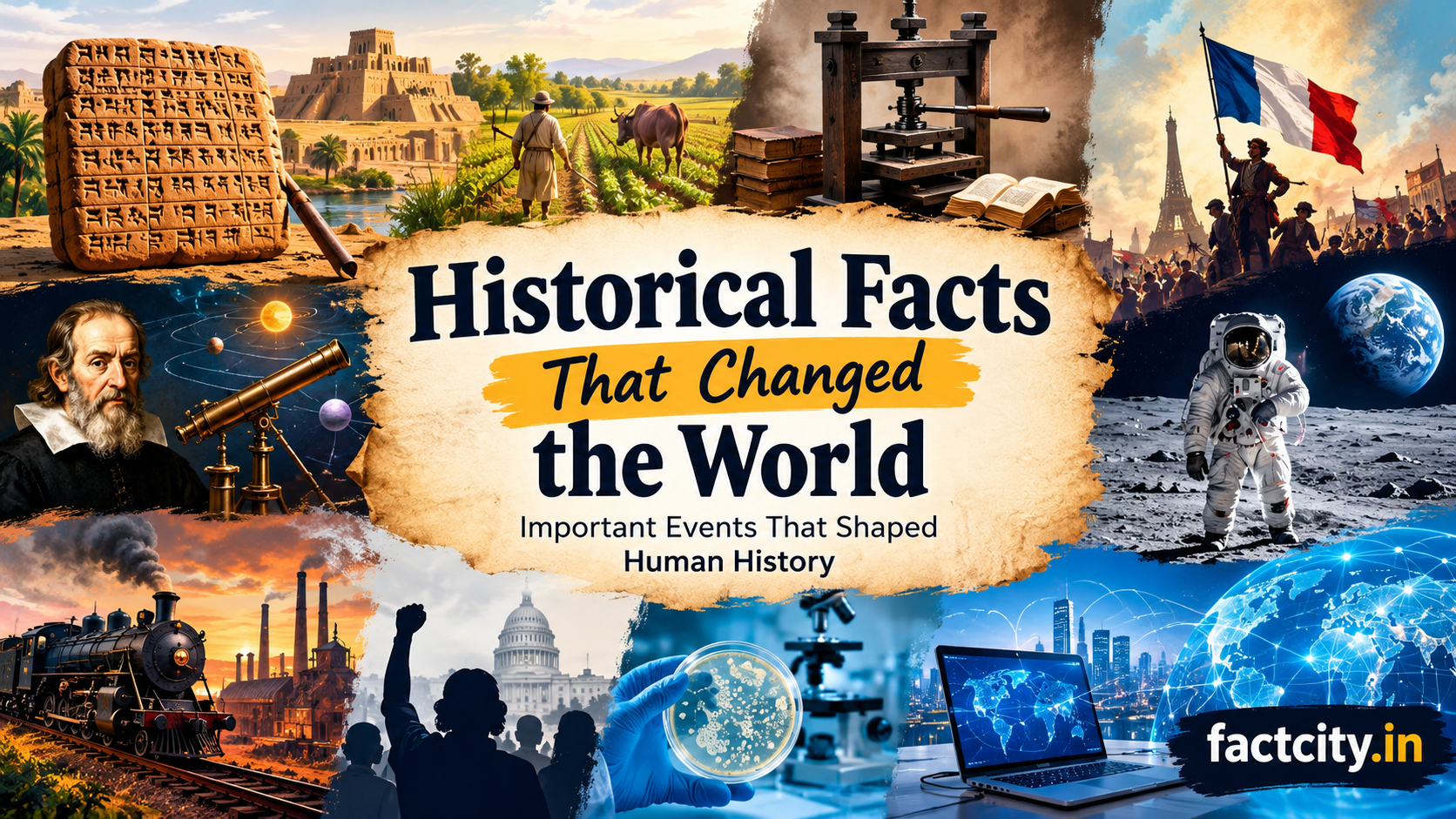
Historical Facts That Changed the World: History is much more than a collection of dates, kings, battles, and ancient civilizations. It tells the story of how people lived, how societies developed, and how the world gradually became what it is today. Some historical events changed the way humans communicate, travel, trade, govern themselves, and understand the universe. From the invention of writing to the Industrial Revolution and the discovery of modern medical treatments, these milestones have influenced billions of lives. Learning about world-changing historical facts helps us understand the origins of modern society and why many things we take for granted today exist.
1. The Invention of Writing Changed Human Communication
One of the most important developments in human history was the invention of writing. Around 3200 BCE, people in ancient Mesopotamia began using early writing systems, including cuneiform, to record information. Initially, writing was often used to manage trade, count goods, track agricultural products, and maintain administrative records. Over time, it became a powerful way to preserve laws, stories, religious beliefs, and scientific knowledge. Before writing became widespread, people depended heavily on spoken communication, which made preserving detailed information across generations more difficult. Writing allowed knowledge to travel beyond the lifetime of the person who created it, helping civilizations develop more complex governments, educational systems, and cultural traditions.
2. The Agricultural Revolution Changed Human Settlements
Thousands of years before modern cities appeared, humans began moving from hunting and gathering toward farming and animal domestication. This transformation, known as the Agricultural Revolution, began in different regions of the world at different times, with early farming communities emerging around 10,000 BCE in parts of Southwest Asia. Farming made it possible for some communities to produce more food in one place and establish permanent settlements. As agricultural production increased, populations grew, and villages gradually developed into towns and cities. This change supported specialized occupations, trade networks, organized governments, and new forms of social structure. However, farming also introduced challenges, including unequal access to resources, the spread of certain diseases, and greater dependence on crops. Despite these difficulties, agriculture became one of the foundations of modern civilization.
3. The Invention of the Printing Press Spread Knowledge
The development of movable-type printing in Europe by Johannes Gutenberg during the fifteenth century transformed the spread of information. Printing methods had existed earlier in East Asia, but Gutenberg’s system helped make book production more efficient in Europe. Before printed books became widely available, copying manuscripts by hand was slow and expensive. Printing allowed texts to be reproduced in larger quantities, making books more accessible to scholars, students, religious communities, and ordinary readers. This development helped spread scientific discoveries, encouraged literacy, and supported major intellectual movements, including the Renaissance and the Protestant Reformation. Ideas could reach people across distant regions more quickly than before, reducing the control that a small number of institutions had over written information. The printing revolution laid important foundations for modern education, journalism, and mass communication.
4. The Scientific Revolution Changed How People Understood Nature
During the sixteenth and seventeenth centuries, European thinkers increasingly relied on observation, experimentation, and mathematical reasoning to investigate the natural world. Scientists such as Nicolaus Copernicus, Galileo Galilei, and Isaac Newton helped transform ideas about astronomy, motion, and the physical universe. Copernicus proposed a model in which Earth and the other planets orbit the Sun, while Galileo’s astronomical observations provided important evidence supporting the changing understanding of the solar system. Newton later developed laws of motion and universal gravitation that explained many physical phenomena. These developments challenged established assumptions and encouraged people to test ideas using evidence rather than accepting every traditional explanation. The Scientific Revolution influenced modern medicine, engineering, astronomy, and technology while helping establish scientific inquiry as a central part of understanding the world.
5. The Industrial Revolution Transformed Everyday Life
The Industrial Revolution began in Britain during the eighteenth century before spreading to other parts of the world. New machines, improved manufacturing processes, and the use of steam power changed how goods were produced. Instead of relying mainly on small workshops and manual labor, many industries moved toward factory-based production. Textile manufacturing, mining, transportation, and metalworking experienced major changes, while railways and steamships made it easier to transport people and products. Industrialization increased production and contributed to the growth of cities, modern businesses, and international trade. However, it also brought difficult working conditions, child labor, pollution, and overcrowded urban neighborhoods. Over time, industrial societies introduced labor reforms, improved infrastructure, and developed new technologies. The Industrial Revolution helped shape the modern economy and changed how people work, travel, and live.
6. The American and French Revolutions Influenced Modern Democracy
The American Revolution, which led to the independence of the United States in 1776, and the French Revolution, which began in 1789, became important turning points in political history. Both movements challenged existing systems of authority and helped spread ideas about popular sovereignty, citizenship, rights, and representative government. The American Declaration of Independence expressed principles of equality and individual rights, although these ideals were not applied equally to everyone at the time. The French Revolution challenged the privileges of the monarchy and aristocracy and promoted ideas associated with liberty and equality. These revolutions influenced political movements in other countries and contributed to debates about constitutions, voting rights, and the relationship between citizens and governments. Their legacies remain important in discussions about democracy, freedom, and social justice.
7. The Abolition of Slavery Changed Millions of Lives
For centuries, slavery deprived millions of people of their freedom and subjected them to forced labor, violence, and family separation. Resistance by enslaved people, abolitionist campaigns, political struggles, and changing economic and social conditions contributed to the gradual abolition of slavery in different parts of the world. The British Parliament passed legislation abolishing slavery in most of the British Empire in 1833, with implementation beginning in 1834 and important exceptions and transitional arrangements. In the United States, the Thirteenth Amendment abolished slavery in 1865, except as punishment for a crime under its constitutional wording. These changes represented major legal turning points, but freedom did not immediately bring equality. Discrimination, forced labor, racial segregation, and other injustices continued in many societies. The history of abolition demonstrates the power of resistance and reform while reminding us that protecting human rights requires continuing effort.
8. The Discovery of Germs Revolutionized Medicine
For much of history, people had limited knowledge of what caused many infectious diseases. Illness was often explained through incorrect theories, and medical treatments were frequently ineffective or dangerous. During the nineteenth century, scientific research by figures such as Louis Pasteur and Robert Koch helped establish the role of microorganisms in causing particular diseases. This growing understanding supported improvements in hygiene, food safety, sterilization, and disease prevention. The development of germ theory also strengthened the scientific foundations of modern medicine. Alongside advances in vaccination, sanitation, and later antibiotic treatment, these discoveries helped healthcare professionals prevent and treat many infections more effectively. Medical progress has never eliminated all disease, but understanding how infections spread has saved countless lives and changed hospitals, public health systems, and everyday healthcare practices.
9. The World Wars Reshaped International Relations
The First World War, fought from 1914 to 1918, and the Second World War, fought from 1939 to 1945, transformed international politics and caused enormous human suffering. The First World War contributed to the collapse of several empires and redrew political boundaries across Europe and the Middle East. The Second World War brought widespread destruction, the Holocaust, and the use of atomic weapons against Hiroshima and Nagasaki in August 1945. After the war, the United Nations was established in 1945 to encourage international cooperation and help maintain peace and security. The conflict also contributed to the emergence of the United States and the Soviet Union as rival superpowers, beginning the Cold War. These events influenced modern diplomacy, international law, human rights discussions, military strategy, and the global political order.
10. The Moon Landing Expanded Human Possibilities
On July 20, 1969, astronauts Neil Armstrong and Buzz Aldrin became the first humans to walk on the Moon during NASA’s Apollo 11 mission, while Michael Collins remained in lunar orbit. Armstrong’s first step onto the lunar surface became one of the most recognizable moments in modern history. The mission demonstrated what could be achieved through scientific research, engineering, international observation, and coordinated teamwork. The broader space race accelerated developments in computing, telecommunications, materials science, and aerospace engineering. Space exploration also changed how people viewed Earth by providing striking images of our planet from space. Although the Moon landing was part of a political and technological competition during the Cold War, its significance extended beyond that rivalry. It opened a new chapter in human exploration and inspired generations of scientists, engineers, and students.
11. The Invention of the Internet Connected the World
The development of the internet changed how people communicate, learn, work, and conduct business. Its foundations emerged from computer networking research during the twentieth century, including ARPANET, which began operating in 1969. A major milestone came in 1983, when ARPANET adopted the TCP/IP protocols that helped establish the foundations of the modern internet. Later, Tim Berners-Lee developed the World Wide Web, proposing it in 1989 and creating its first implementation in the early 1990s. The web made it easier to access and share information through linked documents. Today, the internet supports online education, digital banking, international communication, remote work, scientific collaboration, and global commerce. It has also introduced challenges involving privacy, misinformation, cybersecurity, and unequal access to technology. Nevertheless, it remains one of the most influential technological developments in modern history.
12. The Human Rights Movement Changed Social Expectations
Throughout history, many people have fought against discrimination and unequal treatment based on race, gender, religion, disability, and social background. These struggles have included movements for women’s voting rights, civil rights, labor protections, and equal access to education. One important milestone came in 1948, when the United Nations adopted the Universal Declaration of Human Rights. The declaration established a widely recognized set of principles concerning dignity, freedom, and equality. It was not itself a legally binding international treaty, but it influenced later human rights agreements and national laws. Civil rights movements across the world also helped challenge discriminatory systems and expand political participation. Progress has differed across countries, and many forms of inequality remain. Even so, these movements have changed public expectations about fairness and the responsibility of governments to protect fundamental rights.
Why Learning Historical Facts Matters Today
Understanding historical facts that changed the world helps us recognize how modern life developed through centuries of discoveries, struggles, and decisions. The food we eat, the books we read, the medicines we use, the political systems we live under, and the technologies that connect us all have roots in earlier historical developments. History also teaches us that progress is rarely simple. Scientific breakthroughs can improve lives, but industrial growth can create environmental problems. Political revolutions can expand rights, but equality may take generations to achieve. By studying the past carefully, we can better understand current challenges, recognize the consequences of human decisions, and make more informed choices about the future. historical-discoveries-that-changed-the-world
Conclusion
The most important historical events are not simply moments recorded in textbooks; they are turning points that changed how humanity lives and thinks. The invention of writing preserved knowledge, agriculture supported settled communities, printing spread ideas, and scientific discoveries transformed our understanding of nature. Revolutions reshaped governments, medical research improved public health, world wars changed international relations, and the internet connected people across continents. Each development contributed to the world we know today, often in ways that earlier generations could never have imagined. Exploring these historical facts that changed the world makes the past more meaningful and reminds us that the decisions, discoveries, and struggles of people today may also shape the future for generations to come.