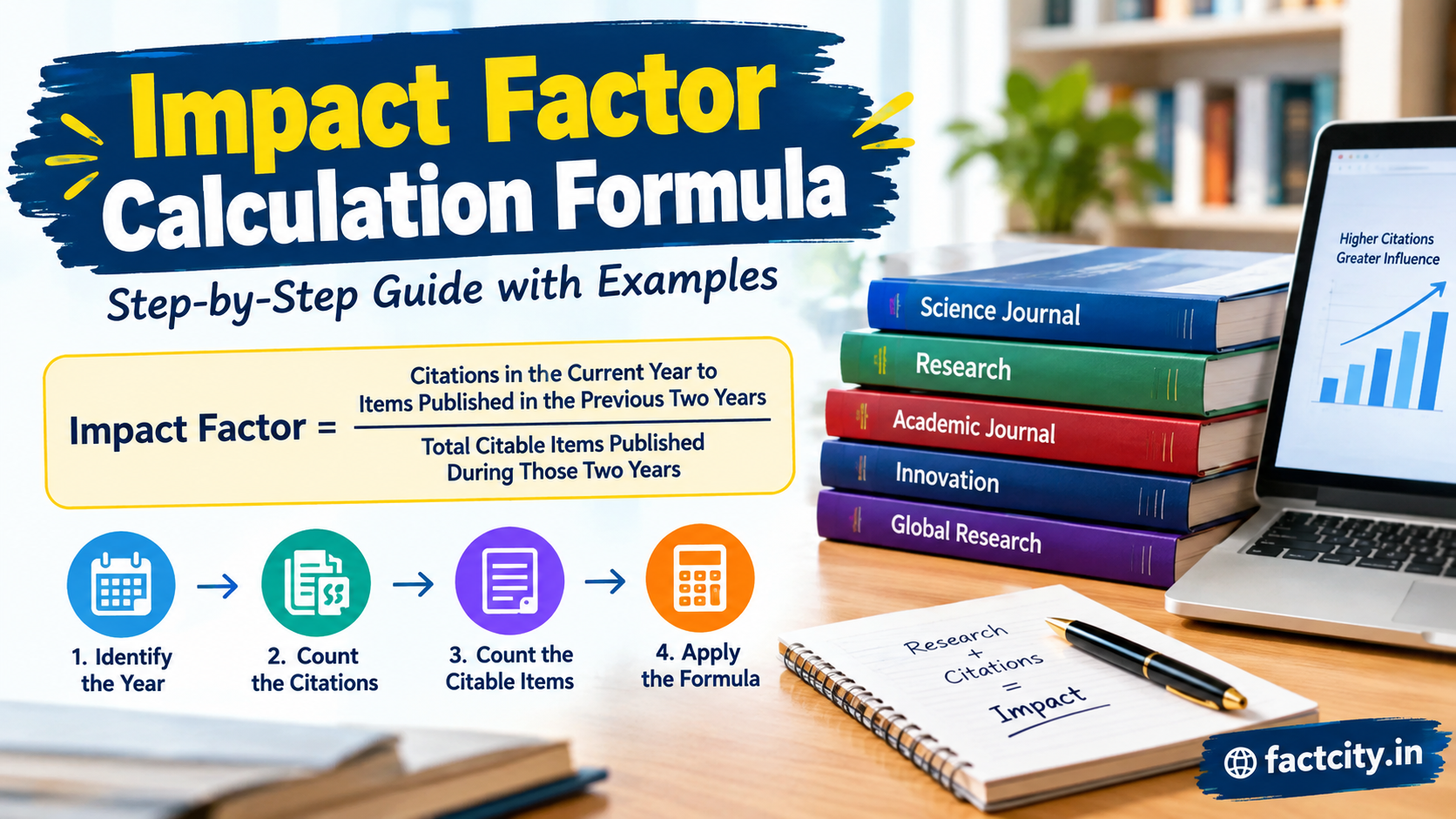
Impact Factor Calculation Formula: The calculation of the impact factor formula is a very important topic for researchers, students, professors, and academic writers who want to know the quality and influence of scientific journals. When researchers want to publish their work, they often look at the impact factor of a journal. It helps them understand how often the research published in the journal is cited by other researchers. Higher impact factor journals usually have higher citation impact in their academic field, but this number alone cannot determine the quality of each article.
Clarivate publishes the Journal Impact Factor (JIF) via the Journal Citation Reports (JCR). It is calculated by dividing the number of citations received in a given year by the number of citable items published in the previous two years. This formula can aid researchers in interpreting journal metrics and in making more informed publication choices.
What is Journal Impact Factor?
The Journal Impact Factor is a citation-based measure of the impact of an academic journal. It reflects the average number of total citations to articles published in the journal during the two previous years. This means that if a journal has an impact factor of 4.0, it means that its recent content was cited an average of about four times per citable item according to the metric’s calculation method. This doesn’t imply that every article got four citations. Some articles will have many citations, others few or none.
The impact factor is calculated annually, based on citation and publication data for the given year. It’s especially helpful for comparing journals within the same academic disciplines. Citation practices vary between subjects, however, and care should be taken when comparing journals in unrelated fields.
Impact Factor Calculation
Journal Impact Factor is calculated using the standard two-year Journal Impact Factor formula:
Impact Factor = Citations in Current Year to Items Published in Previous Two Years / Total Citable Items Published During Those Two Years
Mathematically, this is:
A / B = JIF
When and where:
A (Numerator). Citations in the calculation year to content published in the previous two years in a journal.
B (Denominator): The total number of citable items published by the journal in those same two years.
The official Journal Impact Factor is calculated by Clarivate, using its Journal Citation Reports methodology, by selecting the relevant citation data and eligible publication types. Articles and review articles are typical examples of citable items.
Calculation of impact factor step by step
There are three steps in the calculation of a journal impact factor, in principle. You can find the correct years, count citations to the journal content for those years, and divide total citations by the number of eligible citable items.
Step 1: Determine the Year for the Calculation
First, select the year for which you want to calculate the impact factor. The standard Journal Impact Factor is based on citation data from this year and publication data from the two previous years.
For example, a 2025 calculation will make use of citations in 2025 to relevant content published in 2023 and 2024. The calculation can only be carried out if the publication window and the citation year are correctly identified.
Step 2: Tally the Citations
Then, for the two preceding years, count the number of citations received by the journal in the year of calculation.
For this calculation, assume that the articles and other content of a journal published in 2023 and 2024 were cited a total of 900 times in 2025. For example, in this case, the numerator is 900.
Citations for the official JIF may be to journal content of different document types, not just those which are part of the denominator itself. The official result is based on the data and rules used by Clarivate.
Count the Citable Items
Now add up the total number of citable items the journal published in the same two-year period. Suppose the journal published 200 citable items in 2023 and 2024. In our example, this total is what we call a denominator. The numerator and denominator are not two counts of the same set of documents. The criterion does not include citations to content that itself is not counted as a citable item.
Step 4: Use the Formula
As in the example above:
Total citations in 2025 = 900
Total citable items published = 200 (2023-2024)
Impact Factor = 900/200
Impact Factor = 4.5
In this hypothetical example, the impact factor for this journal is calculated to be 4.5. This is an example calculation and not the actual journal’s official impact factor.
Example of Impact Factor Calculation
Now imagine a different journal that published 150 citable items in two years. These and other relevant journal items were cited 600 times in the following year of calculation.
This would be calculated as:
Impact factor = 600 / 150
Impact Factor = 4.0
The result shows a citation rate of around four citations per citable item in this metric. That doesn’t mean all published articles are of equal importance, or that the journal is the best choice for all researchers by default.
The table below shows the various citation numbers and the results they can yield, assuming the number of citable items is constant.
Total number of citations
Items that may be cited
Impact Factor
200 100 2.0 400 100 4.0 600 100 6.0 800 100 8.0 1,000 100 10.0. The examples show the mathematical relationship between citations and impact factor. If a denominator is constant, the greater the numerator, the greater the result.
What is the Numerator and Denominator?
To be able to fully understand the impact factor calculation formula, you need to understand the numerator and the denominator, respectively. The numerator is the number of citations recorded in the given year to the content of the journal published in the two preceding years. These citations are taken from the sources included in the respective Journal Citation Reports methodology.
The determinant is the number of articles that are citable and that the journal has published in those two years. Articles and reviews are good examples of the sort of publication that is counted here.
Therefore, researchers should not compute an official Journal Impact Factor by dividing all citations available on a website by the total number of items in an archive of a journal. The official calculation uses publication years, citation data, document classifications, and coverage rules.
Five-Year Impact Factor Two-Year Impact Factor
The standard score is the Journal Impact Factor, which uses a two-year publication window. But researchers may also encounter the five-year Journal Impact Factor. The two-year measure is based on citations to journal content published in the two years prior to the year in question. The five-year metric is based on a five-year publication window and tracks citations to content published in that time frame.
For fields where citations take longer to accrue for research, five-year measures may provide context. Some research papers, for instance, may remain relevant to scholarship for many years after their publication. Neither is better in any universal sense. The best metric is dependent on the field, the publication practices, and the purpose of the comparison.
Why does the Impact Factor matter?
The impact factor is used by researchers to compare journals, decide where to publish, and assess the impact of citations on academic publications. Universities, research institutions, and librarians can also use journal-level metrics as part of wider research evaluation or collection decisions.
Journal metrics can be one factor in choosing a journal to submit a manuscript to for authors. However, the journal’s subject matter, readership, peer-review process, publication fees, indexing status, and relevance for the research topic are also important.
It is important that a high impact factor does not give the impression that acceptance of a manuscript is guaranteed or that all articles in the journal are of excellent quality. The metric describes the citation pattern at journal level and does not measure the scientific value of each paper.
Limitations of the Impact Factor
Although the impact factor is well-known, it has various limitations. Citation practices vary widely across disciplines. The impact factor of a journal can be higher in fields with high citation frequency than in fields with naturally low citation rates.
The metric is also susceptible to manipulation by a small number of highly cited papers. Thus, the average citation rate may not be representative of the experience of every article published in the journal. weird-and-crazy-facts-that-will-blow-your-mind
Another important limitation is that citations do not always mean agreement, practical importance, or research quality. Another author may cite a paper because he/she is disputing its conclusions or discussing its limitations.
Therefore, the impact factor should be considered in conjunction with other relevant information, such as article-level citations, peer-review standards, journal scope, editorial policies, and the actual quality of the research.
How to find a journal’s official impact factor
If you want to check an official Journal Impact Factor, go to Clarivate’s Journal Citation Reports. You can search for the journal by title or other identifying information available and review the information provided for the relevant reporting year.
You want to check the exact journal title and ISSN. There may be similar journal titles. Researchers should also verify that the metric presented is for the correct year.
Watch out for websites that promote an impact factor without explaining where it comes from. Some websites use alternative metrics or unofficial calculations and should not be confused with the Journal Impact Factor published by Clarivate.
Summary.
The calculation of the impact factor is simple. It is the number of citations that were made in a given year to the contents of the journal in the previous two years divided by the total number of citable items that were published in those two years.
For example, an impact factor could be 900 citations / 200 citable items, so 4.5. However, the official Journal Impact Factor requires the right citation data and publication classifications.
This formula is very useful for students, researchers, and academic writers to interpret the journal metrics more precisely. The impact factor is a useful way of comparing journals, but it should never be the only measure used to assess the quality of research. A thorough assessment also includes the relevance, the reliability, the novelty, and the practical value of the research being published.