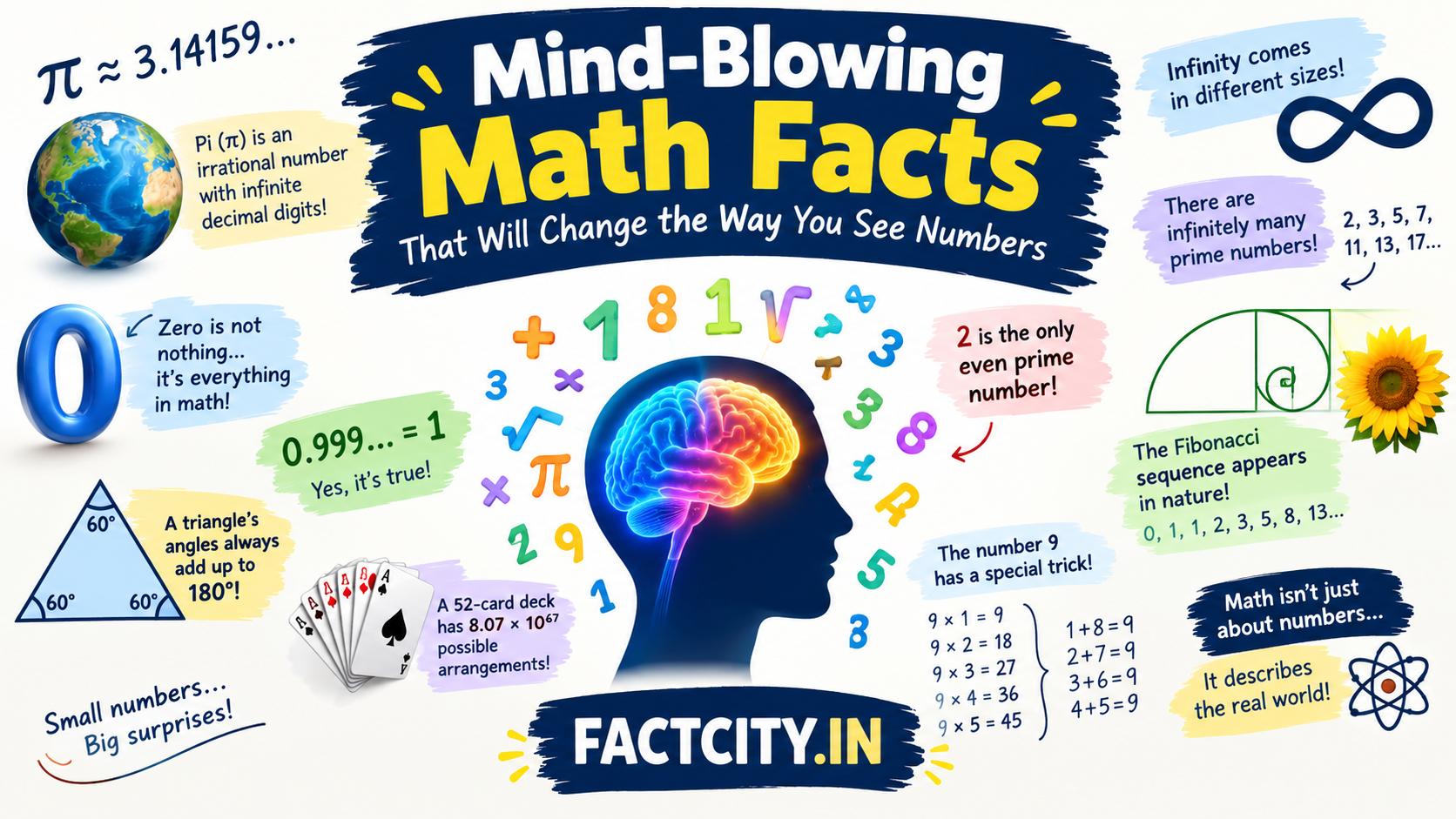
Mathematics is often presented as a collection of formulas, rules, and calculations. But there are some really surprising ideas in mathematics outside of equations and classroom exercises. Weird patterns in numbers, cool facts about infinity, geometry, probability, and prime numbers — maths can be way more interesting than it first seems.
If you love discovering weird facts, then these mind-blowing maths facts will give you a fresh perspective on numbers and the world around you. Some are easy to understand; others illustrate how deep and mysterious mathematics can be.
Zero Is a Very Important Number
Zero may appear to be nothing, but it totally changed mathematics. It is the absence of quantity and an important part of our number system. “Mind-Blowing Math Facts“
For example, in the modern place-value system, it would be hard to tell 5, 50, and 500 apart without zero.
Zero has another special mathematical property. Any number multiplied by zero will always equal zero:
25 × 0 = 0
The creation and utilisation of zero as a number was a giant leap in the history of mathematics.
There Are an Infinite Number of Primes
Prime numbers are whole numbers greater than 1 that can only be divided without a remainder by 1 and themselves.
A few examples are:
2, 3, 5, 7, 11, 13, 17, 19
One very interesting fact about primes is that there is no greatest prime number in existence. No matter how many primes you have found, there is always another prime number out there somewhere.
The Greeks showed this in their mathematics, with a famous proof traditionally attributed to Euclid.
The Sole Even Prime Numeral
This is a simple fact that many people overlook.
There is only one even prime . The number 2 .
Every second even number is divisible by 2. For example,
4 = 2 × 2
6 = 2 × 3
8 = 2 × 4
10 = 2 × 5
Since a prime number has only two positive factors, no even number other than 2 can be prime.
The Ratio Is the Same Regardless of the Size of the Circle
Pi (π) is the mathematical constant that is the ratio of a circle’s circumference to its diameter.
For every circle is perfect,
Diameter / Circumference = pi
The first digits of pi are:
3.1415926535…
The digits go on forever with no repeating. Whether you think of it as a little coin or a big round thing, the ratio is the same.
And that’s part of why pi is one of the most famous constants in mathematics.
0.999… Is Equal to 1
This fact may sound impossible at first.
The recurring decimal:
0.999999…
is actually equal to one.
One way to understand it simply is to allow:
x =.999…
Multiplying both sides by 10, we get
10x=9.999….
Subtract the first from the second:
9x = 9
So:
x = 1
So, in mathematical language:
0.999… = 1
It is not simply a number that tends to 1 more and more. Its decimal expansion to infinity has the same value as 1.
Some Numbers Are Not Rational
Not all numbers can be expressed as simple fractions.
Irrational numbers include such numbers as √2 and π. Their decimal expansions continue forever without eventually settling into a repetend.
For instance:
√2 ≈ 1.414213562…
No final digit, no repeating block that continues forever.
That’s part of what makes mathematics so interesting: numbers can have properties that can’t be written out completely in ordinary decimal notation.
Infinity Has Different Sizes
Infinity is not merely a very large number. In mathematics, it is something that has no end.
Even better, mathematicians have shown that infinite sets can be of different sizes.
For example, the set of integers:
1, 2, 3, 4, 5…
is unbounded.
The set of real numbers is also infinite, but mathematicians have proved that the real numbers are a higher order of infinity than the counting numbers.
This idea changed the way mathematicians think about the concept of infinity.
Fibonacci Sequence in Nature
The Fibonacci sequence starts with:
0, 1, 1, 2, 3, 5, 8, 13, 21…
You add the last 2 numbers together to get every number .
For example:
5 + 8 = 13
This sequence is well known, since similar mathematical patterns can be found in natural structures, for instance, some arrangements of leaves, seeds, and other patterns of biological growth.
It is so interesting to study the Fibonacci numbers and nature, but real-life examples do not always follow the sequence perfectly.
52 Card Deck has a Tonne of Possible Combinations
A standard deck of playing cards consists of 52 cards.
The number of ways you can order those cards is:
52!
That means multiplying every integer from 1 to 52.
The result is something like:
8.07 × 10⁶⁷
And that’s a very, very large number.
In fact, there are so many possible arrangements that it is extraordinarily unlikely that a randomly shuffled deck has ever occurred in exactly the same order before.
The Number 9 Has an Amazing Trick
Multiplication by 9 results in some interesting patterns.
As follows:
9 × 1 = 9
9 × 2 = 18
9 × 3 = 27
9 × 4 = 36
9 × 5 = 45
Observe that many of the answers have digits that add up to 9:
1 + 8 = 9
2 + 7 = 9
3 + 6 = 9
4 + 5 = 9
This works due to mathematical properties relating to the decimal number system and divisibility by nine.
Angles of a Triangle Always Add Up to 180 Degrees
In ordinary Euclidean geometry, the sum of the three interior angles of a triangle is always
180°
For example, a triangle might have angles of:
60° + 60° + 60° = 180°
Or else:
90° + 40° + 50° = 180°
This simple rule is one of the fundamental rules of geometry. It is worth noting, however, that this rule depends on the geometry used. On curved surfaces like the sphere, the angles of a triangle need not sum to 180 .
There’s a Number Called Googol
A googol is a very large number:
10¹⁰⁰
That’s a one followed by 100 zeroes.
The most popular history of the term is that the name “googol” was suggested by mathematician Edward Kasner’s young nephew in the early 20th century.
It is so big that it is hard to imagine in physical terms.
A googol is also far larger than the number of particles thought to be in the observable universe.
Negative Numbers Were Weird
Today negative numbers are commonplace.
We apply them to negative temperatures, bank balances, sea levels below sea level, and a lot of maths.
But historically, negative numbers were not always accepted as real numbers. Mathematicians argued about their interpretation and whether they corresponded to real quantities.
Algebra, geometry, science, economics, and engineering all depend on negative numbers.
- Pi has infinite digits
Pi is irrational, which means that its decimal expansion never ends but also does not have a repeating pattern.
For practical calculations, people usually use:
π = 3.14159
or else
pi ≈ 3.14159
Computers have computed trillions of digits of pi, but there is no last digit to be found.
This makes pi one of the most intriguing mathematical constants ever studied.
The Real World Can Be Described by Mathematics
Perhaps the most amazing math fact is that mathematical ideas developed or studied by humans can accurately describe physical phenomena.
Engineers use maths to design bridges, aeroplanes, electrical systems and machines. Scientists use mathematical models to study planets, weather, particles, populations and many other systems.
Mathematics is a language to describe relationships and patterns. From the movement of planets to the design of smartphones.
What Makes These Math Facts So Interesting?
These amazing maths facts show that maths is a lot more than solving equations on a piece of paper. It has infinite numbers, strange patterns, huge quantities, fascinating shapes, probability, infinity, and structures that reappear throughout science and nature.
Some facts are simple to demonstrate, and others lead to profound mathematical questions which researchers have been studying for centuries.
So next time you see a number, don’t just think of it as a symbol. It might have properties and relations much more interesting than meets the eye.
Summary
There are many surprises in mathematics. These facts show just how rich the world of mathematics really is, from the elusive nature of infinity and irrational numbers to the infinite digits of pi and the unbelievable number of possible card arrangements.
If you are a student, teacher, math lover, or even just a person who likes to know interesting facts, then looking at crazy mathematical ideas can make the numbers a lot more fun.