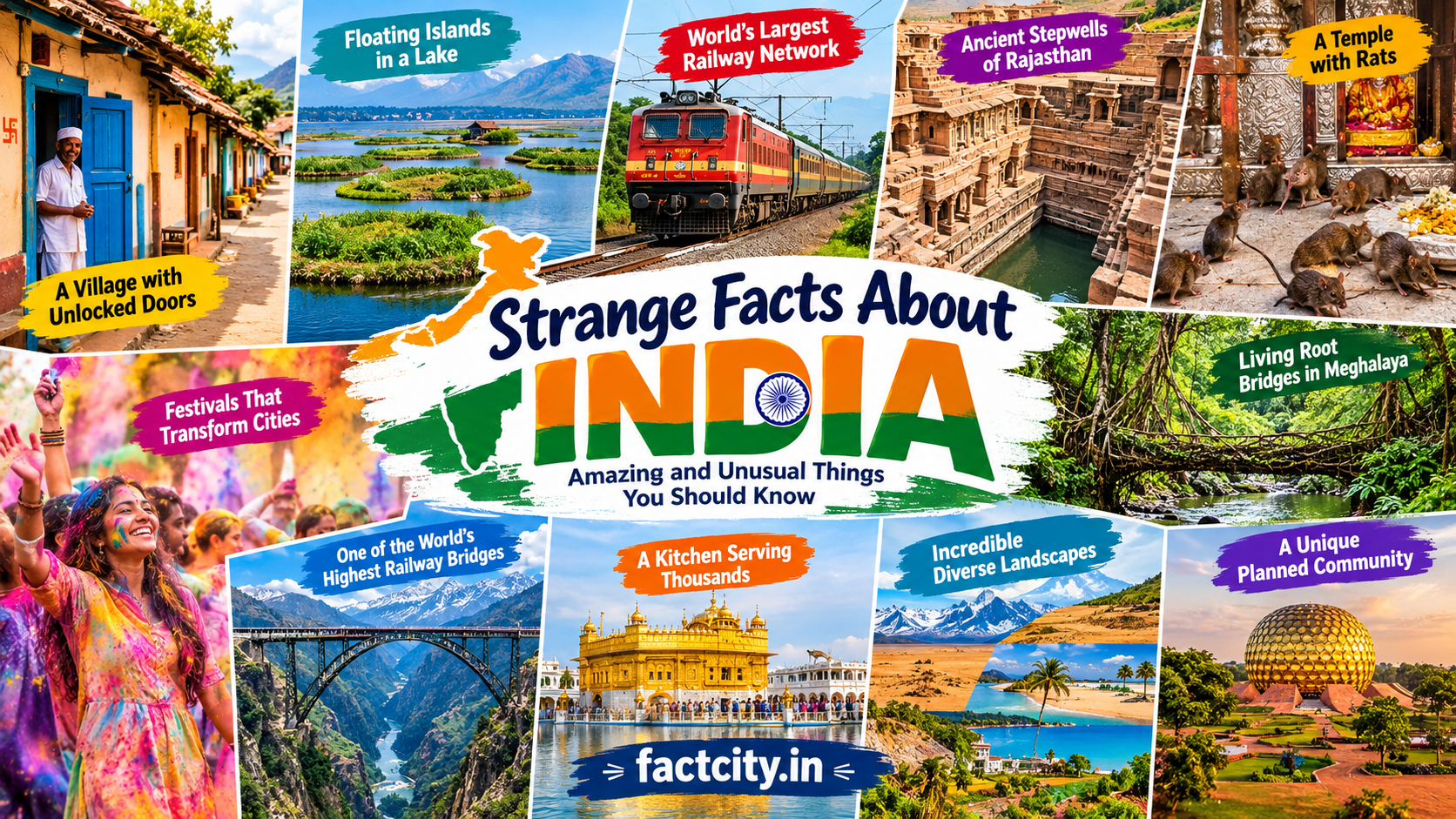
India is a country of old traditions living side by side with modern cities, of many languages, of special natural sights, and of interesting cultural practices. With a history dating back several thousand years and a population exceeding a billion people, it is no wonder that India has a wealth of stories and facts that sound strange, surprising, or simply unbelievable.
India is a country of strange details. There is a village where people don’t lock their homes, and there is a lake with strange floating islands. Some facts are related to history and geography, others to local customs and everyday life.
In this article, we discuss some strange facts about India that show how diverse and fascinating the country can be.
India Has a Village Where Doors Are Never Locked
Shani Shingnapur in Maharashtra is famous for an ancient local custom of open houses and shops. The village is linked to the Hindu god Shani, and many of the local people have long believed the deity protects the community from theft.
The modern lifestyle and choices of individuals may be different, but the picture of a village with homes that don’t have conventional locked doors has indeed emerged as one of the quirkiest cultural tales of India.
India Has A Lake That Is A Floating Island
Famous for its floating masses of vegetation, soil and organic matter, Loktak Lake in Manipur is known to be home to the phumdis.
Such strange shapes can look like islands floating on the surface of the lake. Some are large enough to support vegetation, wildlife and human activity.
The Loktak Lake also houses the Keibul Lamjao National Park, the only floating national park in the world.
India is home to one of the world’s largest rail networks
India has a vast railway network that links cities, towns, villages, and remote parts of the country. Indian trains carry millions of passengers every day.
The railway system is not just transportation. For many Indians, trains form an important part of culture and travel. The long-distance journey can take many hours or even a day or more, allowing passengers the opportunity to experience a range of landscapes and regions in one journey.
India has a village famed for its unique water management
Some Indian communities have built amazing traditional ways of collecting and managing water.
In Rajasthan, for instance, people used to construct baolis and stepwells to store and retrieve water. They could be multi-tiered stairways that descend to the water.
Stepwells are fascinating because they are at the crossroads of engineering and architecture. Others are adorned with elaborate carvings and still stand today as important historical landmarks.
Temple of Rats, India
The Karni Mata Temple in Deshnoke, Rajasthan, is famous for the rats that live and are looked after in the temple premises.
These rats are known locally as kabbas, and devotees treat them with respect. Visitors can see them walking around the temple grounds and eating food offered to them.
This may seem strange to those not familiar with the tradition, but it is a major religious and cultural activity for temple devotees.
India has a place where the roots of living trees become bridges
In some areas of Meghalaya, local communities have trained the roots of rubber fig trees to create living bridges.
Rather than building bridges of concrete or steel, people guide the growth of tree roots in certain directions until they form strong, natural paths over streams and valleys.
Some of these bridges take years to construct. They are a stunning example of people working with nature rather than simply building over it.
India has hundreds of languages and even more dialects
Among the most interesting things about India is its huge linguistic diversity.
Hindi and English are the most widely spoken languages for communication and administration, but there are many constitutionally recognised languages and hundreds of other languages and dialects spoken by various communities in India.
Anyone travelling from one part of India to another could come across entirely different languages, scripts, accents and vocabulary.
This linguistic diversity is one reason why India can seem like several cultural worlds inside one country.
Some of the World’s Highest Railway Bridges are in India
The Chenab Rail Bridge in Jammu and Kashmir is an extraordinary engineering feat. It crosses the Chenab River in a mountainous area and is part of the rail infrastructure that connects the area to the wider Indian rail network.
Its great height above the river makes it one of the most remarkable railway bridges in the world.
The project shows how modern engineering is being used to overcome difficult mountain terrain.
India Has a Temple With a Kitchen That Feeds Huge Numbers Of People
The Golden Temple in Amritsar, Punjab, is not only known for its beautiful architecture but also for its langar, or community kitchen where visitors can get free meals.
Whichever background they come from, people can sit around a table and break bread.
At busy times, the scale of the operation can be quite remarkable. Volunteers assist with cooking, serving, cleaning, and other duties.
This custom is a reminder of the importance of community service and equality in Sikh religious culture.
The Indian Landscape Is One of the Most Diverse on Earth
The geography of India is very diverse. The country has Himalayan mountains, deserts, tropical forests, fertile plains, beaches, islands, wetlands, and high-altitude areas.
For instance, the west’s Thar Desert environment is not the same as the rain-drenched Meghalaya landscape in the northeast.
In the Himalayan region, it can be freezing cold, while the tropical regions of southern India can be warm for much of the year.
This geographical variation is why India is unique in biodiversity.
There is a festival involving living fire that is famous in a village
Some of the Indian festivals and traditions have strange forms of cultural expression which may be surprising to outsiders.
Communities all over the country hold festivals with fire walking, costumes, giant processions, traditional dances and religious ceremonies.
These practices are very specific to the region and community, many having histories going back generations.
India Has a Town Known for Its Special Planned Community
An experimental international community called Auroville was created in Tamil Nadu in 1968. It was designed to bring people from different countries together to live and work.
The community is known for its unique architecture, environmental efforts, and the Matrimandir, a large meditation structure constructed of gold.
It is an interesting destination for those studying alternative communities because of its unusual social and architectural experiment.
Indian Festivals Change Cities
India has a huge number of festivals all through the year.
During Diwali, Holi, Durga Puja, Ganesh Chaturthi, Onam and many regional celebrations, ordinary streets can be transformed with decorations, lights, music, food, processions and public gatherings.
The same country can thus appear entirely different seasonally and regionally.
Why So Many Strange Facts About India?
Part of the answer is in the sheer size of India, its long history and its cultural diversity.
For thousands of years, India has been the passageway for migration, trade, kingdoms, religions, technology and culture. Different communities developed their own languages, food, architecture, festivals, clothing and traditions.
Therefore, what may appear unusual in one part of India may be quite normal in another.
The Last Word.
These oddities of India show that the country is so much more than famous sights and teeming cities. India has so many stories to tell, from floating landscapes, living root bridges, unusual temples, ancient water systems, massive railway infrastructure, and diverse cultural traditions.
Though some facts may seem unbelievable at first, many are rooted in India’s geography, history, engineering, religion, or local customs. Looking into these oddities can help us better understand the country’s amazing variety.
For an Indian reader, when you come across a new story about your own country, or for an international reader, when you learn about India for the first time, there is always a fascinating story waiting to be discovered.