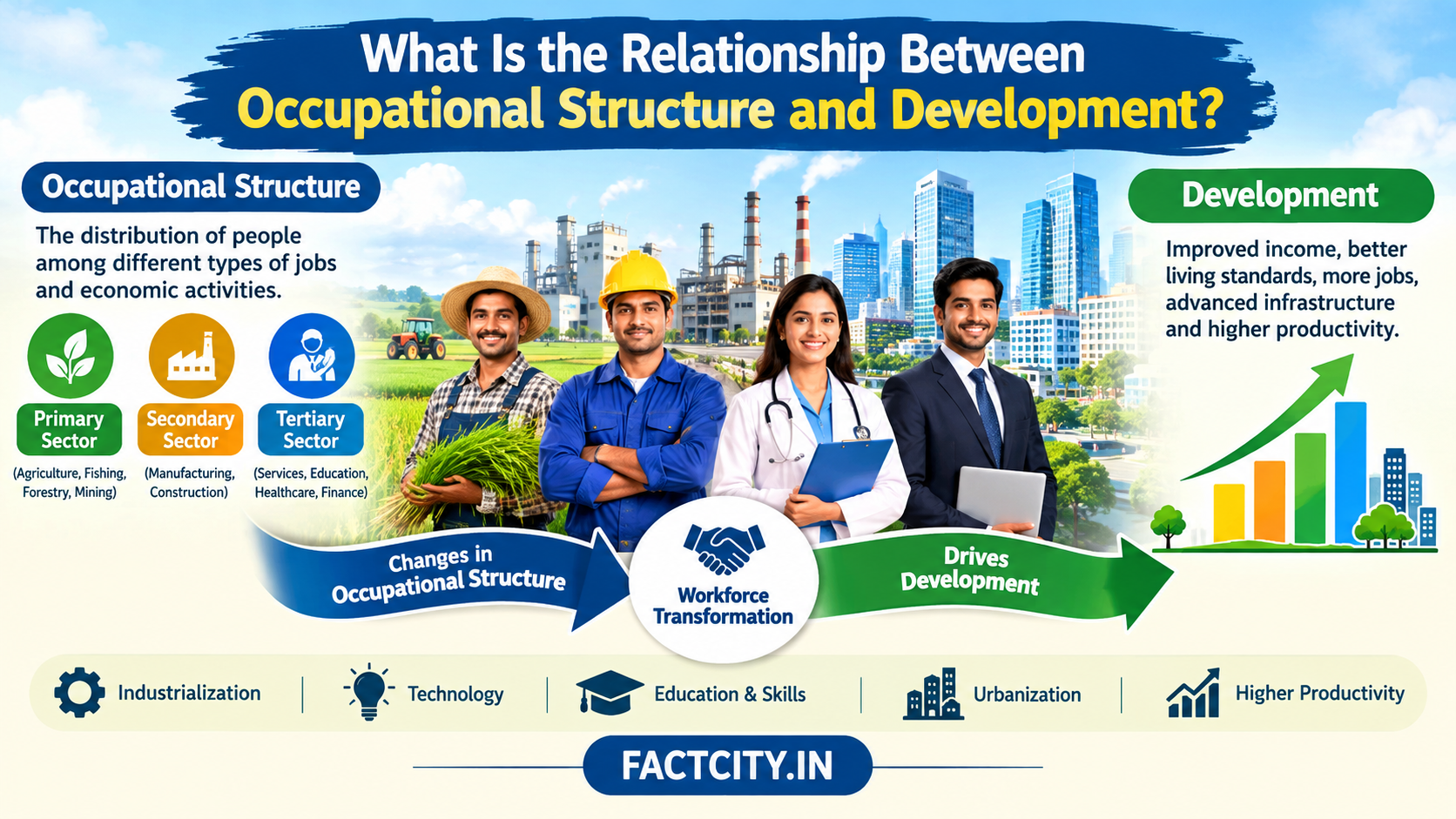
What Is the Relationship Between Occupational Structure and Development? A key issue in economics, geography, sociology, and development studies is the relationship between occupational structure and development. The occupational structure is the composition of a population into different jobs and economic activities in a country or region. These activities are generally categorised as the primary, secondary and tertiary sectors.
The occupational structure of a country is typically an indicator of its level of economic development. As an economy grows, the population usually transitions from traditional agricultural roles to manufacturing, services, technology, finance, education, health care, and other modern jobs. But development also changes the nature of jobs in each sector.
What is the Occupational Structure?
Occupational structure is the distribution of the working population among different occupations or sectors of the economy. “What Is the Relationship Between Occupational Structure and Development?“
Broadly, it is divided into three major sectors:
The Primary Sector
The primary sector means activities using raw materials directly. For example:
Agriculture Fishing Forestry Mining Animal husbandry
Much of the labour force in less developed economies may be employed in primary sector activities, particularly in agriculture.
The Secondary Sector
Manufacturing and construction are part of the secondary sector. Examples are:
- Factories
- Food processing
- Textile manufacturing
- Automobile manufacturing, building, machinery production
As countries industrialise, there is a tendency for the secondary sector to increase its employment.
Tertiary Sector:
The third sector is the provision of services, not physical goods. Here are some examples:Banking, education, health care, information technology, tourism, transport, retail, communication, insurance. In highly developed economies, the service sector usually has a large share of employment.
What Is Economic Development?
Economic development is the overall process of improvement in the economic and social conditions of a country. It is not only about increasing national income.
Development can involve:
- Greater per capita income
- More job opportunities
- Better education
- Better health care
- Better performance
- Better infrastructure.
- Progress in Tech
- Lower Poverty
- Better standards of living
- Greater access to basic services
Thus, occupational structure and development are closely related, as changes in employment are often associated with changes in productivity, technology, income, and standards of living.
Occupational Structure and Development: What Is the Connection?
The occupational structure and development relationship can be viewed as a structural transformation of the economy. In many developing economies, a large proportion of workers begin their working lives in agriculture and other primary activities. As productivity increases and industries expand, workers are slowly moving into manufacturing and services.
A simple pattern is:
Agriculture → Manufacturing → Services and knowledge occupations
It doesn’t mean agriculture disappears. Instead, its share of total employment may decline as productivity and technology rise.
Service Employment Higher in Developed Economies
One of the more obvious relationships between occupational structure and development is the increasing importance of the service sector.
In developed economies, many people work in areas like:
- Information and software technologies
- Financials
- Healthcare, education, business management
- Research Professional Services
- Tourism Entertainment
This is because the higher the income, the higher the demand for services. Also, technological development increases productivity in agriculture and manufacturing. But that also means that less labour is needed to produce the same quantity of agricultural or manufactured products.
Agriculture Is More Important in Less-Developed Economies
In less developed countries, a large proportion of the workforce can be employed in agriculture.
This is especially common when:
- Farming is a lot of work
- Limited mechanisation.
- Small industrial development relatively
- Large rural populations
- Few alternative employment opportunities
High levels of agricultural employment are not an indication of the economic unimportance of agriculture. Agriculture may play a critical role in food security, export, rural livelihoods and raw materials for industry. However, a very high dependence on low-productivity agriculture could be indicative of an economy that has not yet experienced large-scale structural transformation.
Changes in Occupational Structure with Industrialisation
Another important factor connecting occupational structure and development is industrialisation. As factories and manufacturing industries grow in size, they provide jobs outside of agriculture. In industry, workers can move from the farms and villages to the towns and cities.
Manufacturing jobs can provide opportunities in:
- Production
- Use of machine
- Quality Control, Packaging, Logistics, Engineering, Maintenance Management
Industrialisation also creates indirect employment in transport, banking, retail, construction and other services.
The Impact of Technology on Employment
Technological development may have an important impact on occupational structure. Modern machinery, automation, computers, artificial intelligence, and digital systems can boost productivity while reducing the need for some routine jobs.
At the same time, technology creates new jobs, such as:
- Software Development
- Data analysis
- Cybersecurity practitioners
- Digital Marketing Experts
- Support technicians, IT
- Robotics technologists,
- Online services practitioners
So technological progress doesn’t only reduce employment. It frequently changes the kinds of skills and jobs that are needed.
Structural Transformation Induced by Higher Productivity
Productivity is a major channel of influence of occupational structure on development. Think of a farming community that takes up better irrigation, better machinery, better seeds, and modern agricultural techniques. Then fewer workers may produce the same quantity of food. The displaced agricultural workers can be absorbed either in manufacturing or in services.
The process can raise the overall level of economic productivity and income when new sectors create productive jobs.
Urbanisation and Employment
Economic development is often associated with urbanisation. With the growth of industries, businesses, educational institutions, hospitals and service companies in cities, employment opportunities get diversified.
People may migrate from rural areas to urban areas in search of:
- Higher-paying jobs
- Education
- Opportunities for business
- Professional career
- Improved Infrastructure More
- Better public services
Hence, urbanisation is a factor of change in occupational structure, and change in occupational opportunities also promotes urbanisation.
Education Changes the Occupational Structure
Education and skills are important for economic development. As literacy, higher education, vocational training and technical education improve, workers are qualified for more specialised occupations. For instance, a developing economy may over time see growing demand for:Teachers Nurses Engineers Accountants Technicians Managers IT pros, researchers. This implies that gains in human capital can partially explain the shift to higher-productivity occupations.
Development Can Also Be Influenced by Occupational Structure
They’re a two-way street. Development changes the occupational structure, but the occupational structure can also affect development.
A skilled and productive workforce can create:
- Boost production
- Getting investments
- Innovation is our engine
- Enhance business competitiveness
- Raise household incomes
- Boost tax revenues
- Raising living standards
A good diversification of activities can thus favour sustained economic development.
- Occupational Structure and Development: A Simple Comparison
- Development level: Normal Working Pattern
- Less developed: High reliance on agriculture and other primary activities
- Manufacturing and services are expanding, but agriculture remains significant.
- Developing industrial economy: Manufacturing, construction, trade, and services are expanding rapidly
- Well-developed: prevalence of services and knowledge-intensive occupations
This is a general “rule of thumb” and not a rule. Countries can take different development paths depending on their resources, institutions, technology, geography and economic policies.
Structural Change Example
Suppose a rural economy in which most people work in agriculture. Initially, 70% of the labour force may be engaged in agriculture, with only a small proportion in manufacturing and services. Over time, better agricultural technology increases productivity on farms. Then manufacturing industries grow, and new jobs are created. Later, education, tech, healthcare, finance, tourism, and digital businesses grow.
The structure of employment is gradually becoming more diversified.
The important point is that economic development is not only about creating more jobs; it is also about creating more productive and higher-value jobs. Employment quality and occupational structure development should not be measured solely by the share of workers engaged in agriculture, manufacturing, or services. The quality of jobs matters as well.
Even a country with a large service sector can have problems such as:
- Low-paid
- Casual work
- Social protection is limited
- Insecure work
- Under employment
- Skills development gap
Similarly, modern technology, good infrastructure, efficient markets and skilled workers can make agricultural employment very productive. Thus, the occupational structure should be studied simultaneously with productivity, wages, working conditions, skills, and job security. interesting-facts-about-disney-world
Why does this relationship matter?
Better decisions can be made by governments and policymakers if they understand the relation of the occupational structure to development.
For example, a country with a large young workforce might have to invest in:
- Upskilling
- Vocational education, manufacturing, digital infrastructure
- Business Ownership
- Contemporary agriculture
- Small and medium businesses
The goal should be to generate productive jobs and to provide workers the opportunity to shift to better opportunities as the economy evolves.
Conclusion
The link between occupational structure and development is a strong and dynamic one. As economies develop, employment diversification typically increases. The workforce may move gradually away from agriculture and other primary activities into manufacturing and then into a broader range of service and knowledge-based jobs.
Meanwhile, education, technology, urbanisation, industrialisation and rising productivity determine the pace and the direction of this transformation.