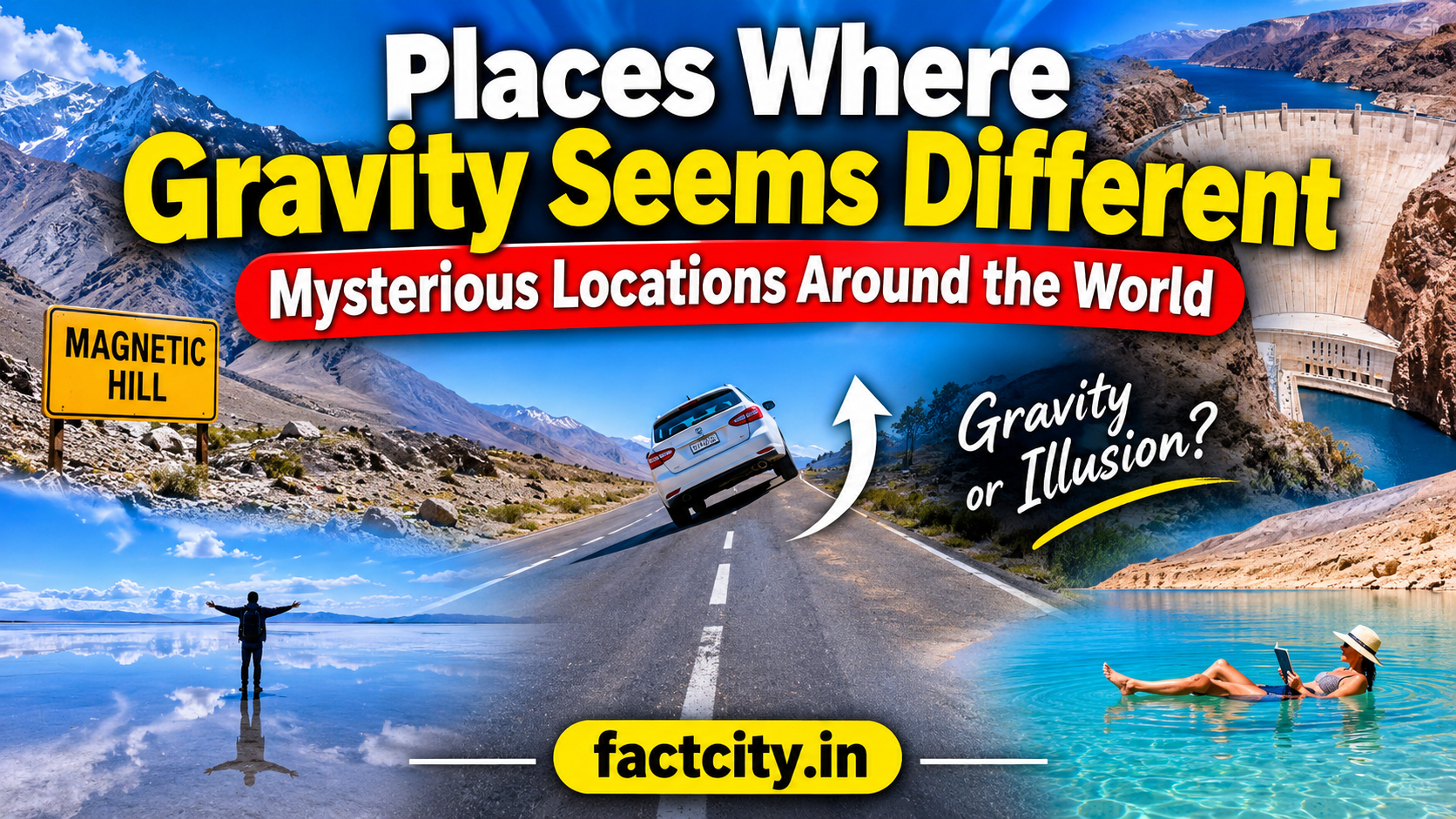
Places Where Gravity Seems Different Gravity is one of the most important forces in our daily lives. It keeps our feet on the ground, makes objects fall when we drop them, and holds planets in their orbits around the Sun. We experience gravity everywhere, so most people believe it works in exactly the same way across the entire planet. However, there are several fascinating places around the world where gravity appears to behave differently. In these locations, cars seem to roll uphill, water appears to flow in unexpected directions, and people sometimes feel as if they are standing on a strange slope. These unusual experiences have attracted tourists, scientists, and curious travellers for many years.
The interesting truth is that gravity is not actually reversing itself in these places. Instead, unusual landscapes, optical illusions, geological structures, and the shape of the Earth create experiences that make gravity seem different. Some locations also have small measurable variations in gravitational strength because of differences in Earth’s underground structure and elevation. Let’s explore some of the most fascinating places where gravity seems different and discover the science behind these mysterious locations.
1. Magnetic Hill, Ladakh, India
One of the most famous places where gravity seems different is Magnetic Hill in Ladakh, India. Located on the Leh-Kargil-Srinagar highway, this unusual location has become a popular tourist attraction because of an optical illusion that makes vehicles appear to move uphill without an engine running. Visitors are often surprised when they see a vehicle placed in neutral gear apparently rolling upward along the road.
The surrounding mountains and the shape of the landscape create a visual illusion that makes the road appear to slope upward when it actually slopes downward. The horizon is difficult to judge because the surrounding terrain hides the true reference points needed to understand the road’s elevation. As a result, the human brain interprets the slope incorrectly. This phenomenon is commonly known as a gravity hill or magnetic hill.
Despite its name, there is no reliable scientific evidence that a powerful magnetic force pulls vehicles upward at this location. The experience is mainly caused by the unusual landscape and visual perception. Magnetic Hill remains one of India’s most interesting destinations for travellers who enjoy natural mysteries and unusual geographical attractions.
2. Mystery Spot, Santa Cruz, California, USA
The Mystery Spot in Santa Cruz, California, is another famous destination where visitors experience unusual effects that appear to challenge gravity. Discovered in 1939, this attraction is known for its tilted buildings, strange perspectives, and unusual demonstrations involving balls, people, and other objects.
Inside the attraction, visitors may notice that people appear to lean at unusual angles without falling. Balls seem to roll in unexpected directions, while objects placed on certain surfaces appear to behave strangely. These experiences can make visitors question their understanding of balance and gravity.
However, scientists explain these effects through visual perception and perspective. The tilted structures and surrounding reference points confuse the brain’s ability to identify what is vertical and horizontal. When the visual information does not match the body’s balance system, people can feel as though gravity is acting differently.
The Mystery Spot is a fascinating example of how the human brain interprets the physical world and how carefully designed environments can create convincing illusions.
3. Spook Hill, Florida, USA
Spook Hill in Lake Wales, Florida, is a well-known gravity hill that has attracted curious visitors for generations. According to local stories, a vehicle placed in neutral gear on a particular section of the road appears to roll uphill by itself. The experience has helped make Spook Hill one of the unusual roadside attractions in the United States.
Local legends have added mystery to the location. Some stories connect the hill with supernatural events and unusual historical encounters. However, the scientific explanation is much simpler. The surrounding landscape creates an optical illusion that makes a downward slope appear to be an uphill road.
The absence of a clear horizon and the position of nearby trees and land features influence how the brain judges elevation. Visitors who experience the illusion often find it difficult to believe that the road is actually descending.
Spook Hill demonstrates how ordinary geographical features can create extraordinary visual experiences.
4. Magnetic Hill of Moncton, Canada
The Magnetic Hill in Moncton, New Brunswick, Canada, is another popular destination associated with unusual gravitational experiences. For many years, visitors have travelled to this location to witness vehicles apparently moving uphill without using their engines.
The attraction became especially popular during the twentieth century and remains an interesting stop for travellers exploring the region. Drivers follow instructions to stop their vehicles at a designated point, shift into neutral, and observe what happens. The vehicle then appears to move uphill, creating an experience that seems impossible at first.
The explanation involves the surrounding terrain and the way people perceive slopes. The actual downward gradient is difficult to recognise because the landscape creates misleading visual reference points. This makes the road appear to rise even though it is descending.
The location is not evidence of reversed gravity or an unusual magnetic field. Instead, it provides an excellent example of how the brain can misinterpret the shape of the environment.
5. Jeju Island, South Korea
Jeju Island in South Korea is famous for its volcanic landscapes, beautiful coastlines, waterfalls, and unusual natural attractions. One of its most interesting features is the Mysterious Road, also known as Dokkaebi Road.
At this location, parked vehicles appear to move uphill when placed in neutral gear. Water poured onto the road may also seem to flow upward, creating an experience that attracts visitors who are interested in unusual natural phenomena.
The mystery is caused by an optical illusion. The surrounding landscape makes a downhill road appear to rise. Without a clear visual reference, the brain struggles to determine the true direction of the slope.
Jeju’s Mysterious Road has become a popular tourist attraction because it offers a simple but surprising demonstration of how human perception works. It is a reminder that what we see is not always an accurate representation of the physical world.
6. Hoover Dam, Nevada-Arizona Border, USA
Hoover Dam is one of the most impressive engineering structures in the United States. Built across the Colorado River on the Nevada-Arizona border, this massive concrete dam is famous for its enormous size and engineering achievements. It is also sometimes mentioned in discussions about unusual gravitational effects.
A popular demonstration involves pouring water from a bottle near certain areas of the dam. Because of the surrounding airflow and the way the structure is shaped, the water may appear to move strangely or be pushed back toward the person pouring it.
This effect is not caused by gravity reversing. Instead, strong air currents rising along the dam’s curved surface can influence the direction of falling water droplets. The upward-moving air can push light droplets away from their expected path.
Hoover Dam is therefore an interesting example of how airflow, engineering structures, and gravity interact to create surprising visual effects.
7. The Oregon Vortex, Oregon, USA
The Oregon Vortex, located near Gold Hill in Oregon, is another unusual attraction associated with strange gravitational experiences. The site is famous for its tilted buildings, unusual optical effects, and demonstrations that appear to challenge normal physical expectations.
Visitors often report that their height seems to change depending on where they stand, while balls and other objects appear to move in unexpected directions. The surrounding structures create confusing visual perspectives that make it difficult to judge angles accurately.
The attraction is sometimes described as a place where mysterious forces affect gravity. However, there is no accepted scientific evidence that gravity behaves abnormally there. Most of the effects can be explained by perspective, tilted surfaces, and the way the human brain processes visual information.
The Oregon Vortex remains a popular destination for people who enjoy exploring unusual attractions and understanding how optical illusions influence human perception.
8. Karpacz Gravity Hill, Poland
Karpacz, a beautiful mountain town in southwestern Poland, is known for its natural scenery, historic buildings, and unusual roadside attractions. One of its interesting features is a section of road where vehicles appear to roll uphill.
Visitors often stop to observe this strange phenomenon. When a vehicle is placed in neutral gear, it appears to move in the opposite direction from what people expect. This creates the impression that gravity is behaving differently.
The explanation is similar to other gravity hills around the world. The surrounding landscape makes the road’s actual slope difficult to recognise. The position of trees, nearby hills, and the visible horizon can all influence the way people judge the direction of the road.
Karpacz is an interesting example of how the same optical illusion can occur in different geographical environments.
9. Mount Aragats, Armenia
Mount Aragats is the highest mountain in Armenia and is famous for its impressive volcanic landscape. The region has also attracted attention because of reports of unusual roadside experiences where vehicles appear to move uphill without engine power.
Like other gravity hills, these experiences are generally connected to the visual appearance of the surrounding terrain. The mountain landscape creates confusing reference points, making it difficult for visitors to identify the true direction of the slope.
Mount Aragats is also an interesting destination from a geological perspective. Its volcanic history and varied landscape provide an opportunity to understand how natural processes shape the Earth’s surface.
Although the reported effects may look mysterious, they do not demonstrate that gravity has changed or disappeared.
10. The Dead Sea Region, Israel and Jordan
The Dead Sea is one of the most unusual natural locations on Earth. Situated between Israel, the West Bank, and Jordan, it is famous for its extremely salty water and its position at the lowest exposed land elevation on the planet.
Visitors often notice that floating in the Dead Sea feels very different from swimming in ordinary freshwater lakes or oceans. The high salt concentration makes the water much denser, creating greater buoyancy. As a result, people can float more easily without making much effort.
Although this experience is sometimes confused with unusual gravity, the actual explanation is related to water density and buoyancy. Gravity is still pulling the body downward, but the upward buoyant force from the dense water helps keep a person floating.
The Dead Sea is an excellent example of how different natural conditions can change the way we experience familiar physical forces.
11. Salar de Uyuni, Bolivia
Salar de Uyuni in Bolivia is the world’s largest salt flat and one of the most extraordinary landscapes on Earth. During the rainy season, a thin layer of water covers the salt surface and creates an enormous natural mirror.
The reflection of the sky, clouds, and surrounding mountains can make it extremely difficult to distinguish between the ground and the sky. Visitors sometimes feel as though they are walking through an endless space without a clear sense of direction.
Although gravity works normally here, the unusual reflections can create a powerful visual experience. Without familiar visual reference points, the human brain may struggle to judge distance, height, and orientation.
Salar de Uyuni demonstrates how environmental conditions can influence our perception of the physical world, making an ordinary walk feel like an experience on another planet.
12. The Equator, Ecuador
The Equator is an imaginary line that divides Earth into the Northern and Southern Hemispheres. One famous tourist attraction associated with it is Mitad del Mundo, located near Quito in Ecuador.
Some visitors believe that gravity behaves dramatically differently when they stand on the Equator. This idea is often connected to demonstrations involving balancing eggs or water flowing in different directions. However, these popular claims are frequently exaggerated or based on misleading demonstrations.
There is a real scientific difference in effective gravity between the Equator and the poles. Earth’s rotation produces a centrifugal effect that slightly reduces effective gravity near the Equator. In addition, the planet is wider around the Equator than at the poles, meaning the distance from Earth’s centre is greater.
However, these differences are very small and cannot normally be noticed by simply standing at the Equator. The location is scientifically interesting because it helps explain Earth’s rotation, shape, and gravitational field.
Why Does Gravity Seem Different in These Places?
Gravity hills and unusual geographical attractions can create the impression that gravity is behaving differently, but several scientific factors explain these experiences.
1. Optical Illusions: The most common explanation is visual perception. When the surrounding landscape hides the true horizon or creates misleading reference points, a downhill road may look like an uphill road. This makes vehicles appear to move against gravity.
2. Earth’s Shape: Earth is not a perfect sphere. It is slightly wider around the Equator than at the poles. This difference affects the distance from Earth’s centre and contributes to small variations in gravitational strength.
3. Earth’s Rotation: The rotation of our planet creates a centrifugal effect that slightly reduces effective gravity near the Equator. This is one reason why effective gravity is marginally weaker there than near the poles.
4. Underground Geological Structures: The Earth’s crust contains rocks and minerals with different densities. Large underground formations can create small local variations in gravitational attraction. These differences can be measured using specialised scientific instruments, although people cannot normally feel them. 10-places-where-the-sun-never-sets-in-summer
5. Air Pressure and Wind: Some unusual demonstrations involve moving water or lightweight objects. In certain locations, wind and rising air currents can change the movement of falling water droplets, creating effects that may look unusual.
Can Gravity Really Reverse in These Locations?
No, gravity does not reverse itself at the famous gravity hills mentioned in this article. The force of gravity continues to pull objects toward Earth’s centre. When vehicles appear to roll uphill, the road is usually sloping downward even though it looks like an uphill slope.
There are genuine variations in Earth’s gravitational field, but they are relatively small. Scientists use sensitive instruments called gravimeters to measure these changes. Such measurements help researchers study the planet’s internal structure, underground geological formations, and changes in Earth’s mass distribution.
The difference between a visual illusion and a real gravitational variation is important. Many tourist attractions use the mystery of gravity to attract visitors, but their unusual effects can usually be understood through physics and human perception.
Conclusion
The places where gravity seems different are among the most fascinating attractions in the world. From Magnetic Hill in Ladakh to the Mystery Spot in California and the Mysterious Road in South Korea, these destinations demonstrate how easily our understanding of the physical world can be challenged by unusual landscapes and optical illusions.
Some locations also offer genuine scientific lessons about Earth’s shape, rotation, geology, and gravitational field. The Dead Sea shows how water density affects floating, while the Equator provides an opportunity to understand the small differences in effective gravity across the planet.
Although gravity never stops working in these places, the experiences can still feel extraordinary. They remind us that nature is full of surprising phenomena and that science often provides the most interesting explanations for things that initially seem impossible.
Frequently Asked Questions (FAQs)
1. Which place in India is famous for its gravity illusion?
Magnetic Hill in Ladakh is one of India’s most famous gravity hill attractions. Vehicles appear to roll uphill because of an optical illusion created by the surrounding landscape.
2. Is there any place on Earth where gravity stops working?
No. Gravity does not stop working at any location on Earth. However, its effective strength varies slightly depending on elevation, latitude, Earth’s rotation, and underground geological structures.
3. Why do cars roll uphill on Magnetic Hill?
Cars appear to roll uphill because the road actually slopes downward. The surrounding landscape creates an optical illusion that makes the slope look opposite to its real direction.
4. Is gravity weaker at the Equator?
Yes. Effective gravity is slightly weaker at the Equator than at the poles because of Earth’s rotation and its slightly flattened shape.
5. Can scientists measure changes in gravity?
Yes. Scientists use sensitive instruments called gravimeters to measure small variations in Earth’s gravitational field. These measurements help researchers understand geological structures and changes inside the planet.