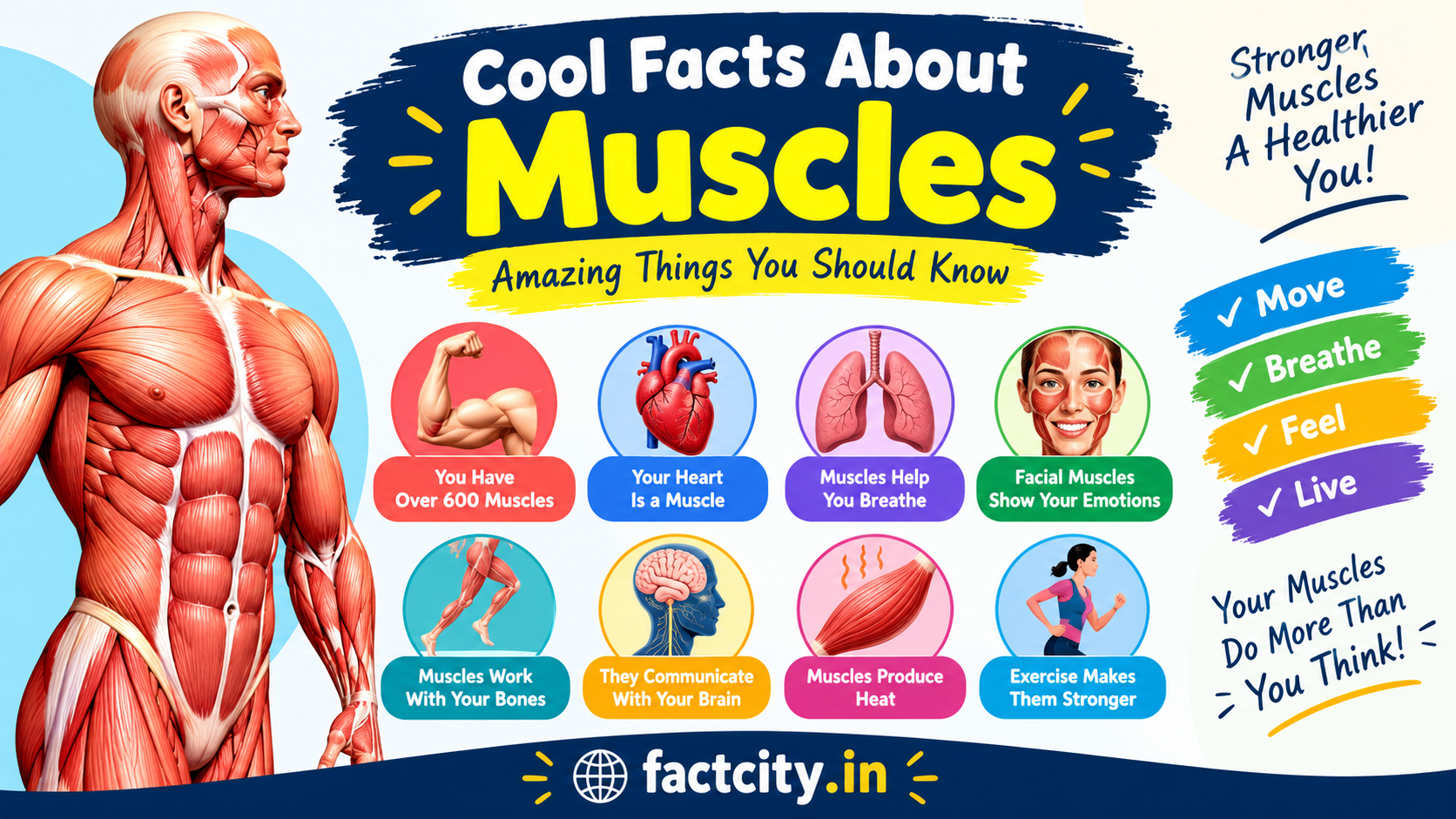
Cool Facts About Muscles: Muscles are one of the most interesting parts of the human body. They help us walk, run, smile, breathe, pick up objects, and even keep our heart beating while we sleep. Most people only think of muscles in terms of exercise and strength, but there is much more going on inside the body.
Muscles are working in your body every second of the day, from the small muscles that control your eyes to the powerful muscles in your legs. In this article, we are going to discover some cool facts about muscles that may surprise you and help you understand how amazing the human body really is.
You Have Hundreds of Muscles in Your Body
There are over 600 muscles in the human body. These muscles differ greatly in size, shape, and function. Some muscles are big and strong. The muscles in your thighs and your back are big and strong. Others are minuscule and make very exact movements. Muscles account for a large portion of your body weight and work with bones, joints, nerves and other tissue to create movement. Interestingly, not all muscles do the same job. Some control voluntary movements; others work automatically without you having to think about them.
Your Heart Is a Muscle
Your heart is made primarily of specialised muscle tissue (another one of the most important cool facts about muscles). Cardiac muscle is the muscle of the heart. Cardiac muscle contracts continuously to pump blood throughout your body. Your skeletal muscles have to be told to beat. Your heart doesn’t. Your heart is working day and night, whether you are working out, sleeping, eating, or relaxing. It is one of the hardest-working muscles in the human body due to its constant activity.
Muscles Help You Breathe
Breathing is automatic, but muscles are a huge part of the game. The diaphragm is a large, dome-shaped muscle that sits below the lungs. When it contracts, it moves downward and makes space for the lungs to expand. This allows air into your lungs. As the diaphragm relaxes, it rises and helps push the air out. Other muscles between the ribs are also involved in breathing. So every normal breath you take has coordinated muscle activity. random-facts-amazing-things-you-probably-didnt-know
The Strongest Muscle Is The One You Define As Strong
You might have heard that the tongue is the strongest muscle in the human body. But it is a common misconception. But there’s no single muscle that can be accurately called the “strongest” in every situation, because strength can be measured by different standards. Some muscles exert colossal force; some are strong for their size.
For example, the masseter, one of the major muscles used in chewing, can generate large forces. In contrast, large muscles like the gluteus maximus are important for powerful movements such as climbing, running, and getting up.
Muscles Can Be Made Stronger By Exercise
Your muscles adapt to the increased workload when you do resistance exercise regularly. Weight training, bodyweight, and resistance workout routines are all things that can promote muscle growth and strength gains. Over time, the body gets better at generating force and taking on physical demands. Building muscle, however, is not just a matter of exercise. Adequate protein, calories, sleep, hydration, and recovery are also important. After hard workouts, your muscles need time to recover and adapt.
Muscles Can Shrink as Well
Muscles don’t always grow. A muscle not put to use atrophies in size and strength slowly. This process is called muscle atrophy. For example, a person who spends a lot of time in bed or who is unable to use a limb because of an injury may lose muscle in that area. That’s why rehab and slow movement are often important after injury or a period of inactivity. The body is a reaction to the needs it is asked to meet.
Your Muscles Make Heat
Do you notice that you feel warmer when you exercise? One reason is your muscles. Muscles use energy when they contract. Not all of this energy becomes motion; some of it is lost as heat.
The heat helps keep your body at its normal temperature. If you are cold, your body may cause your muscles to contract quickly. This is called shivering. Shivering is a way the body creates more heat.
Emotions Are Expressed with Your Facial Muscles
Smiling, frowning, raising your eyebrows, and countless other facial expressions are the result of coordinated muscle movements. Your facial muscles are capable of communicating emotions without you uttering a word. A simple smile can communicate happiness, friendliness, or approval, and a raised eyebrow can signal surprise or doubt. Humans have amazing control over their facial muscles, enabling them to express complex emotions with subtle expressions.
Bones and Muscles Work Together
Muscles can’t move your skeleton by themselves. They work with bones and joints as part of the musculoskeletal system. Many skeletal muscles are connected to bones by strong connective tissues called tendons. When the muscle contracts, it pulls on the tendon, which pulls on the bone. This system allows you to do everyday movements such as walking, reaching, jumping, and lifting. It is like a well-designed machine, the muscles providing the power and the bones acting as levers.
Muscles move your eyes
Your eyes may look small, but it takes a lot of special muscles to move them. The muscles around each eye work together to control the position of the eye and to help you look up and down, left and right. These movements have to be very precise because a small change in the position of your eyes can change what you see. As you read or look at things, your eyes can make small movements. This helps your brain to process visual information.
Muscles Require Energy
Muscles need energy to contract. Most of this energy comes from a molecule called ATP, or adenosine triphosphate. Your body is always making ATP from nutrients like carbohydrates and fats. During strenuous exercise, your muscles need fast energy, so your body uses different energy systems to continue to supply ATP. Exercise can make you feel tired, and that’s why. Your muscles and other systems in your body are working hard to meet the increased energy demand.
Some Muscles Work Without Your Conscious Control
Not all muscles are subject to voluntary control. Skeletal muscles typically enable you to control voluntary movements. But smooth muscle and cardiac muscle are pretty much automatic. Smooth muscle is located in places like the digestive tract and blood vessels. It helps to move food through the digestive system and controls changes in the diameter of some blood vessels. Your heart muscle also contracts on its own. So your heart keeps pumping, without you having to think about it.
Muscle cramps can be uncomfortable.
A muscle cramp is a sudden, painful tightening of a muscle. You may experience cramps during exercise, while at rest, or under special circumstances. They are especially common in places like the calves and the feet. They can be caused by anything from muscle fatigue to prolonged activity, dehydration, or other factors. If you have cramps often, or if they are severe, it is a good idea to talk to a healthcare professional about them.
Your Muscles Are Always Talking to Your Nervous System
Your muscles and your nervous system work together. When you choose to move your hand, your brain sends signals down nerves to certain muscles. Then those muscles contract in a coordinated manner. This communication is at the speed of light. “It lets you do simple things like pick up a cup, and complex things like play an instrument or play sports.”
Rest Is Important for Your Muscles
Exercise stresses the muscles, but recovery helps the body to adapt. During rest, your body performs many processes involved in tissue repair and adaptation to training. Proper sleep is particularly crucial because the body performs many of its recovery functions during sleep. A well-rounded approach that includes exercise, nutritious foods, hydration, and enough rest supports healthy muscles.
Why Are Muscles So Important?
Muscles are important for a lot more than building strength or looking fit. They maintain posture and aid movement, protect parts of the body, assist in breathing, circulate blood, digest food, and regulate body temperature. Without muscles, the simplest activities would not be possible. Whether you are walking to the kitchen, typing on a computer, smiling at a friend, or just breathing, your muscles are involved in making it happen.
Conclusion
These cool facts about muscles show how impressive (and complicated) the human body really is. Muscles are always working, often without us even realising it. They let us walk, to talk, to breathe, to exercise, and do our daily stuff.
You don’t have to be a professional athlete to take care of your muscles. Regular physical activity, a well-rounded diet, good hydration, adequate sleep, and proper recovery can all support overall muscle health.