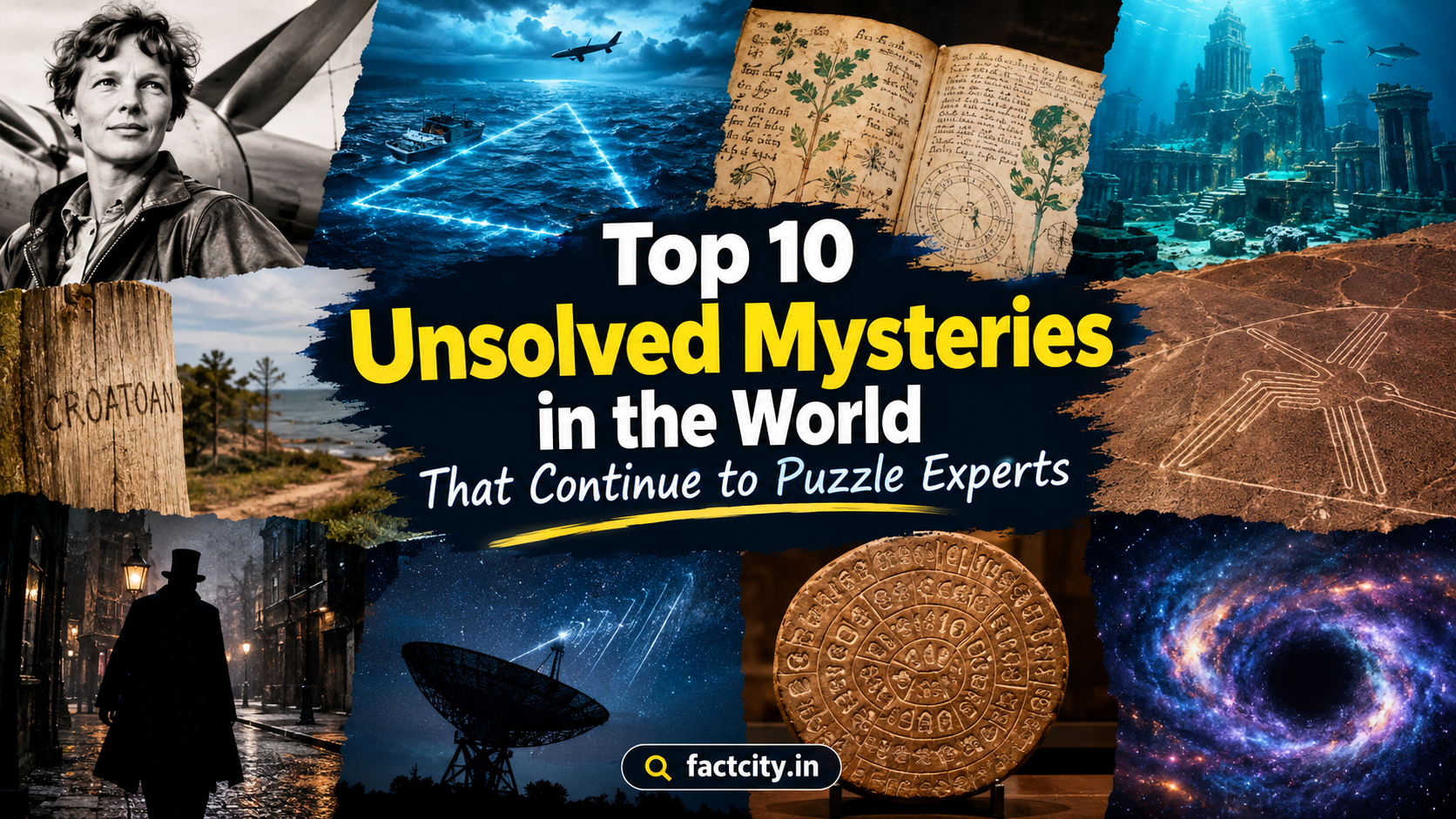
Top 10 Unsolved Mysteries in the World. The world is full of fascinating mysteries that have confused people for centuries. From ancient civilizations that disappeared without leaving clear explanations to strange signals detected from space, many questions remain unanswered despite years of research. Scientists, historians, archaeologists, and investigators continue to study these mysterious events in the hope of discovering the truth. Some mysteries are connected to human history, while others involve unexplained discoveries, unusual disappearances, and questions about the universe. The top 10 unsolved mysteries in the world are especially fascinating because they remind us that there is still so much we do not understand about our planet and the world around us.
1. The Disappearance of Amelia Earhart
Amelia Earhart was one of the most famous female pilots in aviation history. In 1937, she attempted to become one of the first women to fly around the world along an equatorial route. During this journey, she was accompanied by navigator Fred Noonan. However, on July 2, 1937, their aircraft disappeared over the Pacific Ocean while they were attempting to reach Howland Island. Despite extensive search operations, neither the aircraft nor the two crew members was conclusively found. Top 10 Unsolved Mysteries in the World
Several theories suggest that the plane may have run out of fuel and crashed into the ocean, while others propose that Earhart and Noonan might have landed on a remote island. Although researchers have investigated the disappearance for decades, no explanation has been conclusively established. This is why Amelia Earhart’s disappearance remains one of the most famous unsolved mysteries in aviation history.
2. The Mystery of the Bermuda Triangle
The Bermuda Triangle is a region of the Atlantic Ocean generally associated with the area between Florida, Bermuda, and Puerto Rico. It became famous because of reports of ships and aircraft disappearing under unusual circumstances. One of the best-known incidents occurred in December 1945, when five U.S. Navy aircraft known as Flight 19 disappeared during a training mission. A rescue aircraft sent to search for the missing planes also disappeared.
Over the years, people have suggested explanations involving unusual magnetic forces, strange weather conditions, and even supernatural activity. However, scientific investigations have not established that the Bermuda Triangle contains any extraordinary forces. Severe weather, navigation errors, mechanical problems, and human mistakes can explain many maritime and aviation accidents. Although some historical cases remain incompletely understood, the Bermuda Triangle continues to attract worldwide attention because of the unanswered questions surrounding particular incidents.
3. The Voynich Manuscript
The Voynich Manuscript is one of the most mysterious books ever discovered. It is an illustrated manuscript believed to have been created during the early 15th century. The book contains unfamiliar writing, drawings of unusual plants, astronomical diagrams, and illustrations of human figures. It was named after Wilfrid Voynich, a book dealer who acquired it in 1912. Since then, cryptographers, historians, linguists, and researchers have attempted to understand its strange writing system.
Some believe the manuscript contains a genuine language or an encrypted message, while others suggest that it may use an invented writing system. There are also theories that the text was deliberately created to appear meaningful, although no explanation has been universally accepted. Despite advances in computer analysis and language research, the manuscript has not been reliably deciphered. Its unknown purpose and mysterious symbols make it one of the most intriguing unsolved puzzles in the history of written communication.
4. The Lost City of Atlantis
Atlantis is one of the most famous legendary places in the world. The ancient Greek philosopher Plato described Atlantis in his dialogues Timaeus and Critias, presenting it as a powerful civilization that supposedly disappeared beneath the sea. According to his account, Atlantis was a prosperous society that eventually suffered a catastrophic downfall. Over the centuries, researchers and explorers have proposed numerous possible locations for the legendary city, including areas near the Mediterranean Sea and the Atlantic Ocean.
Some theories connect the story to real historical disasters, such as volcanic eruptions, earthquakes, and coastal destruction. Other researchers believe Plato used Atlantis as a philosophical example to explain the dangers of excessive ambition and political power. However, no widely accepted archaeological evidence has confirmed the existence of Atlantis as the advanced island civilization described in his writings. Whether the story was inspired by real events or created primarily as a philosophical narrative remains a subject of historical debate.
5. The Nazca Lines of Peru
The Nazca Lines are enormous designs created in the desert of southern Peru and are among the most remarkable archaeological discoveries in the world. These ancient geoglyphs include figures representing animals, plants, geometric patterns, and other shapes that extend across large areas of land. They were created by removing the dark surface stones to reveal the lighter soil beneath them, and many of the designs are easiest to recognize from elevated viewpoints. Researchers generally associate the lines with the ancient Nazca culture and date many of them to approximately 200 BCE through 650 CE.
Although scientists understand how the designs were physically created, their complete purpose remains debated. Some researchers believe they were connected to religious ceremonies, water-related rituals, or sacred landscapes, while other interpretations suggest that certain designs may have had astronomical significance. It is possible that different figures served different purposes rather than having one single explanation. The Nazca Lines continue to fascinate researchers because they demonstrate the impressive planning, artistic skills, and cultural traditions of ancient societies.
6. The Disappearance of the Roanoke Colony
The Roanoke Colony was an English settlement established on Roanoke Island in present-day North Carolina during the late 16th century. Its fate became one of the most famous mysteries in early American history when the settlement was found abandoned. In 1587, a group of colonists led by John White established the settlement, but White later returned to England to obtain additional supplies. Due to delays, he did not return until 1590. When he finally arrived, he found that the settlement had been abandoned, and the word “CROATOAN” had been carved into a wooden post. No definitive evidence established what had happened to all the colonists.
Historians have proposed several explanations, including the possibility that the settlers relocated to another area, joined nearby Indigenous communities, or suffered from hunger, disease, or conflict. Archaeological investigations have provided clues about life in the region, but the exact fate of the entire group remains uncertain. The Roanoke Colony mystery continues to interest historians because it raises important questions about survival, migration, and the challenges faced by early European settlements.
7. The Identity of Jack the Ripper
Jack the Ripper was the name given to an unidentified killer associated with a series of murders in London’s Whitechapel district in 1888. The crimes attracted widespread attention because of their disturbing nature and the inability of authorities to identify the person responsible. Several victims were women, and some of the murders shared similarities that led investigators to believe they might have been committed by the same individual.
Police examined witness statements, physical evidence, and letters allegedly sent by the killer, but the investigation did not produce a confirmed identification. Over the years, numerous people have been suggested as possible suspects, and historians have continued to examine surviving documents for clues. However, no proposed suspect has been conclusively proven to be Jack the Ripper. Limited forensic technology, incomplete records, and uncertainty surrounding some historical evidence have made the case especially difficult to solve. More than a century later, the identity of Jack the Ripper remains one of the most widely discussed unsolved mysteries in criminal history.
8. The Wow! Signal
The Wow! Signal was an unusual radio signal detected on August 15, 1977, by the Big Ear radio telescope in Ohio, United States. Astronomer Jerry Ehman later noticed the signal in the recorded data and wrote “Wow!” beside it, giving the event its famous name. The signal attracted scientific interest because its characteristics appeared consistent with some of the types of narrowband radio transmissions researchers hoped to detect when searching for possible signals from extraterrestrial civilizations.
However, the signal was observed only once and has never been convincingly detected again. Scientists have proposed several explanations, including possible natural or terrestrial sources, but its exact origin has not been established. There is no confirmed evidence that the signal came from an alien civilization, and researchers remain cautious about drawing conclusions from a single observation. The Wow! Signal continues to fascinate astronomers and space enthusiasts because it represents an unusual event that has not yet received a definitive explanation.
9. The Mystery of the Phaistos Disc
The Phaistos Disc is an ancient clay object discovered in 1908 at the Minoan palace of Phaistos on the Greek island of Crete. It is generally associated with the second millennium BCE, although its exact date and historical context remain subjects of discussion. The disc contains symbols arranged in a spiral pattern on both sides, including images of human figures, animals, plants, and other objects.
Many of these symbols appear to have been stamped into the clay rather than individually drawn, making the object particularly unusual among ancient archaeological discoveries. Researchers have proposed different interpretations, including the possibility that the symbols represent a writing system, a ceremonial text, or another form of communication. However, no interpretation has gained widespread acceptance. One major difficulty is the lack of comparable texts that could help researchers understand the symbols and establish their meaning. As a result, the Phaistos Disc remains an intriguing archaeological puzzle that continues to attract the attention of historians and researchers interested in ancient civilizations.
10. The Mystery of Dark Matter
Dark matter is one of the greatest unanswered questions in modern physics. Scientists have found substantial evidence that an unseen component of the universe influences the movement of stars and galaxies through gravity. Observations of galaxy rotation, gravitational lensing, and the large-scale structure of the universe suggest that visible matter alone cannot explain everything astronomers observe. However, scientists have not yet conclusively identified what dark matter is made of. One possibility is that it consists of particles that interact very weakly with ordinary matter, making them difficult to detect using conventional experiments.
Other investigations explore alternative explanations for the gravitational effects observed in space. Scientists around the world are studying dark matter through astronomical observations, underground experiments, and particle physics research. Unlike mysteries based on incomplete historical records, dark matter is supported by multiple lines of scientific evidence, even though its fundamental nature remains unknown. Discovering what dark matter is could help researchers better understand how galaxies formed and how the universe developed over billions of years.
Why Do Unsolved Mysteries Fascinate People?
Unsolved mysteries fascinate people because they challenge our understanding of the world and encourage us to search for answers. Whether a mystery involves an ancient manuscript, a historical disappearance, an unexplained signal, or a question about the universe, it creates an opportunity to investigate evidence and explore different possibilities. These stories also demonstrate that knowledge develops gradually as researchers discover new information and improve their methods.
However, it is important to distinguish established facts from theories and speculation. An unexplained event does not automatically prove that supernatural forces or extraordinary hidden powers are involved. Reliable explanations require evidence, careful analysis, and conclusions that can be independently examined. By approaching mysteries with curiosity and critical thinking, we can appreciate their importance without confusing unproven theories with established facts. unexplained-mysteries-in-world-history
Conclusion
The top 10 unsolved mysteries in the world reveal how many fascinating questions remain about human history, ancient civilizations, unexplained events, and the universe. From the disappearance of Amelia Earhart and the mystery of the Roanoke Colony to the Voynich Manuscript, the Wow! Signal, and dark matter, each subject presents a different challenge for researchers.
Some mysteries may eventually be explained through new discoveries, improved technology, or the recovery of historical evidence, while others may remain uncertain because essential information has been lost. These mysteries are interesting not only because they may yield extraordinary answers, but also because of the investigation and the knowledge gained along the way. As science, archaeology, and technology continue to advance, today’s unanswered questions may lead to tomorrow’s important discoveries.