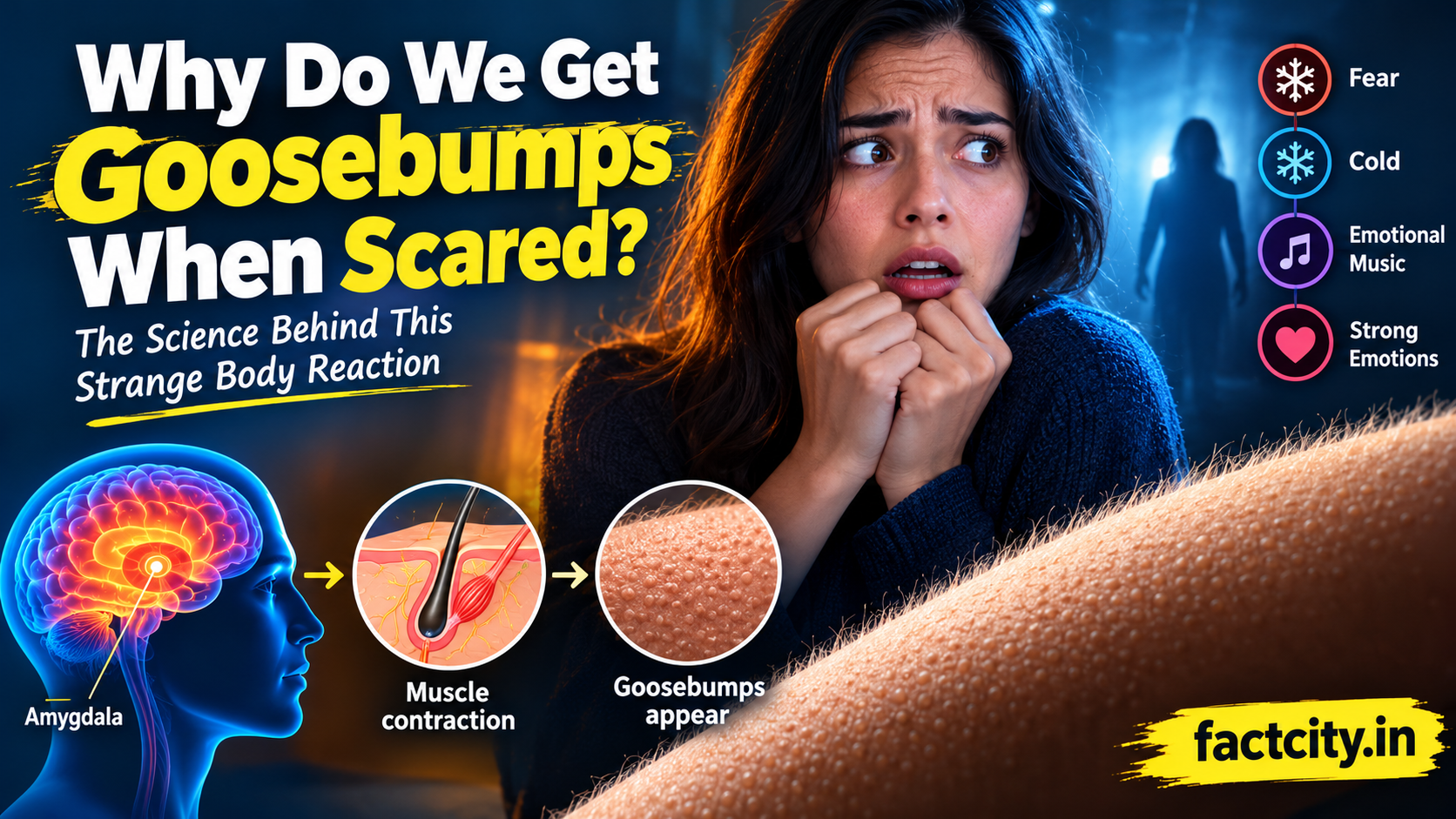
Why Do We Get Goosebumps When Scared? Have you ever felt a sudden wave of fear while watching a horror movie, walking alone in the dark, or hearing an unexpected noise? You may have noticed tiny bumps appearing on your skin, with the hair on your arms standing upright. This common reaction is known as goosebumps. But have you ever wondered why we get goosebumps when scared?
Goosebumps are a natural response controlled by the nervous system. They are connected to an ancient survival mechanism that helped our ancestors respond to danger. Although goosebumps may seem like a small and unimportant physical reaction, they reveal how the human body reacts to fear, cold temperatures, excitement, and other strong emotions. In this article, we will explore why fear causes goosebumps, how the brain controls this reaction, and why humans still experience it today.
What Are Goosebumps?
Goosebumps are small bumps that appear on the surface of the skin when tiny muscles attached to hair follicles contract. These muscles are called arrector pili muscles. When they contract, they pull the hair follicles upward, making the surrounding skin look bumpy. The scientific name for this reaction is piloerection. It can happen when you feel frightened, experience cold weather, listen to emotional music, or feel a sudden rush of excitement.
The term “goosebumps” comes from the resemblance between bumpy human skin and the skin of a plucked goose. Other common names include gooseflesh and chicken skin. Although the reaction is easy to notice, it happens automatically. You do not need to think about it or consciously control your muscles. Your nervous system manages the process without requiring any effort from you.
Why Do We Get Goosebumps When Scared?
The main reason we get goosebumps when scared is that fear activates the body’s automatic stress response. When your brain detects a possible threat, it prepares your body to respond quickly. This response is often called the fight-or-flight response. It helps you react to potentially dangerous situations by preparing you to face a threat or move away from it. During this process, the sympathetic nervous system becomes active. This part of the autonomic nervous system controls several involuntary functions, including changes in heart rate, sweating, and the contraction of tiny muscles attached to hair follicles.
When these muscles contract, your hair stands up, and goosebumps appear. For example, imagine walking through a quiet street at night when you suddenly hear footsteps behind you. Your brain may interpret the sound as a possible warning. Your heart might beat faster, your muscles may become tense, and goosebumps may appear on your arms. These reactions happen because your body is preparing to deal with a possible threat, even before you know whether the situation is actually dangerous.
How Does the Brain Trigger Goosebumps?
The brain plays a central role in the body’s response to fear. Several brain regions work together to recognize possible danger, process emotions, and activate physical reactions. The amygdala is one important structure involved in processing fear and detecting emotionally significant information. When you see something frightening or hear a suspicious sound, the brain evaluates the information and helps coordinate an appropriate response.
If the situation triggers a fear response, the brain communicates with other areas that regulate the autonomic nervous system. The sympathetic nervous system then activates different bodily responses, including the contraction of the small muscles around hair follicles.
This process can happen very quickly. That is why you might experience goosebumps before you have fully understood what frightened you. However, not every frightening experience produces goosebumps. Your response depends on factors such as the intensity of the emotion, the situation, your individual nervous system, and how your brain interprets what is happening.
Goosebumps and the Fight-or-Flight Response
The fight-or-flight response is one of the body’s natural ways of preparing for challenging or threatening situations. It developed over a long period of human evolution and remains active today. When your brain senses danger, your body may experience several changes at the same time.
Your heart rate may increase to help circulate blood. Your breathing may become faster, providing more oxygen. Your muscles may become tense and ready for movement. You may also sweat more, become more alert, or experience a sudden feeling of nervousness. Goosebumps can occur alongside these changes because the sympathetic nervous system controls the tiny muscles attached to your hair follicles.
Importantly, goosebumps do not mean that you are necessarily in danger. The body can activate a stress response when something merely appears threatening. A scary movie, a sudden jump scare, or even an unsettling story can produce a similar reaction.
Why Did Humans Evolve to Get Goosebumps?
To understand why humans still get goosebumps, it helps to look at our evolutionary history. Many mammals raise their body hair when frightened or threatened. This reaction can make an animal appear larger and more intimidating to a potential attacker. Raised fur can also help trap a layer of air close to the skin, providing additional insulation in cold conditions.
Our distant ancestors had more body hair than most modern humans. For them, raising their hair may have provided some defensive and temperature-regulating benefits. For example, an animal that raises its fur during a confrontation may look bigger than it actually is. Similarly, raised fur can help some mammals retain warmth.
Modern humans have relatively little body hair, so goosebumps do not provide the same advantages that they may provide to fur-covered animals. The muscles and nervous system involved in the reaction remain, however. As a result, goosebumps are often considered a remnant of an older biological mechanism. They demonstrate how some bodily responses can continue even after the conditions that originally made them useful have changed.
Why Do We Get Goosebumps When We Are Cold?
Fear is not the only reason goosebumps appear. Cold temperatures can trigger the same physical reaction.
When your body is exposed to cold air, the nervous system helps regulate body temperature. One response is the contraction of the arrector pili muscles, which causes the hair to stand upright. In furry mammals, raised hair can trap air and improve insulation. In humans, this effect is limited because our body hair is relatively sparse.
This explains why you may notice goosebumps when stepping outside on a cold winter morning, swimming in cool water, or sitting in an air-conditioned room. Cold-related goosebumps and fear-related goosebumps involve the same basic muscular response, although the triggers differ. In both cases, the nervous system activates the tiny muscles around the hair follicles. body-language-signs-someone-likes-you-15-subtle-signs
Why Do Emotional Songs and Movies Give Us Goosebumps?
Have you ever listened to a powerful song and suddenly felt chills running down your spine? Perhaps a movie scene made you feel deeply moved, or a surprising moment gave you goosebumps even though you were not afraid. This happens because goosebumps can be triggered by strong emotions, not just fear.
Music, memories, dramatic storytelling, and moments of surprise can produce intense emotional responses. These experiences may involve brain systems associated with emotion, attention, anticipation, and reward. For some people, a beautiful musical performance can create a sensation commonly called musical chills. The experience may include goosebumps, shivering, a tingling feeling, or a sense of excitement. The exact reasons people experience these sensations vary. Some people are more sensitive to emotional or musical triggers than others.
This is another example of how physical reactions can reflect the close relationship between the brain, emotions, and the body.
Are Goosebumps a Sign of Danger?
Goosebumps can accompany fear, but they are not a reliable way to determine whether a situation is dangerous. You might get goosebumps while watching a fictional horror scene, listening to emotional music, feeling cold, or experiencing an unexpected surprise. None of these reactions necessarily indicates that a real threat exists.
The response is automatic and reflects activity in your nervous system rather than a direct measurement of danger. If you experience goosebumps in a frightening situation, it may simply mean that your body is responding to what your brain perceives as threatening.
Goosebumps are generally harmless. However, if they occur alongside severe symptoms such as chest pain, difficulty breathing, fainting, or a sudden feeling of serious illness, seek appropriate medical attention rather than assuming the symptoms are caused by fear alone.
Can You Control Goosebumps?
Most people cannot directly control goosebumps because the reaction is managed by the autonomic nervous system. You cannot usually make the tiny muscles around your hair follicles contract or relax simply by deciding to do so.
However, you may be able to reduce fear-related reactions by helping your body become calmer. Taking slow, comfortable breaths, moving to a safe environment, and reminding yourself that a frightening situation may not represent a real threat can help reduce feelings of anxiety.
As your stress response settles, related physical reactions may gradually decrease. Nevertheless, relaxation techniques do not guarantee that goosebumps will disappear immediately, because the response is involuntary. Some people can experience goosebumps in response to particular thoughts, music, or emotional memories. Researchers have studied individual differences in these reactions, but the ability to deliberately produce goosebumps is not universal.
Interesting Facts About Goosebumps
Goosebumps are a fascinating example of the way the human body works automatically. Here are a few interesting facts about this reaction. First, goosebumps have a scientific name: piloerection. The term describes the raising of hair due to the contraction of small muscles attached to hair follicles. Second, fear is only one possible trigger. Cold temperatures, excitement, emotional music, and powerful memories can also cause goosebumps.
Third, the reaction is controlled by the autonomic nervous system, which manages many bodily functions without conscious effort. Fourth, goosebumps are more useful for temperature regulation and defensive displays in some furry animals than they are in humans. Finally, people do not all experience goosebumps in the same way. Some notice them frequently during emotional experiences, while others rarely experience them except in cold weather.
Conclusion
Why do we get goosebumps when scared? The answer lies in the connection between the brain, the nervous system, and our evolutionary past. When your brain detects a possible threat, it can activate the sympathetic nervous system as part of the fight-or-flight response. This causes tiny muscles around your hair follicles to contract, making your hair stand upright and creating the familiar bumps on your skin.
Although goosebumps may once have provided greater benefits to our hairier ancestors, they remain a normal part of human physiology. They can appear during fear, cold weather, excitement, and emotionally powerful moments.
The next time you feel goosebumps while watching a horror movie or hearing a mysterious sound, remember that your body is responding automatically to an experience it considers significant. This small reaction is a fascinating reminder that many of our modern physical responses have roots deep in human evolutionary history.