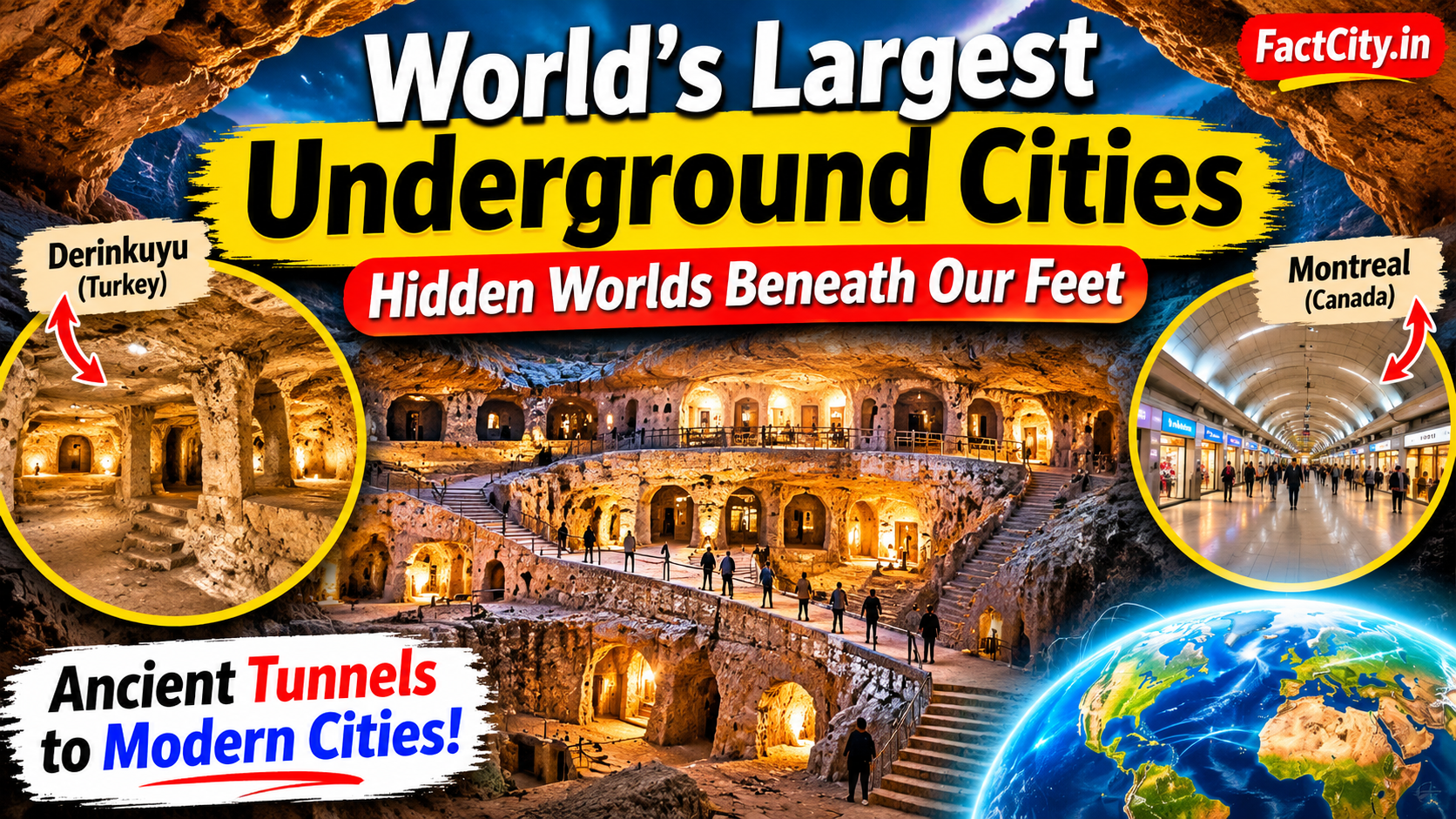
World’s Largest Underground Cities: Have you ever imagined living in a city hidden beneath the ground? While most people associate cities with tall buildings, busy roads, shopping malls, and crowded streets, some of the world’s most fascinating places exist below the Earth’s surface. These incredible underground spaces contain ancient tunnels, secret rooms, shopping centres, transportation networks, and even entire communities. The World’s Largest Underground Cities reveal how human beings have used creativity and engineering to build extraordinary places beneath the ground.
Underground cities have existed for thousands of years. Some were created to protect people from wars and invasions, while others were developed to provide comfortable spaces for shopping, travelling, working, and entertainment. Today, these underground destinations attract tourists, historians, architects, and curious travellers from different parts of the world. From the mysterious underground settlements of Turkey to the modern tunnel networks of Canada, each place has its own fascinating story.
In this article, we will explore some of the most remarkable underground cities in the world, discover why they were built, and understand what makes these hidden places so special.
1. Derinkuyu Underground City, Turkey
Located in the Cappadocia region of Turkey, Derinkuyu is one of the most extraordinary ancient underground settlements ever discovered. It is widely recognised as the largest excavated underground city in Turkey and is famous for its incredible depth, complex tunnels, and impressive design. The underground settlement reaches approximately 85 metres below the surface and is believed to have been capable of sheltering as many as 20,000 people, along with their livestock and food supplies. World’s Largest Underground Cities
What makes Derinkuyu particularly fascinating is that it was not simply a collection of caves. It contained different areas designed for everyday activities and survival. Archaeologists have identified spaces that served as kitchens, storage rooms, stables, religious areas, and places for education. Narrow passageways connected the different levels, while large circular stone doors could be used to block entrances and protect people from outside threats.
The underground city was developed over different historical periods, and its exact origins remain a subject of archaeological discussion. It became especially important as a place of refuge during periods of conflict and insecurity. The settlement demonstrates how ancient communities adapted their surroundings to survive difficult conditions. Today, Derinkuyu is one of Cappadocia’s most popular historical attractions and offers visitors a rare opportunity to explore an extraordinary world beneath the ground.
2. Kaymakli Underground City, Turkey
Another remarkable underground destination in Cappadocia is Kaymakli Underground City. Located not far from Derinkuyu, this ancient settlement is famous for its interconnected chambers, low ceilings, narrow corridors, and carefully designed living spaces. It is considered one of the largest underground settlements in the region and provides valuable information about how people once used underground spaces for protection and daily life.
Kaymakli contains several underground levels, although only a portion of the entire settlement is accessible to visitors. Its rooms were arranged for different purposes, including food storage, animal shelters, cooking, and other household activities. The narrow passages and stone barriers helped residents control access between different sections of the settlement.
One interesting feature of Kaymakli is the way its underground spaces were organised. Instead of building everything in one large chamber, people created connected rooms and passages that made it possible to move between different areas. The design also helped residents make use of the natural qualities of the surrounding volcanic rock.
Kaymakli and Derinkuyu show that Cappadocia was home to a remarkable network of underground settlements. These places were not built simply to impress future generations. They were practical solutions created by people who needed safety, storage, and shelter in an uncertain world.
3. Montreal Underground City, Canada
Not every underground city belongs to ancient history. Montreal, in Canada, is home to one of the world’s most famous modern underground networks, known as RÉSO or the Underground City. Unlike the underground settlements of Turkey, this extensive system was developed to connect buildings and public spaces beneath the busy downtown area.
Montreal experiences extremely cold winters, with snow, freezing temperatures, and strong winds. Walking between different buildings can become uncomfortable during these months. The underground network provides a convenient alternative by connecting shopping centres, office buildings, hotels, metro stations, restaurants, and other important destinations.
The network extends for approximately 32 kilometres through connected underground passages and buildings. Millions of people use these spaces throughout the year for shopping, commuting, eating, and accessing public transportation. It is not a separate city hidden completely beneath the ground but rather an interconnected urban environment that forms an important part of Montreal’s daily life.
What makes RÉSO special is the way it combines transportation, shopping, and public spaces. Visitors can move between several destinations without constantly returning to street level. It is an excellent example of how modern cities can use underground areas to improve convenience and make better use of limited urban space.
4. PATH Underground Network, Toronto, Canada
Toronto is another Canadian city famous for its extensive underground pedestrian network, known as PATH. It is one of the largest underground shopping complexes in the world and plays an important role in connecting the city’s downtown buildings.
The PATH network links shopping centres, restaurants, office towers, hotels, and public transportation facilities. It allows pedestrians to move through much of the downtown area while avoiding the weather outside. This is particularly useful during Toronto’s cold winter season, when snow and freezing temperatures can make walking outdoors difficult.
One of the most interesting aspects of PATH is how closely it is connected to the city’s commercial and business districts. Thousands of people use its passages while travelling to work, meeting friends, shopping, or enjoying a meal. The underground walkways make it easier to move between buildings without dealing with busy roads and changing weather conditions.
Although PATH and Montreal’s RÉSO are often compared, they serve slightly different purposes and have different layouts. Both demonstrate how underground pedestrian networks can become essential parts of modern urban life.
5. Beijing Underground City, China
Beijing, the capital of China, has another fascinating underground structure known as the Beijing Underground City, or Dixia Cheng. It was developed during the Cold War period when concerns about international conflict and possible attacks encouraged the construction of underground shelters.
The project involved an extensive network of tunnels and underground spaces designed to provide protection during emergencies. These structures included passageways and rooms intended to support people in the event of a serious security threat.
Unlike modern underground shopping networks, Beijing’s underground system was primarily associated with emergency preparedness and civil defence. It reflects a period in history when governments and communities considered underground shelters an important part of national security planning.
The history of Beijing’s underground city also highlights how underground construction has served different purposes throughout the world. Some underground places were built for commercial activities, while others were designed to protect people during dangerous situations. The Beijing network remains an interesting example of how political and historical circumstances can influence urban development.
6. Napoli Sotterranea, Naples, Italy
Beneath the historic streets of Naples, Italy, lies a fascinating underground world known as Napoli Sotterranea. This remarkable network includes ancient tunnels, chambers, caves, and other underground structures that reveal different stages of the city’s history.
The underground spaces of Naples have served many purposes over the centuries. Some areas were used as stone quarries, while others became water systems, storage spaces, and shelters. During the Second World War, several underground locations were also used by residents seeking protection from air raids.
One of the most interesting features of Napoli Sotterranea is the way it connects modern Naples with its ancient past. Visitors can explore underground passages and learn how generations of people used the space beneath the city for practical and protective purposes.
The underground world is a reminder that the history of a city is not always visible from its streets and buildings. Sometimes, the most fascinating stories are hidden beneath the places people walk through every day.
7. SubTropolis, Kansas City, United States
SubTropolis in Kansas City, Missouri, is a unique example of modern underground development. Unlike ancient underground cities designed mainly for shelter, SubTropolis is a large underground industrial and commercial complex.
It was developed inside a former limestone mine, where extensive spaces created by mining activities were adapted for business use. The underground environment offers relatively stable temperatures throughout the year, making it useful for storage, distribution, and different industrial operations.
SubTropolis is often described as one of the world’s largest underground business complexes. Its enormous size allows different companies to use the underground facilities for warehousing and other commercial purposes.
The site demonstrates how underground spaces created for one purpose can eventually be transformed into something completely different. Instead of constructing every facility above the ground, businesses can make use of existing underground areas and turn them into valuable commercial locations.
Why Were Underground Cities Built?
Underground cities were created for different reasons depending on the historical period, geographical location, and needs of the people who built them. In ancient times, safety was one of the most important reasons. Communities living in regions affected by wars, invasions, and political instability often needed secure places where they could hide and protect their families.
The natural environment also played an important role. In areas with soft volcanic rock, such as Cappadocia in Turkey, carving underground rooms and passages was possible. These underground spaces could provide shelter from extreme temperatures and offer protection from outside dangers. Storage rooms, wells, ventilation shafts, and food preparation areas helped people remain underground when necessary.
Modern underground cities have different purposes. In countries with cold winters, underground walkways allow people to travel between buildings without facing snow and freezing temperatures. Commercial underground networks also provide additional space for shops, offices, restaurants, and transportation facilities.
Another important reason is the growing demand for urban space. As cities become more crowded, planners and engineers increasingly explore ways to use the land beneath existing buildings and roads. Underground transportation systems, parking facilities, tunnels, and commercial spaces can help cities manage their growing populations.
How Do Underground Cities Get Fresh Air and Light?
One of the biggest challenges of building underground spaces is providing enough fresh air and maintaining comfortable conditions. Without proper ventilation, underground rooms can become difficult and unsafe to use for long periods.
Ancient underground settlements such as Derinkuyu used ventilation shafts to allow air to circulate between different levels. These shafts also helped connect underground spaces with the surface. Some settlements included wells and carefully planned openings that supported everyday needs.
Modern underground networks use more advanced engineering systems. Mechanical ventilation, air conditioning, lighting, emergency exits, and fire safety equipment help make underground buildings suitable for regular use. Engineers carefully plan these systems to maintain air quality and provide safe access for visitors and workers.
Natural and artificial lighting are also important. Ancient underground spaces often depended on small openings and lamps, while modern facilities use electrical lighting to make corridors, shops, and public areas comfortable. countries-with-the-most-natural-lakes-in-the-world
Are Underground Cities Safe to Visit?
Many underground cities are open to tourists and offer fascinating opportunities to explore history and architecture. However, safety depends on the condition of the site, its maintenance, and the facilities available to visitors.
Ancient underground settlements can contain narrow corridors, steep staircases, low ceilings, and uneven surfaces. People with mobility difficulties or claustrophobia may find some sections challenging. Visitors should follow local safety instructions and avoid entering restricted areas.
Modern underground networks generally have designated entrances, emergency exits, lighting, and safety systems. However, visitors should still follow posted directions and respect the rules of individual buildings and transportation facilities.
Before visiting any underground attraction, it is sensible to check its current opening hours, accessibility information, and visitor guidelines.
The Future of Underground Cities
As the world’s population continues to grow and major cities become increasingly crowded, underground development may become more important in the future. Architects and urban planners are exploring new ways to use underground areas for public transportation, commercial activities, pedestrian routes, storage, and infrastructure.
Future underground developments may include improved ventilation, energy-efficient lighting, advanced safety systems, and better connections with above-ground buildings. These technologies could make underground spaces more comfortable and practical for everyday use.
However, building underground is not always simple. Construction costs, groundwater conditions, ventilation, emergency planning, and environmental effects must all be considered. Every underground project requires careful planning to ensure that it is safe, useful, and sustainable.
The world’s existing underground cities provide valuable lessons for future development. Ancient settlements demonstrate the importance of adapting to natural surroundings, while modern networks show how engineering can improve urban convenience.
Conclusion
The World’s Largest Underground Cities are some of the most fascinating examples of human creativity, survival, and engineering. From the ancient tunnels of Derinkuyu and Kaymakli in Turkey to the modern shopping networks of Montreal and Toronto, these extraordinary places show how people have transformed the space beneath their feet.
Some underground settlements were created to protect families from danger, while others were developed to support transportation, business, and everyday activities. Each one tells a different story about the people, challenges, and ideas that shaped its construction.
As technology continues to improve and cities search for new ways to use limited space, underground development may become an increasingly important part of urban planning. The hidden worlds beneath our feet remind us that a city is not always defined by what we can see above the ground. Sometimes, its most remarkable features are waiting just below the surface.