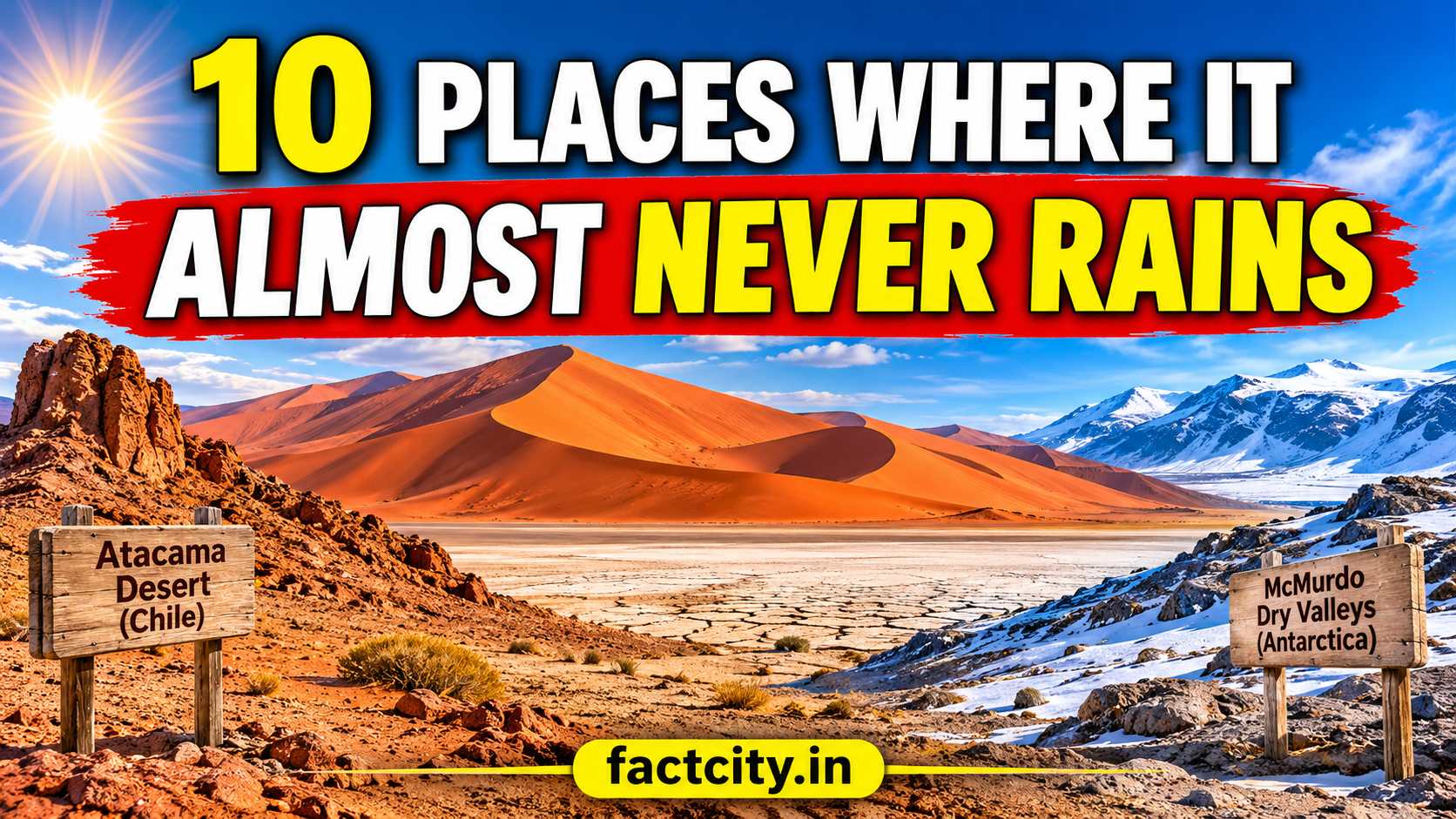
Places Where It Never Rains: Rain is one of the most important parts of life on Earth. It provides water for plants, supports wildlife, fills rivers and lakes, and helps maintain the natural balance of our environment. While many parts of the world receive regular rainfall throughout the year, some places experience extremely dry conditions. In certain regions, rain is so rare that people can live for years without seeing proper rainfall.
The places where it never rains are among the most fascinating locations on our planet. Some are covered with endless sand dunes, while others have rocky mountains, dry valleys, and landscapes that look almost like the surface of another planet. Although these destinations may seem completely lifeless, many of them are home to specially adapted plants, animals, and even human communities.
Interestingly, not every extremely dry place is a hot desert. Some of the driest regions on Earth are cold, icy, and located near the poles. Their lack of rainfall is caused by unique geographical and atmospheric conditions. Let’s explore 10 places around the world where rain is extremely rare and discover what makes these destinations so unusual.
1. Atacama Desert, Chile
The Atacama Desert in northern Chile is widely recognized as one of the driest non-polar places on Earth. Some areas of this remarkable desert receive almost no measurable rainfall for decades. Its landscape is filled with dry valleys, rocky mountains, salt flats, and enormous stretches of land where vegetation is extremely limited.
One major reason behind the Atacama Desert’s dryness is its geographical location. The cold Humboldt Current along the Pacific coast reduces moisture in the atmosphere, while the Andes Mountains block much of the moisture coming from the east. These natural conditions make it extremely difficult for rain clouds to develop.
Despite its harsh environment, the Atacama Desert is not completely lifeless. Certain plants and microorganisms have developed special ways to survive with very little water. The region is also famous for its incredibly clear skies, making it one of the best locations in the world for astronomical observations. Scientists and astronomers travel here to study distant stars, planets, and galaxies.
2. McMurdo Dry Valleys, Antarctica
When people think about Antarctica, they usually imagine enormous glaciers, heavy snowfall, and endless sheets of ice. However, Antarctica also contains one of the driest environments on Earth: the McMurdo Dry Valleys. This extraordinary region has extremely low moisture levels and receives very little precipitation.
Unlike typical deserts covered with sand, the McMurdo Dry Valleys feature exposed rocks, frozen lakes, mountains, and wide areas of bare ground. Strong winds play an important role in keeping the region dry by removing snow and moisture from the surface.
Some parts of these valleys have remained without significant precipitation for extremely long periods. The combination of freezing temperatures, strong winds, and limited moisture creates conditions that are difficult for most living organisms to survive.
Scientists are particularly interested in this region because its harsh environment provides useful opportunities to study life in extreme conditions. Some microorganisms can survive in protected areas, including beneath rocks and within salty environments. The landscape is also sometimes compared with conditions that may exist on Mars.
3. Sahara Desert, North Africa
The Sahara Desert is the largest hot desert in the world and covers a huge area of North Africa. It stretches across several countries, including Algeria, Egypt, Libya, Morocco, Mauritania, Mali, Niger, Chad, Sudan, and Tunisia. Many parts of the Sahara experience extremely low rainfall, with some locations receiving almost no rain for years.
The desert is famous for its enormous sand dunes, rocky plateaus, dry valleys, and extreme temperatures. During the daytime, temperatures can become extremely high, while nights may be surprisingly cold.
The Sahara’s dry climate is largely connected to the atmospheric conditions found around the subtropical region. Air descends from higher levels of the atmosphere, becoming warmer and reducing the chances of cloud formation and rainfall.
Although much of the Sahara appears empty, it supports a surprising variety of life. Desert foxes, camels, reptiles, insects, and specially adapted plants can survive in different parts of the region. Several communities have also lived in the Sahara for generations, developing ways to manage limited water resources.
4. Death Valley, United States
Death Valley, located mainly in California, is one of the hottest and driest places in North America. It is particularly famous for its extreme temperatures and extremely limited rainfall. Some areas receive very little precipitation throughout the year, creating a landscape that appears almost completely dry.
Badwater Basin, located inside Death Valley National Park, is the lowest point in North America at approximately 86 metres below sea level. Its salt-covered ground, surrounding mountains, and wide open landscape make it one of the most unusual natural locations in the United States.
The surrounding mountain ranges influence the region’s weather by creating a rain-shadow effect. As moist air moves across the mountains, much of its moisture falls before reaching the valley. This leaves Death Valley with very dry conditions.
Despite its challenging climate, different plants and animals survive here. Desert shrubs, insects, reptiles, and small mammals have adapted to the limited availability of water. Death Valley also attracts visitors who want to experience its unusual landscapes, colourful mountains, and famous salt flats.
5. Rub’ al Khali, Arabian Peninsula
Rub’ al Khali, also known as the Empty Quarter, is one of the largest continuous sand deserts in the world. It stretches across parts of Saudi Arabia, Oman, the United Arab Emirates, and Yemen. The region is famous for its enormous sand dunes, extreme temperatures, and extremely low rainfall.
Some sections of the Empty Quarter receive very little rain throughout the year. In certain locations, rainfall can be absent for long periods, making the area one of the most challenging environments for human survival.
The desert contains massive dunes that can reach impressive heights. Strong winds constantly move the sand, changing the appearance of the landscape over time. The region also experiences significant temperature differences between daytime and nighttime.
Although the Empty Quarter looks empty, it is not entirely without life. Certain desert plants, insects, reptiles, and animals can survive in its harsh conditions. However, the availability of natural water is extremely limited, and large parts of the region remain difficult to access.
6. Namib Desert, Namibia
The Namib Desert, located along the Atlantic coast of Namibia, is considered one of the oldest deserts on Earth. It is famous for its giant red sand dunes, dry valleys, and unusual natural scenery. Some areas receive very little rainfall, making the desert an excellent example of an extremely dry environment.
One interesting feature of the Namib Desert is that coastal fog often provides an important source of moisture. Cold ocean currents help create fog along the coastline, allowing certain plants and animals to collect water without depending entirely on rainfall.
The desert is home to specially adapted species, including fog-harvesting beetles and desert plants. Some animals have developed unique methods of surviving in the hot and dry environment.
Sossusvlei is one of the most famous attractions in the Namib Desert. Its towering orange-red dunes and white salt pan create a beautiful contrast that attracts photographers and travellers from around the world. Although the region receives little rain, its natural beauty makes it one of Africa’s most remarkable destinations.
7. Dasht-e Lut, Iran
Dasht-e Lut, also known as the Lut Desert, is one of the most extreme desert environments in the world. Located in southeastern Iran, this vast region is known for its dramatic rock formations, enormous sand dunes, and exceptionally high surface temperatures.
The desert receives very little rainfall because of its geographical location and surrounding mountain ranges. Its dry conditions have created unusual landforms known as yardangs, which are long, naturally sculpted ridges shaped by powerful winds.
Some parts of the Lut Desert have recorded extremely high land-surface temperatures through satellite measurements. These measurements are different from the air temperatures reported by ordinary weather stations, but they demonstrate just how intense the desert environment can become.
Despite its harsh conditions, the Lut Desert is an important natural landscape. Its unique geological formations provide scientists with opportunities to understand how wind, heat, and erosion shape desert environments over thousands of years.
8. Arica, Chile
Arica is a coastal city in northern Chile, close to the Atacama Desert. It is famous for its exceptionally dry climate and very limited rainfall. The city and surrounding region experience conditions that make regular rain a rare event.
The cold Humboldt Current helps maintain the area’s dry climate by limiting the amount of moisture available in the atmosphere. The Andes Mountains also influence regional weather patterns, preventing much of the moisture from reaching the western side of the continent.
Although rainfall is extremely rare, Arica is not an empty desert. It is a populated coastal city with beaches, homes, businesses, and agricultural activity in areas where irrigation and water management make cultivation possible.
Its unusual weather conditions make Arica an interesting example of how a place can support human life despite receiving very little natural rainfall.
9. Wadi Rum, Jordan
Wadi Rum is one of the most beautiful desert landscapes in the Middle East. Located in southern Jordan, this region is famous for its red sand, enormous sandstone mountains, natural rock arches, and wide-open valleys.
The area receives limited rainfall, and some periods can pass without significant precipitation. Its dry climate has helped create a landscape filled with impressive rock formations and sandy plains.
Wadi Rum is also known as the Valley of the Moon because its unusual scenery resembles the surface of another planet. Over thousands of years, wind and occasional rainfall have shaped its mountains and rocks into remarkable natural structures.
Despite the harsh climate, the region supports desert plants and animals. Bedouin communities have also lived in and around Wadi Rum for generations, developing traditional methods of surviving in the desert.
Today, Wadi Rum is a popular destination for travellers interested in desert camping, mountain scenery, and exploring one of Jordan’s most extraordinary natural environments.
10. McMurdo Ice-Free Areas, Antarctica
Antarctica contains several regions where extremely low precipitation creates conditions similar to those found in the world’s driest deserts. The McMurdo Ice-Free Areas are particularly interesting because they receive very little snowfall compared with much of the surrounding continent.
These areas are surrounded by enormous ice sheets and glaciers, but their exposed rocky surfaces remain largely free of permanent ice. Powerful winds, extremely cold temperatures, and low humidity help maintain their unusual environment.
Although Antarctica is often described as the coldest continent, it is also considered a polar desert because precipitation is extremely limited across large parts of the region. Most of the moisture that falls is snow rather than rain.
The McMurdo Ice-Free Areas are important for scientific research because they provide opportunities to study how living organisms survive in environments with almost no liquid water. Tiny microorganisms and other specially adapted life forms can exist in protected habitats, demonstrating the incredible ability of life to survive under difficult conditions.
Why Do Some Places on Earth Receive Almost No Rain?
There are several natural reasons why certain regions receive extremely little rainfall. Geography is one of the most important factors. Mountains can block moisture-filled winds, preventing clouds from reaching areas on the other side. This process creates a rain-shadow effect, which is responsible for the dryness of several deserts around the world.
Ocean currents also influence rainfall patterns. Cold ocean currents can reduce evaporation and limit the amount of moisture entering the atmosphere. This is one reason why coastal deserts such as the Atacama and Namib receive so little rainfall.
Another important factor is atmospheric circulation. In some parts of the world, air regularly descends from higher levels of the atmosphere. As it sinks, it warms and becomes less favourable for cloud formation and rainfall. This helps explain why many major deserts are located around subtropical latitudes. countries-with-the-most-time-zones-in-the-world
Can People Live in Places Where It Never Rains?
Living in extremely dry regions can be difficult, but it is not impossible. Many communities have developed different methods of collecting, storing, and managing water. Some depend on underground water sources, while others use reservoirs, pipelines, desalination plants, and modern water treatment systems.
Traditional desert communities have also developed ways to survive with limited resources. Their knowledge of local plants, animals, weather patterns, and natural water sources has helped them live in challenging environments for generations.
Modern technology has made life easier in several dry regions. However, water conservation remains essential because even advanced systems cannot completely remove the challenges created by long-term water shortages.
Conclusion
The places where it never rains show just how different Earth’s climate can be. From the extremely dry Atacama Desert in Chile to the frozen McMurdo Dry Valleys in Antarctica, these regions demonstrate that deserts are not always hot and sandy. Some are cold, rocky, and covered with ice, while others contain enormous dunes and sun-baked landscapes.
Although these destinations receive very little rainfall, many support unique plants, animals, and human communities. Their existence also helps scientists understand climate, geography, and the remarkable ways living organisms adapt to extreme environments.
These dry regions remind us that water is one of the most valuable natural resources on our planet. Even in places where rain is almost unknown, life can find surprising ways to survive.