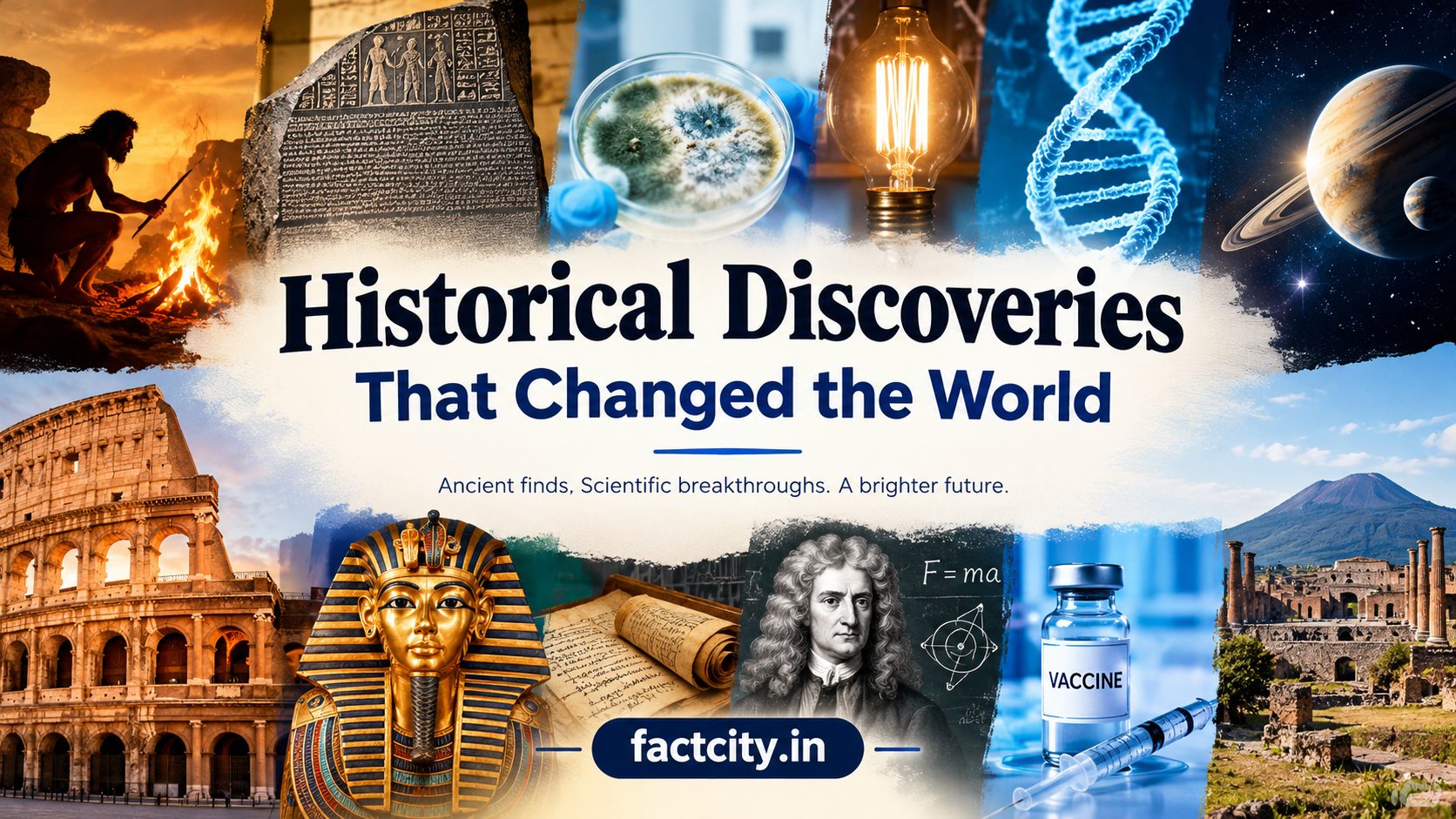
Historical Discoveries That Changed the World. History is full of remarkable discoveries that changed the way people live, think, and understand the world. From ancient archaeological findings to scientific breakthroughs, these discoveries have helped humanity solve mysteries, develop new technologies, and learn more about its past. Some discoveries revealed how ancient civilizations lived, while others transformed medicine, communication, transportation, and our understanding of the universe. Many things that seem ordinary today became possible because someone asked a question, explored the unknown, or uncovered evidence that had remained hidden for centuries. In this article, we will explore some of the most important historical discoveries that changed the world and explain why they continue to matter today.
1. The Discovery of Fire
The discovery and controlled use of fire was one of the most important turning points in human history. Although the exact circumstances remain unknown, early humans gradually learned how to use natural fires and eventually developed ways to produce and control flames. Fire provided warmth, protection from certain predators, and a reliable way to cook food. Cooking made many foods easier to chew and digest, while fire also helped people survive in colder environments. Over time, humans used fire to make tools, work with metals, and develop new technologies. This discovery laid the foundation for many later advances in human civilization. Historical Discoveries That Changed the World
2. The Rosetta Stone and the Secrets of Ancient Egypt
The discovery of the Rosetta Stone in 1799 was a major breakthrough in understanding ancient Egyptian civilization. French soldiers discovered the stone near the town of Rashid, known as Rosetta, in Egypt. The stone contains the same decree written in three scripts: Egyptian hieroglyphs, Demotic script, and ancient Greek. Because scholars could read ancient Greek, they had a valuable starting point for understanding the other two scripts. French scholar Jean-François Champollion made a major breakthrough in deciphering Egyptian hieroglyphs in 1822. This achievement allowed historians to read inscriptions, royal records, religious texts, and other documents that had remained largely mysterious for centuries. The Rosetta Stone transformed the study of ancient Egypt and helped researchers understand its history, beliefs, and culture.
3. The Discovery of Penicillin
The discovery of penicillin changed modern medicine and saved millions of lives. In 1928, Scottish scientist Alexander Fleming noticed that a type of mold growing in a laboratory dish had stopped bacteria from growing nearby. He investigated the observation and recognized that the mold produced a substance capable of killing certain bacteria. This substance became known as penicillin. Although Fleming’s discovery was an important first step, further research and development by scientists including Howard Florey and Ernst Boris Chain helped turn penicillin into a practical treatment during the 1940s. Before antibiotics became widely available, bacterial infections could be extremely dangerous, even after relatively minor injuries. Penicillin helped doctors treat infections that had previously been difficult or impossible to cure. Its development also opened the door to the discovery and use of many other antibiotics.
4. The Discovery of Electricity’s Practical Potential
Electricity was known through natural phenomena such as lightning long before scientists developed a clear understanding of it. During the eighteenth and nineteenth centuries, researchers made discoveries that transformed electricity from a scientific curiosity into a practical resource. Benjamin Franklin’s experiments helped advance the understanding of electrical phenomena, while Alessandro Volta developed an early electric battery in 1800. Later, Michael Faraday’s work on electromagnetic induction in 1831 provided a foundation for electric generators and transformers. These developments eventually made large-scale electricity production and distribution possible. Electric lighting, household appliances, industrial machinery, and modern communication systems all depend on advances in electrical science. The development of practical electricity fundamentally changed homes, workplaces, cities, and everyday life.
5. The Discovery of DNA’s Double-Helix Structure
The discovery of DNA’s structure was a major milestone in biology. DNA, or deoxyribonucleic acid, carries genetic information that helps determine how living organisms develop and function. In 1953, James Watson and Francis Crick proposed the double-helix model of DNA, building on crucial experimental evidence, including X-ray diffraction research by Rosalind Franklin and Raymond Gosling, as well as work by Maurice Wilkins and other scientists. The model explained how genetic information could be stored and copied. This discovery helped establish the foundations of modern molecular biology and transformed research into heredity, inherited diseases, and evolution. Today, DNA science supports genetic testing, forensic investigations, ancestry research, and the development of treatments for certain diseases. Its influence continues to grow as scientists learn more about the human genome.
6. The Discovery of the Americas by Europeans
Christopher Columbus’s 1492 voyage across the Atlantic Ocean led to sustained contact between Europe and the Americas. However, the Americas were already home to millions of Indigenous people and many advanced civilizations, and Norse explorers had reached parts of North America centuries earlier. Therefore, Columbus did not discover an uninhabited or unknown continent. His voyage instead marked a major turning point in the history of contact between Europe and the Americas. This contact led to extensive exploration, trade, migration, and colonization. It also caused devastating consequences for Indigenous populations, including the spread of diseases, the loss of land, forced labor, and cultural disruption. The resulting exchange of plants, animals, technologies, and people between the continents reshaped agriculture, economies, and societies around the world.
7. The Discovery of Ancient Pompeii
Pompeii is one of the most valuable archaeological sites ever discovered. In AD 79, Mount Vesuvius erupted and buried the Roman city beneath volcanic material. The eruption killed many residents and preserved buildings, streets, artwork, household objects, and other evidence of everyday life. Although the ruins were known before modern excavations began, systematic archaeological work in the eighteenth century brought widespread attention to the site. Pompeii gave historians an unusually detailed view of Roman society, including its homes, shops, public baths, food habits, and entertainment. The remains also revealed information about architecture, social differences, and the daily routines of ordinary people. Unlike many historical records written by powerful individuals, Pompeii’s physical remains help researchers understand how people from different backgrounds lived nearly two thousand years ago.
8. The Discovery of King Tutankhamun’s Tomb
The discovery of Tutankhamun’s tomb in Egypt in 1922 attracted worldwide attention. British archaeologist Howard Carter led the excavation, supported by the funding of Lord Carnarvon. The tomb was remarkable because it contained an extraordinary collection of objects, including furniture, jewelry, ceremonial items, and the famous golden burial mask. Many ancient Egyptian royal tombs had been robbed over the centuries, so the contents of Tutankhamun’s burial chamber provided valuable evidence about royal burial practices and material culture. The discovery also increased public interest in ancient Egypt and encouraged further archaeological research. Although Tutankhamun was not among Egypt’s most powerful rulers, the objects found in his tomb helped historians learn more about royal life, craftsmanship, religion, and beliefs about the afterlife.
9. The Discovery of Radioactivity
Radioactivity transformed the fields of physics, chemistry, and medicine. In 1896, French physicist Henri Becquerel discovered that uranium salts could produce radiation without exposure to sunlight. Marie Curie and Pierre Curie later conducted important research into radioactive materials and discovered the elements polonium and radium. Their work helped scientists understand that atoms were not as unchanging as many had once believed. Research into radioactivity eventually contributed to medical imaging, cancer treatments, nuclear physics, and the development of nuclear energy. It also revealed serious risks associated with radiation exposure, leading to the development of safety practices. The discovery brought major scientific opportunities while reminding researchers that powerful technologies must be handled carefully.
10. The Discovery of the Structure of the Atom
The development of atomic theory changed humanity’s understanding of matter. Ancient Greek thinkers had suggested that matter might consist of tiny particles, but modern atomic science emerged through experiments conducted centuries later. In the early nineteenth century, John Dalton developed an influential scientific atomic theory. In 1897, J. J. Thomson discovered the electron, showing that atoms contained smaller components. Ernest Rutherford’s experiments in the early twentieth century provided evidence for a small, dense atomic nucleus, and later research helped establish the modern picture of atomic structure. These discoveries transformed chemistry and physics by explaining how matter behaves at a fundamental level. Atomic science eventually contributed to electronics, advanced materials, medical technologies, and nuclear energy. It also changed our understanding of the forces and particles that make up the physical universe.
11. The Discovery of the Dead Sea Scrolls
The Dead Sea Scrolls are among the most significant archaeological discoveries connected to the history of ancient Judaism. In 1947, the first scrolls were found in caves near Qumran, close to the Dead Sea. Further discoveries revealed hundreds of manuscripts and fragments, including copies of biblical books, religious writings, and documents that provide insight into Jewish life during the Second Temple period. Some manuscripts are more than two thousand years old. These texts helped scholars compare ancient versions of biblical writings and study the religious beliefs, languages, and traditions of communities living in the region. The scrolls also demonstrated the importance of preserving fragile historical materials. Their discovery continues to influence research into ancient history, religion, and the development of biblical texts.
12. The Discovery of the Laws of Motion
Isaac Newton’s work on motion and gravity was a turning point in the history of science. In 1687, Newton published Philosophiæ Naturalis Principia Mathematica, a book that presented his laws of motion and universal gravitation. These ideas provided a mathematical framework for explaining how objects move on Earth and how planets travel through space. Newton’s work built on earlier contributions from scientists such as Galileo Galilei and Johannes Kepler. His laws helped scientists predict the movement of objects and understand the relationship between force, mass, and acceleration. Newtonian mechanics became essential to engineering, astronomy, and classical physics. Although modern physics later expanded our understanding of gravity and motion, Newton’s discoveries remain useful in many everyday calculations and engineering applications.
13. The Discovery of Vaccination
Vaccination is one of the most influential developments in public health. In 1796, English physician Edward Jenner demonstrated that exposure to material from cowpox lesions could help protect against smallpox. His work contributed to the development of vaccination as a preventive medical practice. Over the following centuries, scientists developed vaccines against numerous infectious diseases. Vaccination has helped reduce illness and death, prevent outbreaks, and protect vulnerable communities. A particularly important achievement came in 1980, when the World Health Organization declared that smallpox had been eradicated worldwide following a coordinated international vaccination campaign. This success demonstrated how scientific research, public health planning, and international cooperation could eliminate a devastating disease. Today, vaccines remain an important tool for preventing serious infections.
14. The Development of Modern Antibiotics
The development of penicillin deserves special attention because its impact extended far beyond the original laboratory observation. During the Second World War, large-scale production made the drug available to many more patients. Doctors could treat bacterial infections that had previously caused severe complications and deaths. Penicillin also helped make certain medical procedures safer because infections could be treated more effectively. Its success encouraged pharmaceutical research and supported the development of other antibiotics. However, antibiotics do not work against viruses, and their overuse can contribute to antimicrobial resistance. This history shows that a major discovery can transform healthcare while also creating new responsibilities for doctors, researchers, and patients. 10-interesting-facts-about-the-brain
15. The Discovery of Exoplanets
The discovery of planets beyond our solar system changed our understanding of the universe. For centuries, scientists wondered whether other stars might have planets like those orbiting the Sun. In 1992, astronomers confirmed planets orbiting a pulsar, and in 1995, researchers announced the discovery of a planet orbiting a Sun-like star. Since then, astronomers have identified thousands of confirmed exoplanets using methods such as observing the slight dimming of a star when a planet passes in front of it. These discoveries have revealed planetary systems that differ greatly from our own. Some planets orbit extremely close to their stars, while others may have conditions worth studying for their potential to support life. Although no confirmed evidence of extraterrestrial life has been found, exoplanet research has greatly expanded the search for habitable worlds.
Why Historical Discoveries Matter Today
Historical discoveries are important because they help us understand how human knowledge develops over time. Many breakthroughs began with simple observations, unanswered questions, or unexpected findings. The Rosetta Stone helped unlock an ancient language, penicillin transformed the treatment of bacterial infections, and DNA research changed biology and medicine. Archaeological discoveries such as Pompeii and the tomb of Tutankhamun have also helped researchers reconstruct the lives of people who lived long before us. Together, these achievements show that progress often depends on curiosity, careful investigation, and cooperation between researchers. Studying the past also helps society understand the risks, ethical questions, and responsibilities that can accompany scientific and technological advances.
Conclusion
The historical discoveries that changed the world have shaped nearly every aspect of modern life. From the controlled use of fire to the discovery of DNA, radioactivity, and planets beyond our solar system, each breakthrough has expanded human understanding and created new possibilities. Archaeological findings have revealed lost civilizations, while scientific discoveries have transformed medicine, technology, and our knowledge of nature. These achievements remind us that the world still holds many unanswered questions. By studying past discoveries and continuing to investigate the unknown, humanity can build on earlier knowledge and make further progress. The next discovery that changes the world may already be waiting for someone curious enough to search for it.